Inspect the fittings for cracks, and check the
hose where it fits over the fitting for distortion,
which could cause leakage.
9 A small piece of vacuum hose can be used
as a stethoscope to detect vacuum leaks.
Hold one end of the hose to your ear, and
probe around vacuum hoses and fittings,
listening for the “hissing” sound characteristic
of a vacuum leak.
Warning: When probing with the
vacuum hose stethoscope, be
very careful not to come into
contact with moving engine
components such as the fan or fan belt.
Fuel hoses
Warning: Before carrying out the
following operation, refer to the
precautions given in “Safety
first!” at the beginning of this
manual, and follow them implicitly. Petrol
is a highly dangerous and volatile liquid,
and the precautions necessary when
handling it cannot be overstressed.
10 Check all fuel hoses for deterioration and
chafing. Check especially for cracks in areas
where the hose bends, and also just before
fittings, such as where a hose attaches to the
carburettor.
11 Spring-type clamps are commonly used
on fuel lines. These clamps often lose their
tension over a period of time, and can be
“sprung” during removal. Replace all spring-
type clamps with screw clips whenever a hose
is replaced.
Metal lines
12 Sections of metal piping are often used
for fuel line between the fuel tank, filter and
the engine. Check carefully to be sure the
piping has not been bent or crimped, and that
cracks have not started in the line.
13 If a section of metal fuel line must be
renewed, only seamless steel piping should
be used, since copper and aluminium piping
don’t have the strength necessary to
withstand normal engine vibration.
14 Check the metal brake lines where they
enter the master cylinder for cracks in the
lines or loose fittings. Any sign of brake fluid
leakage calls for an immediate and thorough
inspection of the brake system.
19 Fuel system components,
checks and lubrication
1
1 Sparingly apply a few drops of light oil to the
throttle spindles, accelerator cable and the
pedal pivot. Similarly lubricate the exposed
ends of the choke cable (where fitted).
2 Check that there is a small amount of
slackness in the cable so that the throttle linkage
closes fully with the accelerator pedal released.
Also check that full throttle can be obtained with
the accelerator pedal fully depressed.
3 If there is any doubt about the cable
adjustment, refer to the relevant Parts of
Chapter 4 for the full adjustment procedure.
4 On carburettor models, unscrew the piston
damper cap from the top of the carburettor
dashpot (see illustration). Top up the damper
with engine oil until the level is 13.0 mm above
the top of the hollow piston rod.
5 Slowly push the damper back into the
piston and screw on the cap taking care not
to cross-thread it.
20 Contact breaker points
check and adjustment
3
Refer to Chapter 5B.
21 Distributor lubrication
1
1 It is important that the distributor cam is
lightly lubricated with general purpose grease,
and that the contact breaker arm, centrifugal
advance weights and cam spindle are also
very lightly lubricated.
2 Great care should be taken not to use too
much lubricant, as any excess that might find
its way onto the contact breaker points could
cause burning and misfiring.
3 If an ignition shield is fitted over the front of
the engine, release the three plastic retaining
lugs and lift away the shield. Detach the two
spring clips or undo the two screws securing
the distributor cap to the distributor body and
lift off the cap.
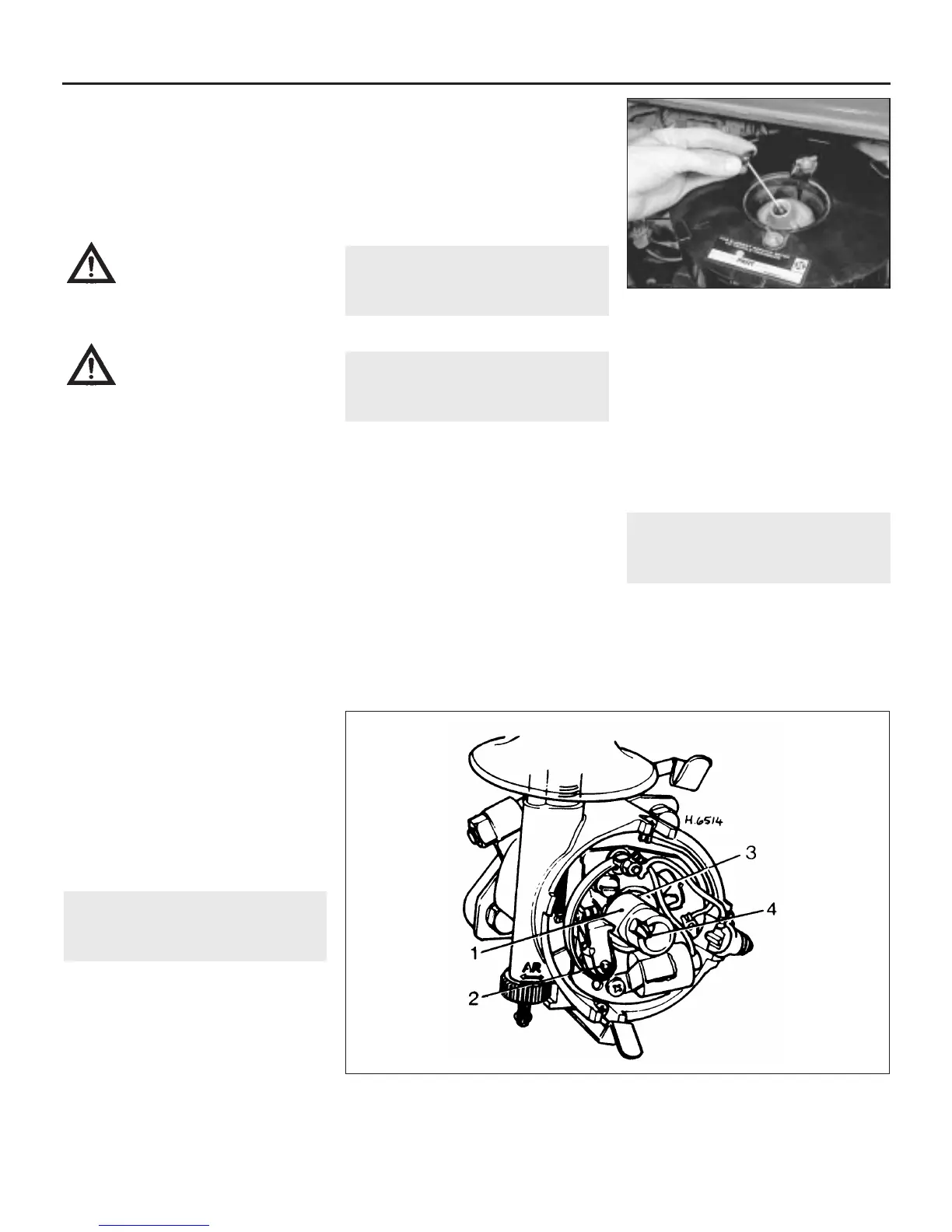
4 To gain access to the cam spindle, lift away
the rotor arm. Drop no more than two drops of
engine oil onto the felt pad or screw head (see
illustration). This will run down the spindle
when the engine is hot and lubricate the
bearings. The centrifugal advance weights
can be lubricated by dropping two or three
drops of engine oil through one of the holes or
slots in the distributor baseplate. No more
than one drop of oil should be applied to the
contact breaker arm pivot post.
5 Refit the rotor arm, distributor cap and
ignition shield on completion.
22 Clutch return stop
adjustment
1
Note: As friction linings of the clutch disc wear,
the distance between the clutch release bearing
and the clutch thrust plate will decrease. The
pressure plate will then move in closer to the
clutch disc to compensate for wear. Unless the
wear is taken up by adjustment of the stop
located between the flywheel housing and the
1•16 Every 6000 miles or 6 months
19.4 Top up the piston damper on
carburettor models
21.4 Distributor lubrication points
1 Contact breaker cam
2 Contact breaker pivot post
3 Centrifugal weights lubrication point
4 Cam spindle


 To Next Page
 Loading...