2 Before removing the crankshaft it is
advisable to check the endfloat using a dial
gauge in contact with the end of the
crankshaft. Push the crankshaft fully one way,
and then zero the gauge. Push the crankshaft
fully the other way, and check the endfloat.
The result can be compared with the specified
amount, and will give an indication as to
whether new thrustwashers are required.
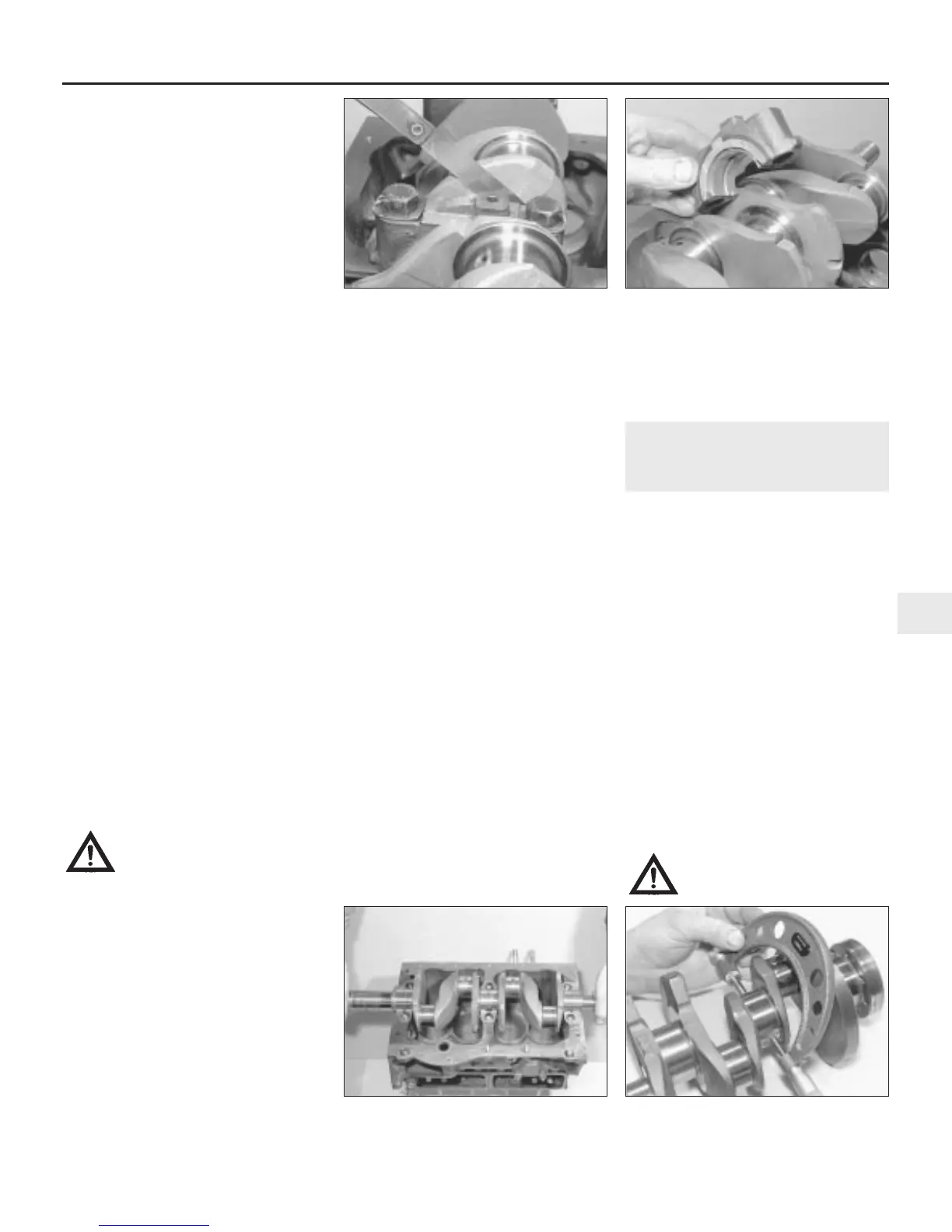
3 If a dial gauge is not available, feeler blades
can be used. First push the crankshaft fully
towards the flywheel end of the engine, then
use feeler blades to measure the gap between
the web of the crankpin and the thrustwasher
(see illustration).
4 If identification marks are not present on
the main bearing caps, mark them suitably so
that they may be refitted in their original
positions and the correct way round.
5 Release the locktabs from the six bolts
which hold the three main bearing caps in
place. Note that locktabs are not used on
1275 cc engines.
6 Unscrew the bolts and remove them
together with the locktabs.
7 Remove the main bearing caps and the
bottom half of each bearing shell, taking care
to keep the bearing shells in the right caps.
8 When removing the centre bearing cap,
note the bottom semi-circular halves of the
thrustwashers - one half lying on each side of
the main bearing. Lay them with the centre
bearing along the correct side (see
illustration).
9 Slightly rotate the crankshaft to free the
upper halves of the bearing shells and
thrustwashers, which should now be
extracted and placed over the correct bearing
cap.
10 Remove the crankshaft by lifting it away
from the crankcase (see illustration).
Inspection
11 Clean the crankshaft using paraffin or a
suitable solvent, and dry it, preferably with
compressed air if available. Be sure to clean
the oil holes with a pipe cleaner or similar
probe, to ensure that they are not obstructed.
Warning: Wear eye protection
when using compressed air!
12 Check the main and big-end bearing
journals for uneven wear, scoring, pitting and
cracking.
13 Big-end bearing wear is accompanied by
distinct metallic knocking when the engine is
running (particularly noticeable when the
engine is pulling from low speed) and some
loss of oil pressure.
14 Main bearing wear is accompanied by
severe engine vibration and rumble - getting
progressively worse as engine speed
increases - and again by loss of oil pressure.
15 Check the bearing journal for roughness
by running a finger lightly over the bearing
surface. Any roughness (which will be
accompanied by obvious bearing wear)
indicates that the crankshaft requires
regrinding (where possible) or renewal.
16 If the crankshaft has been reground,
check for burrs around the crankshaft oil
holes (the holes are usually chamfered, so
burrs should not be a problem unless
regrinding has been carried out carelessly).
Remove any burrs with a fine file or scraper,
and thoroughly clean the oil holes as
described previously.
17 Using a micrometer, measure the
diameter of the main and big-end bearing
journals, and compare the results with the
Specifications (see illustration). By
measuring the diameter at a number of points
around each journal’s circumference, you will
be able to determine whether or not the
journal is out-of-round. Take the
measurement at each end of the journal, near
the webs, to determine if the journal is
tapered. No actual figures are quoted by the
manufacturer for crankshaft journal ovality or
taper but a figure of 0.025 mm should be
considered the maximum acceptable for an
engine of this type. If in doubt, seek the
advice of a Rover dealer or engine specialist.
18 Check the oil seal contact surfaces at
each end of the crankshaft for wear and
damage. If the seal has worn a deep groove in
the surface of the crankshaft, consult an
engine overhaul specialist; repair may be
possible, but otherwise a new crankshaft will
be required.
19 If the crankshaft journals have not been
reground to their minimum regrind diameter, it
may be possible to have the crankshaft
reconditioned, and to fit oversize bearing
shells (see Section 14). If the crankshaft has
worn beyond the specified limits, it will have
to be renewed. Consult your Rover dealer or
engine specialist as to the best course of
action.
13 Cylinder block/crankcase -
cleaning and inspection
3
Cleaning
1 Remove all external components and
electrical switches/sensors from the block.
2 Scrape all traces of gasket from the cylinder
block/crankcase, taking care not to damage
the gasket/sealing surfaces.
3 Remove all oil gallery plugs (where fitted).
The plugs are usually very tight - they may
have to be drilled out, and the holes re-
tapped. Use new plugs when the engine is
reassembled.
4 If the block is extremely dirty, it should be
steam-cleaned.
5 After the block is returned, clean all oil
holes and oil galleries one more time. Flush all
internal passages with warm water until the
water runs clear. Dry thoroughly, and apply a
light film of oil to all mating surfaces, to
prevent rusting., also oil the cylinder bores. If
you have access to compressed air, use it to
speed up the drying process, and to blow out
all the oil holes and galleries.
Warning: Wear eye protection
when using compressed air!
Engine removal and overhaul procedures 2B•17
2B
12.3 Checking crankshaft endfloat using
feeler blades
12.8 Main bearing cap with thrustwashers
in position
12.10 Carefully lift out the crankshaft 12.17 Use a micrometer to measure the
crankshaft bearing journal diameters


 To Next Page
 Loading...