bearing surface with your fingers while
checking it, or the delicate surface may be
scratched.
4 Dirt or other foreign matter gets into the
engine in a variety of ways. It may be left in
the engine during assembly, or it may pass
through filters or the crankcase ventilation
system. It may get into the oil, and from there
into the bearings. Metal chips from machining
operations and normal engine wear are often
present. Abrasives are sometimes left in
engine components after reconditioning,
especially when parts are not thoroughly
cleaned using the proper cleaning methods.
Whatever the source, these foreign objects
often end up embedded in the soft bearing
material, and are easily recognised. Large
particles will not embed in the material, and
will score or gouge the shell and journal. The
best prevention for this cause of bearing
failure is to clean all parts thoroughly, and to
keep everything spotlessly-clean during
engine assembly. Frequent and regular engine
oil and filter changes are also recommended.
5 Lack of lubrication (or lubrication
breakdown) has a number of inter-related
causes. Excessive heat (which thins the oil),
overloading (which squeezes the oil from the
bearing face) and oil leakage (from excessive
bearing clearances, worn oil pump or high
engine speeds) all contribute to lubrication
breakdown. Blocked oil passages, which
usually are the result of misaligned oil holes in
a bearing shell, will also starve a bearing of oil,
and destroy it. When lack of lubrication is the
cause of bearing failure, the bearing material
is wiped or extruded from the shell’s steel
backing. Temperatures may increase to the
point where the steel backing turns blue from
overheating.
6 Driving habits can have a definite effect on
bearing life. Full-throttle, low-speed operation
(labouring the engine) puts very high loads on
bearings, which tends to squeeze out the oil
film. These loads cause the shells to flex,
which produces fine cracks in the bearing
face (fatigue failure). Eventually, the bearing
material will loosen in pieces, and tear away
from the steel backing.
7 Short-distance driving leads to corrosion of
bearings, because insufficient engine heat is
produced to drive off condensed water and
corrosive gases. These products collect in the
engine oil, forming acid and sludge. As the oil
is carried to the engine bearings, the acid
attacks and corrodes the bearing material.
8 Incorrect shell refitting during engine
assembly will lead to bearing failure as well.
Tight-fitting shells leave insufficient bearing
running clearance, and will result in oil
starvation. Dirt or foreign particles trapped
behind a bearing shell result in high spots on
the bearing, which lead to failure.
9 Do not touch any shell’s bearing surface
with your fingers during reassembly; there is a
risk of scratching the delicate surface, or of
depositing particles of dirt on it.
Selection - main and big-end
bearings
10 Main and big-end bearings for the
majority of the engines described in this
Chapter are available in one standard size
and, on earlier engines, in a range of
undersizes to suit reground crankshafts.
11 Selective standard size main bearings are
fitted to later 998 cc and 1275 cc engines.
Red (R), Green (G) or Yellow (Y) codes are
used to identify the bearings, and the colours
or “RGY” stamp will be found on the main
bearing caps and the corresponding web of
the crankshaft. The bearing shells are also
identified in the same way. Undersize main
and big-end bearings are no longer available
from Rover dealers for these engines.
12 The relevant set of bearing shells required
can be obtained by measuring the diameter of
the crankshaft main bearing journals (see
Section 12). This will show if the crankshaft is
original or whether its journals have been
reground, identifying if either standard or
oversize bearing shells are required.
13 If access to the necessary measuring
equipment cannot be gained, the size of the
bearing shells can be identified by the
markings stamped on the rear of each shell.
Details of these markings should be supplied
to your Rover dealer who will then be able to
identify the size of shell fitted.
14 Whether the original shells or new shells
are being fitted, it is recommended that the
running clearance is checked as described in
Section 17 prior to installation.
15 Engine overhaul - reassembly
sequence
1 Before reassembly begins, ensure that all
new parts have been obtained, and that all
necessary tools are available. Read through
the entire procedure to familiarise yourself
with the work involved, and to ensure that all
items necessary for reassembly of the engine
are at hand.
2 In order to save time and avoid problems,
engine reassembly can be carried out in the
following order:
a) Crankshaft (Section 17).
b) Piston rings (Section 16)
c) Piston/connecting rod assemblies
(Section 18).
d) Oil pump (Section 10).
e) Oil filter housing and delivery pipe (Part A
of this Chapter).
f) Oil pressure relief valve (Part A of this
Chapter).
g) Camshaft and tappets (Section 9).
h) Cylinder head (Part A of this Chapter).
i) Timing chain, sprockets and tensioner
(Part A of this Chapter).
j) Distributor driveshaft (Part A of this
Chapter).
k) Engine external components.
3 At this stage, all engine components should
be absolutely clean and dry, with all faults
repaired. The components should be laid out
(or in individual containers) on a completely
clean work surface.
16 Piston rings - refitting
2
1 Before fitting new piston rings, the ring end
gaps must be checked as follows.
2 Lay out the piston/connecting rod
assemblies and the new piston ring sets, so
that the ring sets will be matched with the
same piston and cylinder during the end gap
measurement and subsequent engine
reassembly.
3 Insert the top ring into the first cylinder, and
push it down the bore using the top of the
piston. This will ensure that the ring remains
square with the cylinder walls. Position the
ring near the bottom of the cylinder bore, at
the lower limit of ring travel. On engines with
tapered second and third compression rings,
the top narrow side of the ring is marked with
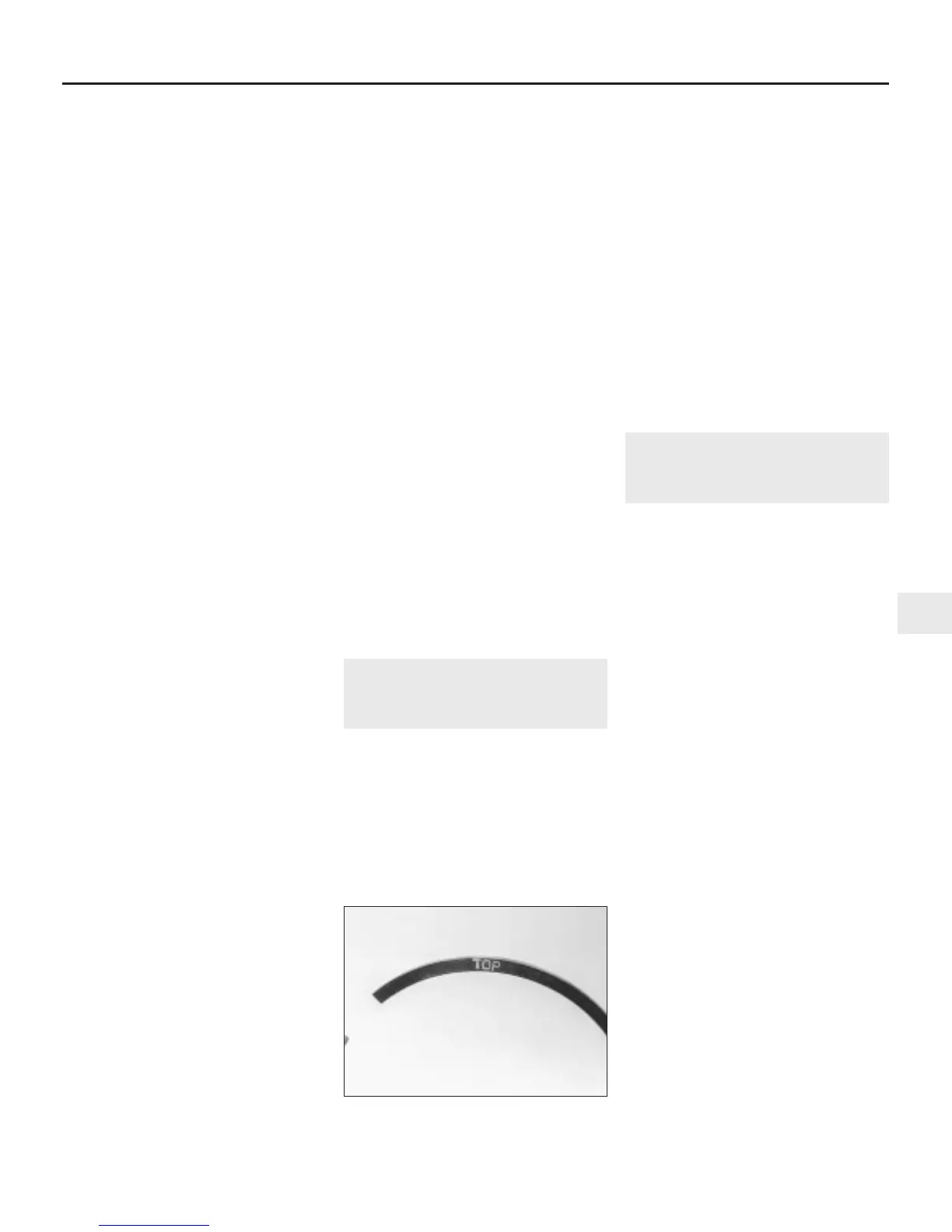
a “T”, or the word “TOP” (see illustration).
4 Measure the end gap using feeler blades.
5 Repeat the procedure with the ring at the
top of the cylinder bore, at the upper limit of
its travel, and compare the measurements
with the figures given in the Specifications.
6 If the gap is too small (unlikely if genuine
Rover parts are used), it must be enlarged, or
the ring ends may contact each other during
engine operation, causing serious damage.
Ideally, new piston rings providing the correct
end gap should be fitted. As a last resort, the
end gap can be increased by filing the ring
ends very carefully with a fine file. Mount the
file in a vice equipped with soft jaws, slip the
ring over the file with the ends contacting the
file face, and slowly move the ring to remove
material from the ends. Take care, as piston
rings are sharp, and are easily broken.
7 With new piston rings, it is unlikely that the
end gap will be too large. If the gaps are too
large, check that you have the correct rings
for your engine and for the particular cylinder
bore size.
Engine removal and overhaul procedures 2B•19
2B
16.3 Piston ring identification markings


 To Next Page
 Loading...