EasyManua.ls Logo

Heathkit IG-4505 - Page 39

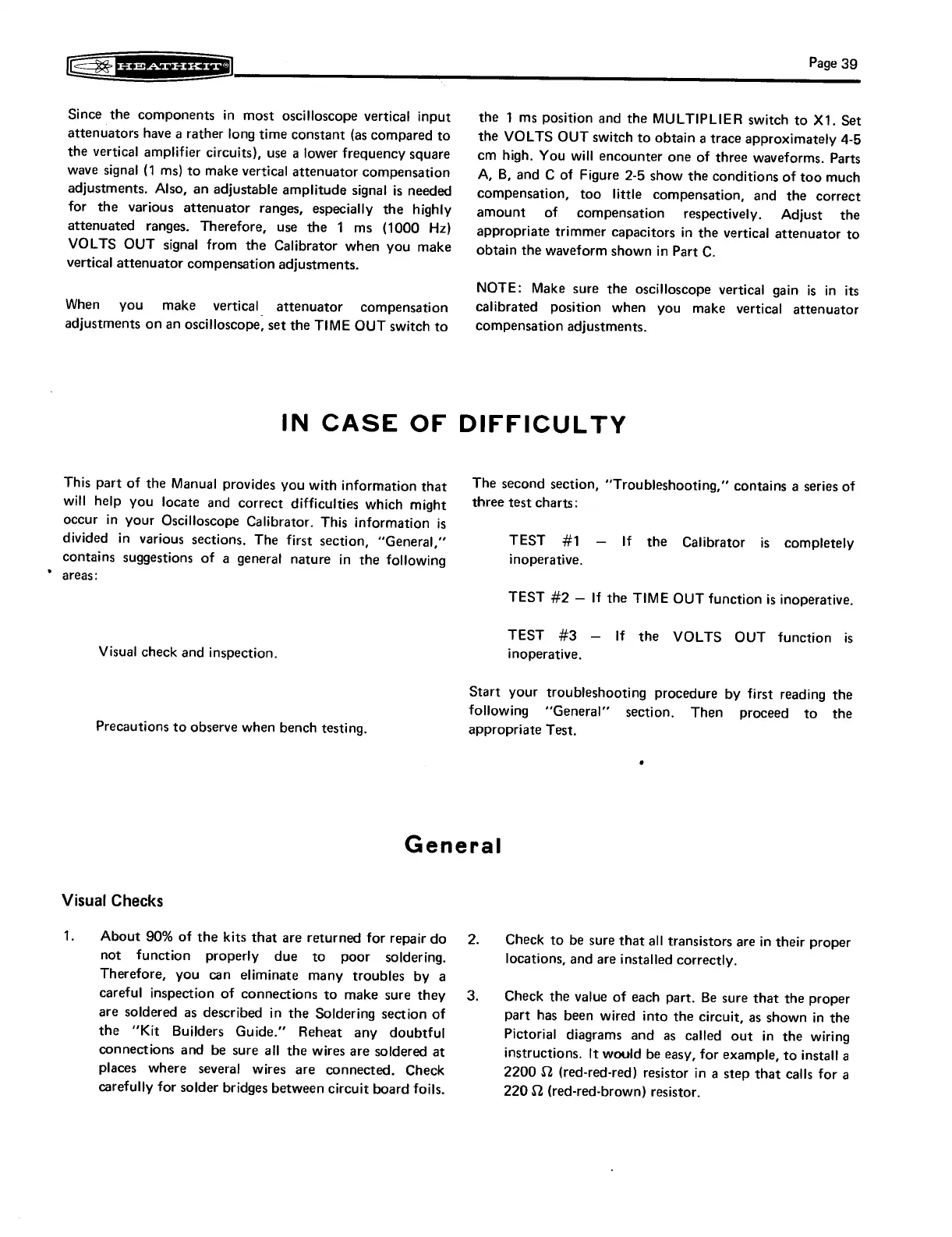
Heathkit IG-4505
54 pages
Print Icon
To Next Page IconTo Next Page
To Previous Page IconTo Previous Page
Loading...
Ge
guearHKir®
Page
39
Since
the
components
in
most
oscilloscope
vertical
input
attenuators
have
a
rather
long
time
constant
(as
compared
to
the
vertical
amplifier
circuits),
use
a
lower
frequency
square
wave
signal
(1
ms)
to
make
vertical
attenuator
compensation
adjustments.
Also,
an
adjustable
amplitude
signal
is
needed
for
the
various
attenuator
ranges,
especially
the
highly
attenuated
ranges.
Therefore,
use
the
1
ms
(1000
Hz)
VOLTS
OUT
signal
from
the
Calibrator
when
you
make
vertical
attenuator
compensation
adjustments.
When
you
make
vertical
attenuator
compensation
adjustments
on
an
oscilloscope,
set
the
TIME
OUT
switch
to
IN
CASE
OF
This
part
of
the
Manual
provides
you
with
information
that
will
help
you
locate
and
correct
difficulties
which
might
occur
in
your
Oscilloscope
Calibrator.
This
information
is
divided
in
various
sections.
The
first
section,
“General,”
contains
suggestions
of
a
general
nature
in
the
following
areas:
Visual
check
and
inspection.
Precautions
to
observe
when
bench
testing.
the
1
ms
position
and
the
MULTIPLIER
switch
to
X1.
Set
the
VOLTS
OUT
switch
to
obtain
a
trace
approximately
4-5
cm
high.
You
will
encounter
one
of
three
waveforms.
Parts
A,
B,
and
C
of
Figure
2-5
show
the
conditions
of
too
much
compensation,
too
little
compensation,
and
the
correct
amount
of
compensation
respectively.
Adjust
the
appropriate
trimmer
capacitors
in
the
vertical
attenuator
to
obtain
the
waveform
shown
in
Part
C,
NOTE:
Make
sure
the
oscilloscope
vertical
gain
is
in
its
calibrated
position
when
you
make
vertical
attenuator
compensation
adjustments.
DIFFICULTY
The
second
section,
“Troubleshooting,”
contains
a
series
of
three
test
charts:
TEST
#1
inoperative.
If
the
Calibrator
is
completely
TEST
#2
If
the
TIME
OUT
function
is
inoperative.
TEST
#3
If
the
VOLTS
OUT
function
is
inoperative.
Start
your
troubleshooting
procedure
by
first
reading
the
following
‘General’
section.
Then
proceed
to
the
appropriate
Test.
General
Visual
Checks
1.
About
90%
of
the
kits
that
are
returned
for
repair
do
not
function
properly
due
to
poor
soldering.
Therefore,
you
can
eliminate
many
troubles
by
a
careful
inspection
of
connections
to
make
sure
they
are
soldered
as
described
in
the
Soldering
section
of
the
“Kit
Builders
Guide.”
Reheat
any
doubtful
connections
and
be
sure
all
the
wires
are
soldered
at
places
where
several
wires
are
connected.
Check
carefully
for
solder
bridges
between
circuit
board
foils.
2.
Check
to
be
sure
that
all
transistors
are
in
their
proper
locations,
and
are
installed
correctly.
3.
Check
the
value
of
each
part.
Be
sure
that
the
proper
part
has
been
wired
into
the
circuit,
as
shown
in
the
Pictorial
diagrams
and
as
called
out
in
the
wiring
instructions.
It
would
be
easy,
for
example,
to
install
a
2200
92
(red-red-red)
resistor
in
a
step
that
calls
for
a
220
22
(red-red-brown)
resistor.

Related product manuals