12
Polar axis alignment
(precise setting)
The following process will allow tracking
without the need for occasional corrections,
and is essential if photography using a
motorised drive is envisioned. If the approx-
imate alignment described above has been
carried out correctly, only very minor adjust-
ments in azimuth (north-south line) and polar
axis elevation are now required. These need
to be carried out via observation of a star
through the telescope.
Polar axis elevation
(altitude) alignment
Choose a bright star in the east and locate in
the eyepiece field. Establish the current axial
motion of the telescope by gently moving the
telescope tube back and forth, (rotating east-
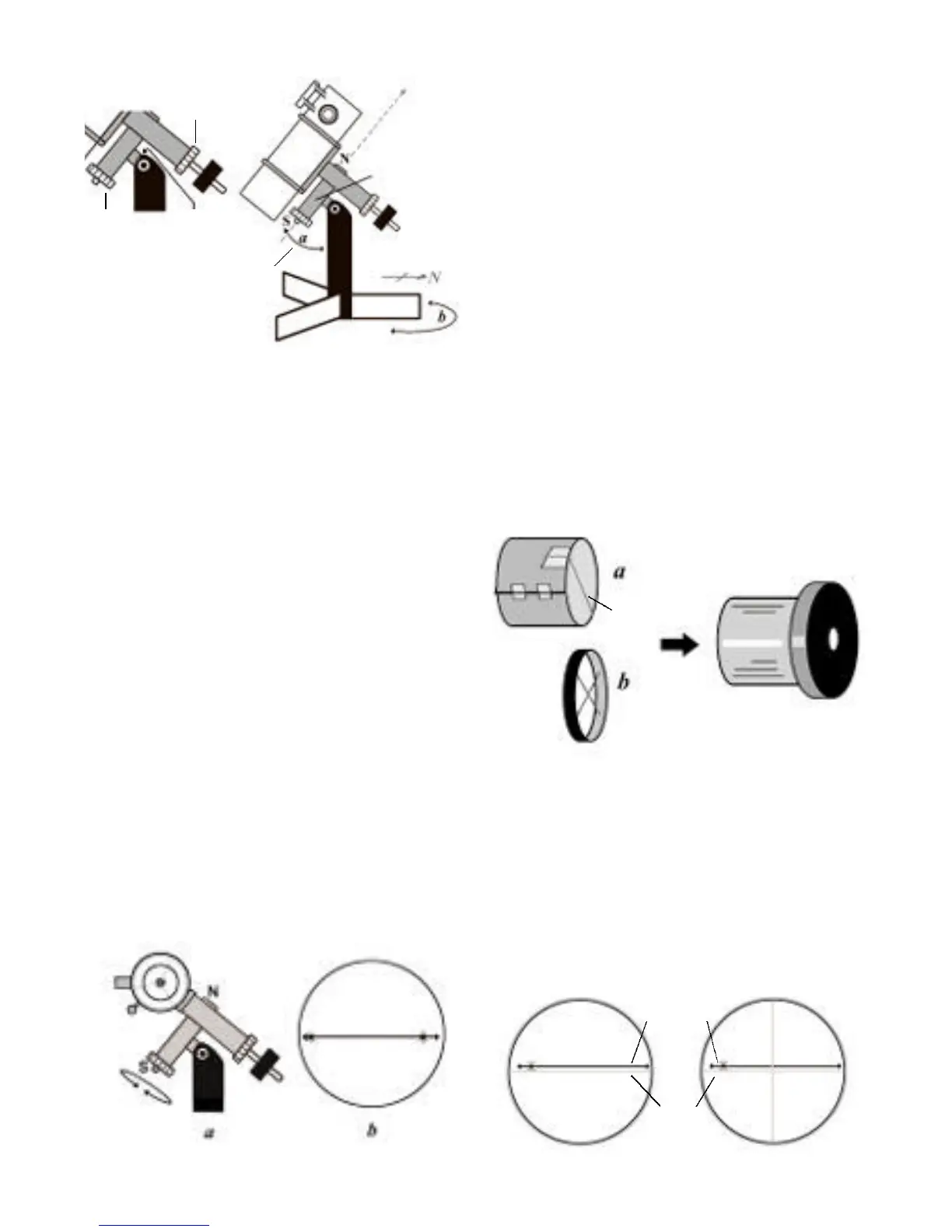
west on the polar axis only as shown in f i g u re 2a)
so that the star is impelled to move from one
side of the eyepiece field to the other. It will
help if you arrange this line of motion to
bisect the eyepiece field (as in figure 2b).
This procedure can be made easier if a reticle
is placed at the eyepiece focus and aligned to
indicate this motion, rather than having to
remember it in the mind's eye.
The reticle can be a rolled piece of cardboard,
joined by sticky tape, of such a diameter that
it snugly fits into the inner barrel of the eye-
piece. A hair or thread is fastened across one
end of this cardboard tube, approximately
bisecting it (figure 3a ). A cross hair reticle
may already be supplied with your instrument
(figure 3b).
Holding the eyepiece up to the light, it should
be possible to insert the reticle until the fila-
ment comes into focus. (Note. The insertion
of a reticle is only possible with cert a i n
e y e piece designs.) The filament, or one of the
c r oss hairs, can then be aligned (by turning the
eyepiece) to establish the direction of axial
movement as re q u i r ed (as in f i g u re 4) .
Declination
Circle
North Celestial Pole
(near Polaris)
Latitude
Polar axis
Polar axis
stars motion
hair or thread
reticle
line
(aligned to
axial motion)
Right
Ascension
Circle
Rotation for
east-west
axial motion
Movement
for altitude
adjustment
Movement for
east-west adjustment
Figure 1
Figure 2 Figure 4
Figure 3
a
b


 To Next Page