This document is an Owner's Manual and Safety Instructions for the HERCULES 4-1/2" Heavy Duty Angle Grinder, Model HE61P. It provides comprehensive information on safe operation, technical specifications, usage, and maintenance of the tool.
Function Description
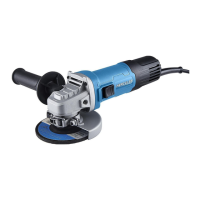
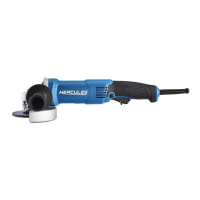
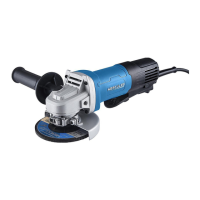
The HERCULES HE61P is a 4-1/2" Heavy Duty Angle Grinder designed for various operations including grinding, sanding, wire brushing, and abrasive cutting-off. It is a versatile power tool intended for heavy-duty applications. The tool features a main body with a motor, a spindle for attaching accessories, a wheel guard for safety, and an auxiliary side handle for improved control. It is equipped with a paddle switch with a safety lock and a switch lock for continuous operation.
Important Technical Specifications
- Electrical Rating: 120VAC / 60Hz / 11A
- No Load Speed: 11,000 RPM
- Spindle Thread: 5/8"-11 TPI Spindle with 7/8" Adaptor
- Max. Accessory Diameter: 4-1/2" (114mm)
The manual emphasizes that accessories must be rated to at least 11,000 RPM, matching or exceeding the tool's maximum speed. The outside diameter and thickness of accessories must be within the capacity rating of the power tool. Arbor sizes of wheels, flanges, and backing pads must properly fit the spindle.
Usage Features
The angle grinder is designed for ease of use with safety as a primary concern.
General Operation:
To start the tool, the safety lock must be pulled back, and the paddle switch pulled upward. For continuous operation, the switch lock can be depressed. To turn off, the safety lock is toggled, releasing the paddle switch to the OFF position. The tool should be allowed to reach full speed before touching the workpiece.
- Grinding/Sanding: For these operations, the wheel or disc should be applied to the work material at a 10°-15° angle, allowing the tool to operate at full speed. Lighter pressure should be used if the tool bogs down. To achieve a smoother surface, the tool should be kept moving over the work surface.
- Abrasive Cutting-off: The cut-off wheel should be applied straight into the work material using only the edge of the wheel, allowing the tool to operate at full speed. Lighter pressure should be used if the tool bogs down. Crucially, the manual warns against grinding with the side of the cut-off wheel, as this can cause shattering.
Accessory Installation:
- Non-threaded Grinding/Cut-Off Wheels: These wheels must be rated to at least 11,000 RPM, no larger than 4-1/2" in diameter, fitted with a 7/8" round arbor hole, and within specific thickness ranges (0.245"-0.3" for grinding, 0.035"-0.095" for cut-off, or 0.125"-0.195" for combo wheels). The spindle lock is used to prevent the spindle from turning while removing/installing the flange nut. The flange nut should be wrench-tightened only enough to securely hold the wheel, avoiding overtightening which can damage the wheel. A specific wheel guard designed for cut-off wheels (if used) is recommended for adequate protection.
- Threaded Accessories (e.g., sanding discs, wire wheels/brushes): These must also be rated to at least 11,000 RPM, no larger than 4-1/2" in diameter, and fitted with a 5/8"-11 TPI threaded opening. The flange nut and flange are removed, and the accessory is threaded firmly onto the spindle and wrench-tightened.
Safety Features:
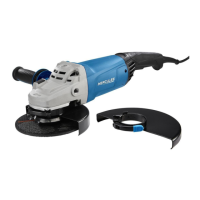
- Wheel Guard: The wheel guard is adjustable by pulling out the lock lever, rotating it to shield the user, and pushing the lever back to secure it. It must be properly installed for safe operation.
- Auxiliary Side Handle: The side handle can be installed in one of two positions on either side of the gear housing and must be securely tightened. The manual explicitly states that the tool should not be operated with one hand only or without the side handle properly installed.
- Spindle Lock: Prevents the spindle from rotating during accessory changes.
Work Area Setup:
A clean, well-lit work area free from distractions is recommended. The power cord should be routed safely to prevent tripping hazards or damage. Loose workpieces must be secured with a vise or clamps. Personal safety equipment, including ANSI-approved eye and hearing protection, and heavy-duty work gloves, are mandatory. Provisions for sparks and debris should be made.
Maintenance Features
Regular maintenance is crucial for the safe and efficient operation of the angle grinder.
Before Each Use:
- Inspect the general condition of the tool, checking for loose hardware, misalignment or binding of moving parts, damaged cord/electrical wiring, cracked or broken parts, and any other condition that may affect safe operation.
After Use:
- Wipe external surfaces of the tool with a clean cloth.
- Periodically blow dust and grit out of the motor vents using dry compressed air. This should be done while wearing ANSI-approved safety goggles and NIOSH-approved breathing protection.
Troubleshooting:
The manual includes a troubleshooting guide for common issues:
- Tool not starting: Check cord connection, power at outlet, thermal reset breaker, and internal damage.
- Tool operating slowly: Decrease pressure on workpiece, check extension cord size/length.
- Performance decrease: Carbon brushes may be worn or damaged.
- Excessive noise/rattling: Internal damage or wear (carbon brushes, bearings).
- Overheating: Forcing the tool to work too fast, blocked motor housing vents, or motor strain from extension cord.
- Tool not grinding/sanding/brushing effectively: Disc accessory may be loose, damaged, worn, or incorrect type for the material.
General Maintenance Advice:
- Procedures not specifically explained in the manual should only be performed by a qualified technician.
- Damaged equipment should not be used. If abnormal noise or vibration occurs, the problem must be corrected before further use.
- If the supply cord is damaged, it must be replaced by a qualified service technician.
- The tool should be used for 15-20 minutes at a time, allowing it to cool completely before next use to prevent tool damage.
- After use, the tool should be turned off, allowed to stop completely, unplugged, cleaned, and stored indoors out of children's reach.
Vibration Safety:
The manual also addresses vibration safety, advising users to reduce exposure to vibration to prevent temporary or permanent physical injury. Recommendations include regular medical check-ups for frequent users, avoiding use by pregnant women or individuals with impaired blood circulation/nervous system disorders, not smoking during use, wearing suitable gloves, using tools with the lowest vibration, including vibration-free periods, and gripping the tool lightly. Maintaining the tool as explained in the manual and stopping use immediately if abnormal vibration occurs are also advised.


 To Next Page
 General