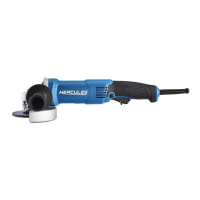
The HERCULES HE61S is a 4-1/2" Heavy Duty Angle Grinder designed for various operations including grinding, sanding, wire brushing, and abrasive cutting-off. This owner's manual provides essential safety instructions, technical specifications, and operational guidelines to ensure safe and effective use.
Function Description:
The angle grinder is a versatile power tool intended for material removal and shaping tasks. It operates by rotating various accessories such as grinding wheels, sanding discs, wire brushes, or cut-off wheels at high speeds.
- Grinding: Used for aggressive material removal, shaping, and smoothing rough surfaces.
- Sanding: Utilizes sanding discs to smooth surfaces, remove paint, or prepare materials for finishing.
- Wire Brushing: Employs wire brushes to clean surfaces, remove rust, paint, or scale.
- Abrasive Cutting-off: Designed for cutting through various materials using specialized cut-off wheels.
Important Technical Specifications:
- Electrical Rating: 120VAC / 60Hz / 7A, indicating it's a corded tool suitable for standard household electrical outlets in North America.
- No Load Speed: 11,000 RPM (Revolutions per Minute), signifying a high rotational speed for efficient material removal.
- Spindle Thread: 5/8"-11 TPI (Threads Per Inch) with a 7/8" Adaptor, which is a common standard for angle grinder accessories, allowing for a wide range of compatible attachments.
- Max. Accessory Diameter: 4-1/2" (115mm), defining the maximum size of grinding wheels, sanding discs, or cut-off wheels that can be safely used with this tool.
Usage Features:
The HE61S angle grinder is designed with several features to enhance usability and safety:
- Side Handle: An auxiliary handle that can be installed in one of two positions on either side of the gear housing. This feature is crucial for maintaining a firm grip and control over the tool, especially to resist kickback forces during operation. The manual explicitly warns against operating the tool with one hand only or without the Side Handle properly installed.
- Spindle Lock: A button that, when depressed, prevents the spindle from turning, allowing for easy and secure attachment or removal of accessories. The manual warns against depressing the spindle lock when starting or during operation.
- Slide Switch: A power switch that can be pushed forward to start the tool. For continuous operation, the front of the switch can be depressed to lock it in the ON position. To turn the tool OFF, the rear of the switch is depressed and slid backward.
- Wheel Guard: A protective guard that must be securely attached and positioned to expose the least amount of the wheel towards the operator, protecting against broken wheel fragments and accidental contact. It features a Wheel Guard Lock Lever for easy adjustment and securing. The manual emphasizes that the tool should not be operated without the Wheel Guard properly installed.
- Accessory Installation: The manual provides detailed instructions for installing both non-threaded accessories (like grinding or cut-off wheels) and threaded accessories (like sanding discs, wire wheels, or wire cup brushes). It highlights the importance of using accessories rated for at least 11,000 RPM and within the 4-1/2" diameter limit. Specific warnings are given regarding overtightening the flange nut, which can damage the wheel, and the necessity of a specific wheel guard for cut-off wheels.
- Workpiece and Work Area Setup: Emphasizes the importance of a clean, well-lit work area free from distractions, securing workpieces with clamps, and ensuring no hazardous objects or utility lines are nearby.
- Operation Guidelines: For grinding and sanding, the tool should be applied to the work material at a 10°-15° angle, allowing it to operate at full speed. For abrasive cutting-off, the wheel should be applied straight into the material using only the edge. Users are advised to use lighter pressure if the tool bogs down and to keep the tool moving for smoother surfaces.
- Thermal Reset Breaker: (If equipped) A safety feature that trips if the tool overheats, preventing damage. Users are instructed to turn off the tool, allow it to cool, and press the reset button.
- Corded Design: Requires an electrical outlet and, if needed, an appropriately sized extension cord. The manual includes a detailed table for recommended minimum wire gauges for extension cords based on amperage and length to prevent voltage drop and tool damage.
Maintenance Features:
Regular maintenance is crucial for the longevity and safe operation of the HERCULES HE61S angle grinder:
- Pre-Use Inspection: Before each use, users must inspect the tool for loose hardware, misalignment or binding of moving parts, damaged cord/electrical wiring, cracked or broken parts, or any other condition affecting safe operation.
- Post-Use Cleaning: After each use, external surfaces of the tool should be wiped with a clean cloth.
- Motor Vent Cleaning: Periodically, dust and grit should be blown out of the motor vents using dry compressed air. This prevents excessive accumulation of powdered metal, which can cause electrical hazards.
- Damaged Cord Replacement: If the supply cord is damaged, it must be replaced only by a qualified service technician.
- Troubleshooting Guide: The manual includes a troubleshooting section to help users diagnose and resolve common issues such as the tool not starting, operating slowly, decreased performance, excessive noise or rattling, overheating, or ineffective grinding/sanding/brushing. Solutions range from checking power connections and accessory installation to seeking professional service for internal damage.
- Carbon Brushes: The troubleshooting section mentions carbon brushes as a potential cause for internal damage or wear, indicating they are a serviceable component.
- Safety Precautions During Maintenance: All safety precautions, including disconnecting the power supply, must be followed when diagnosing or servicing the tool. Only qualified technicians should perform procedures not specifically explained in the manual.
The HERCULES HE61S is a robust tool designed for demanding tasks, emphasizing user safety through comprehensive warnings and detailed operational and maintenance instructions.



 To Next Page
 General