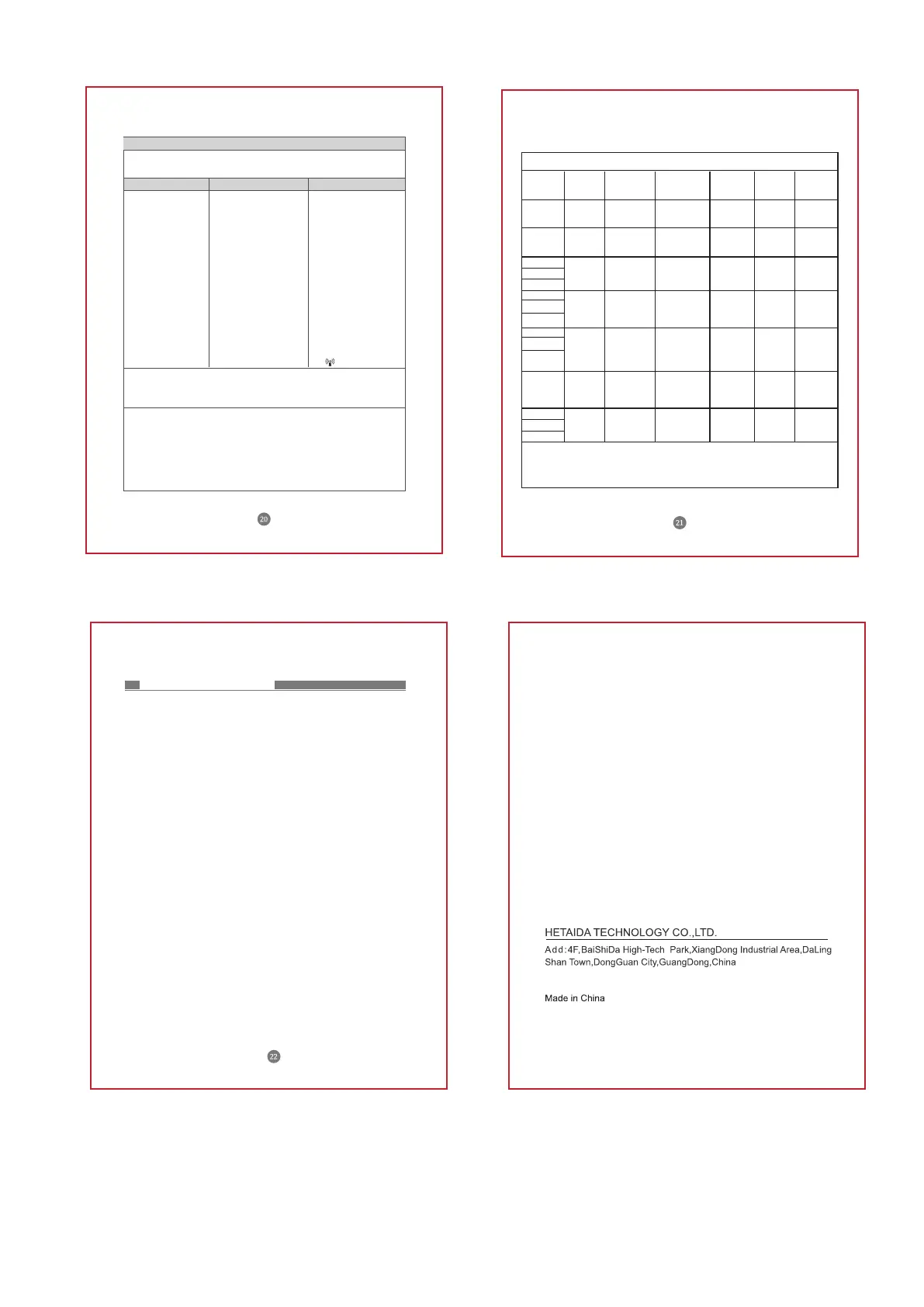
Guidance and manufacture’s declaration – electromagnetic immunity
Immunity test IEC 60601 test level
Not applicable
Compliance level
The Infrared Body Thermometer is intended for use in the electromagnetic environment speci�ied below. The
customer or the user ofthe Infrared Body Thermometer should assure that it is used in such an environment.
Conducted RF
IEC 61000-4-6
3 Vrms
150 kHz to 80 MHz
Radiated RF
IEC 61000-4-3
Professional healthcare
environment: 3 V/m
Home healthcare
environment: 10 Vm
80 MHz to 2700 MHz
Professional healthcare
environment: 3 V/m
Home healthcare
environment: 10 Vm
80 MHz to 2700 MHz
NOTE 1 At 80 MHz and 800 MHz, the higher frequency range applies.
NOTE 2 These guidelines may not apply in all situations. Electromagnetic propagation is affected by absorption
and re�lection from structures, objects and people.
a Field strengths from �ixed transmitters, such as base stations for radio (cellular/cordless) telephones and land
mobile radios, amateur radio, AM and FM radio broadcast and TV broadcast cannot be predicted theoretically with
accuracy. To assess the electromagnetic environment due to �ixed RF transmitters, an electromagnetic site survey
should be considered. If the measured �ield strength in the location in which the Non Contact Infrared Body
Thermometer is used exceeds the applicable RF compliance level above, the Non Contact Infrared Body
Thermometer should be observed to verify normal operation. If abnormal performance is observed, additional
measures may be necessary, such as re-orienting or relocating the Non Contact Infrared Body Thermometer.
b Over the frequency range 150 kHz to 80 MHz, �ield strengths should be less than 3 V/m.
9-Body temperature
● Body temperature varies from person to person and �luctuates during the course
of the day. For this reason, it is suggested to know one's normal, healthy forehead
temperature to correctly determine the temperature.
● Body temperature runs approximately from 35.5℃ to 37.8℃(95.9°F-100°F). To
determine if one has a fever, compare the temperature detected with the person's
normal temperature. A rise over the reference body temperature of 1℃(1°F) or more
is generally indication of fever.
● Different measurement sites(rectal, axillary, oral, frontal, auricular) will give
different readings. Therefore it is wrong to compare the measurement taken from
different sites.
● Here below are typical temperatures for adults, based on different measurement
sites:
-Rectal: 36.6℃ to 38℃/97.9°F-100.4°F
-Axillary: 34.7℃ to 37.3℃/94.5°F-99.1°F
ASTM laboratory accuracy requirements in the display range of 37℃ to 38.9℃(98°F
to 102°F) for IR thermometers is ±0.2℃(±0.4°F), whereas for mercury in-glass and
electronic thermometers, the requirement per ASTM Standards E667-86 and
E1112-86 is ±0.1℃(±0.2°F).
Caution: This infrared thermometer meets requirements established in ASTM
Standard (E1965-98) Except of clause 5.2.2. It displays subject’s temperature over a
range of 34.0~43.0℃. Full responsibility for the conformance of this product to the
standard is assumed by(Hetaida Technology Co., Ltd. Add: 4F, Baishida High-Tech
Park, Xiangdong Industrial Area, Dalingshan Town, Dongguan City, Guangdong, China)
Guidance and manufacturer's declaration - RF wireless communication equipment immunity
Test
frequency
(MHz)
Band
a)
(MHz)
Service
a)
Modulation
b)
Maximum
power
(W)
Distance
(m)
IMMUNITY
TEST LEVEL
(V/m)
385
380 - 390
TETRA 400
Pulse
modulation
b)
18 Hz
1,8
0,3
27
450
430 - 470
GMRS 460,
FRS 460
FM
c)
± 5 kHz deviation
1 kHz sine
2
0,3
28
710
704 - 787
LTE Band 13,
17
Pulse
modulation
b)
217 Hz
0,2
0,3
9 745
780
810
800 - 960
GSM 800/900,
TETRA 800,
iDEN 820,
CDMA 850,
LTE Band 5
Pulse
modulation
b)
18 Hz
2
0,3
28
870
930
1720
1700 -
1990
GSM 1800;
CDMA 1900;
GSM 1900;
DECT;
LTE Band 1, 3,
4, 25; UMTS
Pulse
modulation
b)
217 Hz
2
0,3
28
1845
1970
2450
2400 -
2570
Bluetooth,
WLAN,
802.11 b/g/n,
RFID 2450,
LTE Band 7
Pulse
modulation
b)
217 Hz
2
0,3
28
5240
5100 -
5800
WLAN 802.11
a/n
Pulse
modulation
b)
217 Hz
0,2
0,3
9
5500
5785
a)
For some services, only the uplink frequencies are included.
b)
The carrier shall be modulated using a 50 % duty cycle square wave signal.
c)
As an alternative to FM modulation, 50 % pulse modulation at 18 Hz may be used because while it does not
represent actual modulation, it would be worst case.


 To Previous Page
 Loading...