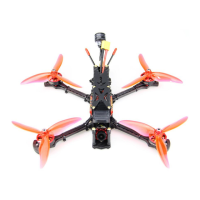
The HGLRC XJB145 is an FPV Racing Drone designed for enthusiasts and pilots seeking a compact yet powerful quadcopter for racing and freestyle flying. This manual provides comprehensive instructions for setup, configuration, and troubleshooting, ensuring users can optimize their drone's performance.
Function Description
The HGLRC XJB145 is a high-performance FPV racing drone, meaning it's designed for speed, agility, and real-time video transmission (First Person View). The core components work together to provide a robust and responsive flying experience:
- Flight Controller (FC): The Forward F4 Flight Controller is the brain of the drone, processing pilot inputs from the receiver, sensor data (accelerometer, gyroscope), and executing flight commands to the ESCs. It runs Betaflight firmware, which is highly customizable and allows for fine-tuning of flight characteristics.
- Electronic Speed Controllers (ESCs): The Forward 35A 4in1 ESC handles power distribution and motor control. A 4-in-1 ESC integrates four individual ESCs into a single board, simplifying wiring and reducing weight. It receives commands from the flight controller and translates them into precise motor speeds, enabling the drone to fly. The DSHOT600 protocol is supported for fast and reliable communication between the FC and ESCs.
- Motors: Equipped with FLAME 1407 3600KV motors, the XJB145 offers a high KV rating, indicating a high RPM per volt, which translates to significant power and speed for racing.
- Video Transmitter (VTX): The Forward MT VTX mini is responsible for transmitting the camera's video feed wirelessly to the pilot's FPV goggles or monitor. It supports various power levels (PIT/25/100/200/400/600mW) and uses OSD SmartAudio for remote configuration, allowing pilots to change VTX settings directly from their transmitter or OSD menu.
- Camera: The RunCam Nano 2 is a compact and lightweight FPV camera known for its good image quality and low latency, crucial for FPV flying.
- Receiver: The drone supports various receiver protocols including SBUS, DSMX, and i.BUS, offering flexibility in choosing a compatible radio transmitter. The receiver translates the pilot's stick commands into digital signals for the flight controller.
- Frame Kit: The XJB145 Frame Kit is the structural backbone, housing all the electronic components and motors. Its design is optimized for durability and weight distribution, essential for racing performance.
Important Technical Specifications
- Model: XJB145 FPV Racing Drone
- Weight (PNP): 135.5g (Plug-N-Play, meaning it comes pre-assembled without a receiver or battery)
- Frame Kit: XJB145 Frame Kit
- Flight Controller: Forward F4 Flight Controller
- ESC: Forward 35A 4in1
- VTX: Forward MT VTX mini (PIT/25/100/200/400/600mW)
- Camera: RunCam Nano 2
- Motor: FLAME 1407 3600KV
- Support Receiver: SBUS, DSMX, i.BUS
- Input Voltage: 3-4S Lipo (Supports 3-cell to 4-cell Lithium Polymer batteries)
Usage Features
The HGLRC XJB145 offers several features that enhance its usability and performance:
- Betaflight Firmware: The flight controller runs Betaflight, a highly popular and feature-rich open-source firmware for FPV drones. This allows for extensive customization of flight modes, PID tuning, OSD elements, and other parameters.
- DFU Mode for Firmware Updates: The drone can be put into DFU (Device Firmware Upgrade) mode by holding the BOOT button while connecting to USB. This allows for flashing new firmware versions to the flight controller using the Betaflight configurator.
- Accelerometer Calibration: Essential for stable flight, the accelerometer can be calibrated through the Betaflight configurator to ensure the drone knows its orientation accurately.
- URAT Serial Port Use: The flight controller offers multiple UARTs for connecting various peripherals:
- UART1: Receiver telemetry
- UART2: VTX image transmission (SmartAudio/Tramp Telemetry)
- UART3: GPS
- UART4: ESC telemetry
- UART6: Receiver (SBUS/DSMX/i.BUS)
- ESC Protocol Support: Supports DSHOT600, a digital ESC protocol known for its speed and noise immunity, contributing to better flight performance.
- Voltage Parameters Setting: Users can configure battery voltage parameters (minimum, maximum, warning cell voltage, capacity) in Betaflight to monitor battery health and prevent over-discharge.
- Receiver Setup: The manual details how to connect and configure various receiver types (SBUS, i.BUS, DSMX, PPM) via the appropriate UART and Betaflight settings.
- VTX SmartAudio/Tramp Telemetry: The Forward MT VTX mini supports OSD SmartAudio, allowing pilots to change VTX settings (band, channel, power) directly from their FPV goggles using the OSD menu, eliminating the need for physical button presses on the VTX.
- OSD (On-Screen Display): Betaflight OSD provides real-time flight information (battery voltage, mAh consumed, flight mode, etc.) overlaid on the FPV video feed. It also allows for in-field adjustments of PIDs, rates, VTX settings, and OSD element placement.
- Flight Mode Configuration: Pilots can assign different flight modes (e.g., ARM, ANGLE) to switches on their radio transmitter through the Betaflight Modes tab, customizing the drone's behavior.
- LED Settings: The flight controller supports LED strips, allowing users to configure colors, effects, and wiring order for visual customization and status indication.
Maintenance Features
The manual emphasizes several points for proper maintenance and troubleshooting:
- Polarity Check: Crucial for preventing damage, users are warned to carefully check polarity before connecting power.
- Power Disconnection: Always disconnect power when connecting, plugging, or unplugging any components to avoid short circuits or damage.
- PID and Gyroscope Refresh Rate: The drone supports a high refresh rate of 8K/8K for PID (Proportional-Integral-Derivative) loop and gyroscope, which contributes to responsive and stable flight. Maintaining this performance requires proper configuration and avoiding unnecessary load on the flight controller.
- Troubleshooting Guide: The manual includes a troubleshooting section for common issues:
- OSD Garbled Characters: Solved by updating the OSD font via the Betaflight configurator's "Font Manager."
- No "BBB" Sound on Battery Plug-in: Indicates a potential issue with the ESC protocol or self-test, requiring a check of ESC settings.
- Aircraft Keeps Spinning: Suggests checking propeller direction and motor direction, as incorrect setup can lead to uncontrolled rotation.
- After-Sales Support: HGLRC offers repair services for quality problems (free) and damage due to improper operation (inspection-based repair). Contact information for domestic and overseas customers is provided.
In summary, the HGLRC XJB145 is a feature-rich FPV racing drone designed for performance and user configurability. Its robust components, coupled with the flexibility of Betaflight firmware and comprehensive manual support, make it a suitable choice for pilots looking for a capable and customizable racing platform.

 Need help?

 To Next Page
 General