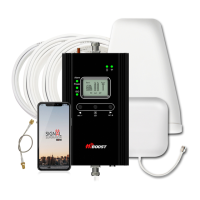
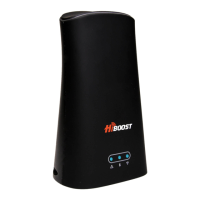
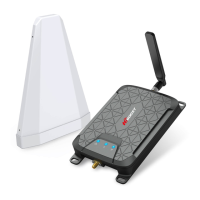
The HiBoost 15K Smart Link Deluxe is a signal booster designed to enhance cellular signals across various bands and standards, including 5G. It aims to improve signal strength for both uplink and downlink communications, providing better voice and streaming quality, and increasing the number of signal bars. The device is part of the Smart Link Series, indicating its capability for smart monitoring and control via a dedicated application.
Function Description:
The HiBoost 15K Smart Link Deluxe operates by receiving weak outdoor cellular signals, amplifying them, and then retransmitting the stronger signals indoors. Conversely, it also amplifies outgoing signals from indoor devices to the cell tower. The system comprises a signal booster unit, an outdoor antenna, indoor antennas (two in this package), and various cables and accessories for installation.
The booster supports multiple frequency bands:
- LTE700: Uplink 698-716MHz, Downlink 728-746MHz (Bands 12/17) and Uplink 776-787MHz, Downlink 746-757MHz (Band 13)
- CELL800: Uplink 824-849MHz, Downlink 869-894MHz (Band 5)
- PCS1900: Uplink 1850-1915MHz, Downlink 1930-1995MHz (Bands 25/2)
- AWS2100: Uplink 1710-1755MHz, Downlink 2110-2155MHz (Band 4)
It is compatible with a wide range of cellular standards, including CDMA, WCDMA, GSM, EDGE, HSPA+, EVDO, LTE, and 5G.
The device features LED status indicators to provide real-time feedback on its operational status:
- ALARM LED:
- Solid Green: Normal operation.
- Slow Flashing Green: Slight Overload.
- Quick Flashing Green: Overload.
- Quick Flashing Red: Booster automatically shut off due to strong overload.
- Power LED:
- Green: Normal.
- Off: DC Power Problem.
- ISO LED:
- Solid Green: Normal.
- Slow Flashing Green: Slight Loopback.
- Quick Flashing Green: Loopback.
- Quick Flashing Red: Booster automatically shut off due to strong loopback.
- Bluetooth LED:
- Slow Flashing Green: Bluetooth Disconnected.
- Quick Flashing Green: Bluetooth Connected.
- Wi-Fi LED:
- Solid Green: Wi-Fi Disconnected.
- Slow Flashing Green: Wi-Fi Connected.
Important Technical Specifications:
- Model No.: HiBoost 15K Smart Link Deluxe
- Working Band: Band 12/17, Band 13, Band 5, Band 25/2, Band 4
- UL Frequency Range (MHz): 698-716 / 776-787 / 824-849 / 1850-1915 / 1710-1755
- DL Frequency Range (MHz): 728-746 / 746-757 / 869-894 / 1930-1995 / 2110-2155
- Supported Standards: CDMA, WCDMA, GSM, EDGE, HSPA+, EVDO, LTE, 5G and all cellular standards
- Max. Gain: 70 dB
- Max. Output Power: UL 17dBm, DL 13dBm
- MGC (Step Attenuation): ≥25 dB / 1 dB step
- I/O Port: SMA-Female & N-Female
- Impedance: 50 ohm
- Environment Conditions: IP40
- Dimensions: 218 mm x 165 mm x 50 mm
- Weight: ≤5.0 lb / 2.2 kg
- Power Supply: Input AC 100~240 V, 50/60 Hz, Output DC 12 V/3 A
The package includes:
- Signal Booster
- Outdoor Antenna
- 50ft Outdoor Cable
- Indoor Antenna (x2)
- 49.2' Indoor Cable
- 30' Indoor Cable
- Power Supply
- Accessories for main parts
- Waterproof tape
- Bluetooth and Wi-Fi antenna
Usage Features:
The installation process involves several key steps:
- Getting Started: Connect the power supply and the whip antenna to the booster.
- App Download and Registration: Download the "Signal Supervisor" app, register an ID, log in, and add the booster to the device list. This app is crucial for monitoring and adjusting the booster's performance.
- Finding the Cell Tower and Outdoor Antenna Position:
- For Android: Use "NetWork Cell Info Lite" to identify the frequency band in use and locate the nearest cell tower on a map. This helps in aiming the outdoor antenna. Screenshots are recommended at this stage.
- For iOS: Dial 3001#12345# and follow instructions to get network information.
- General Method: Use cellmapper.net to find the cell tower. Select your carrier and band, then enter your location coordinates. The map will show nearby towers. The outdoor antenna should be placed at one of the four ends of the roof, facing the cell tower, ensuring no barriers obstruct the signal path.
- Connecting the Outdoor Antenna: Connect the outdoor antenna to the booster using the 50ft outdoor cable. Do not connect indoor antennas at this stage.
- Adjusting and Fixing the Outdoor Antenna: Point the outdoor antenna towards the identified cell tower. Use the Signal Supervisor app to observe the output power and gain. The goal is to achieve the highest possible output power (ideally 13dBm) and full gain (70dB). Secure the antenna using the provided L-bracket, nut, and washer.
- Connecting the 1st Indoor Antenna: Connect the 49.2' indoor cable to the booster and then to the first indoor antenna.
- Adjusting the Indoor Antenna: Position the indoor antenna in the area where signal coverage is desired. It's best if the indoor and outdoor antennas face opposite directions. Ensure the gain reaches about 65dB. If not, adjust the indoor antenna's direction, increase the vertical and horizontal distance between the antennas, or add barriers.
- Signal Quality Test:
- Verify that the signal gauge value in the app remains consistent with the outdoor antenna installation.
- Perform speed tests with the booster on and off to compare performance.
- Check for an increase in signal bars on your devices.
- Make phone calls and send messages to assess improvements in voice and streaming quality.
- Fixing the 1st Indoor Antenna: Secure the indoor antenna using the provided expansion bolt and hook.
- Connecting the 2nd Indoor Antenna: Connect the 30' indoor cable to the booster and then to the second indoor antenna.
- Fixing the 2nd Indoor Antenna and Booster: Repeat the adjustment and fixing process for the second indoor antenna. Fix the booster unit itself using the provided expansion bolt and hook.
Maintenance Features:
The Signal Supervisor app acts as a primary maintenance tool, allowing users to monitor the booster's performance and troubleshoot issues.
The manual outlines common problems and their solutions:
- Overload:
- Symptoms: ALARM light quick blinking green or red, DL Gain <60dB (LTE700/CELL800) or <65dB (PCS1900/AWS2100), Output Power >=10dBm.
- Reason: Outdoor signal is too strong.
- Solution: Point the outdoor antenna slightly away from the cell tower.
- Loopback (Oscillation):
- Symptoms: ISO light blinking green or red, DL Gain <60dB (LTE700/CELL800) or <65dB (PCS1900/AWS2100), Output Power <10dBm.
- Reason: Inadequate separation of indoor and outdoor antennas.
- Solutions:
- Increase vertical and horizontal distance between antennas.
- Ensure indoor and outdoor antennas face opposite directions.
- Add barriers (e.g., walls) between the antennas.
- Poor Signal:
- Symptoms: ALARM light and ISO light solid green, DL Gain >=60dB (LTE700/CELL800) or >=65dB (PCS1900/AWS2100), Output Power --/NEGATIVE.
- Reason: Input signal is too weak.
- Solutions:
- Adjust the outdoor antenna to the best direction.
- Adjust the outdoor antenna to another cell tower.
- Increase the height of the outdoor antenna and ensure no barriers between it and the tower.
- Continue trying these solutions until the output power reaches or exceeds -5dBm.
- Normal but No Boosted Signal:
- Symptoms: ALARM light and ISO light solid green, DL Gain >=60dB (LTE700/CELL800) or >=65dB (PCS1900/AWS2100), Output Power >=-5dBm.
- Reasons:
- The band is not supported.
- The signal is from other carriers.
- Solutions:
- Verify the band you are using. If it's band 66, access 'Detail'/'Setting' of gauges on Signal Supervisor and switch off the RF switch of AWS2100, then readjust the outdoor antenna.
- It's recommended to have two people for adjustment: one near the indoor antenna to check signal boost, and one adjusting the outdoor antenna.
If the booster automatically shuts off due to strong overload or loopback, it needs to be manually rebooted. The manufacturer emphasizes that if a stable 1-bar signal cannot be obtained outside the house or on the roof, the booster may not work effectively in very weak signal areas.
For further information, users can visit www.hiboost.com to download the specific user manual or contact technical support.

 Need help?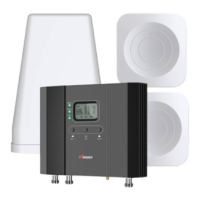

 To Next Page
 General