The number stamped on the wrench refers to the distance of the fastener head.
The box-end wrench is an excellent tool because it grips the fastener on all sides.
This reduces the chance of the tool slipping. The box-end wrench is designed with
either a 6 or 12-point opening. For stubborn or damaged fasteners, the 6-point provides
superior holding because it contacts the fastener across a wider area at all six edges.
For general use, the 12-point works well. It allows the wrench to be removed and
reinstalled without moving the handle over such a wide are.
An open-end wrench is fast and works best in
areas with limited overhead access. It contacts the
fastener at only two points and is subject to slipping if
under heavy force, or if the tool or fastener is worn. A
box-end wrench is preferred in most instances,
especially when braking loose and applying the final
tightness to a fastener.
The combination wrench has a box-end on one
end and an open-end on one end and an open-end
on the other. This combination makes it a convenient
tool.
Adjustable wrenches
An adjustable wrench or Crescent wrench (Figure
6) can fit nearly any nut or bolt head that has clear
access around its entire perimeter. An adjustable
wrench is best used as a backup wrench to keep a
large nut or bolt from turning while the other end is
being loosened or tightened with a box-end or socket
wrench.
Adjustable wrenches contact the fastener at only
two points, which makes them more subject to
slipping off the fastener. Because one jaw is
adjustable and may become loose, this shortcoming
is aggravated. Make certain the solid jaw is the one
transmitting the force.
Socket Wrenches, Ratchets and
Handles
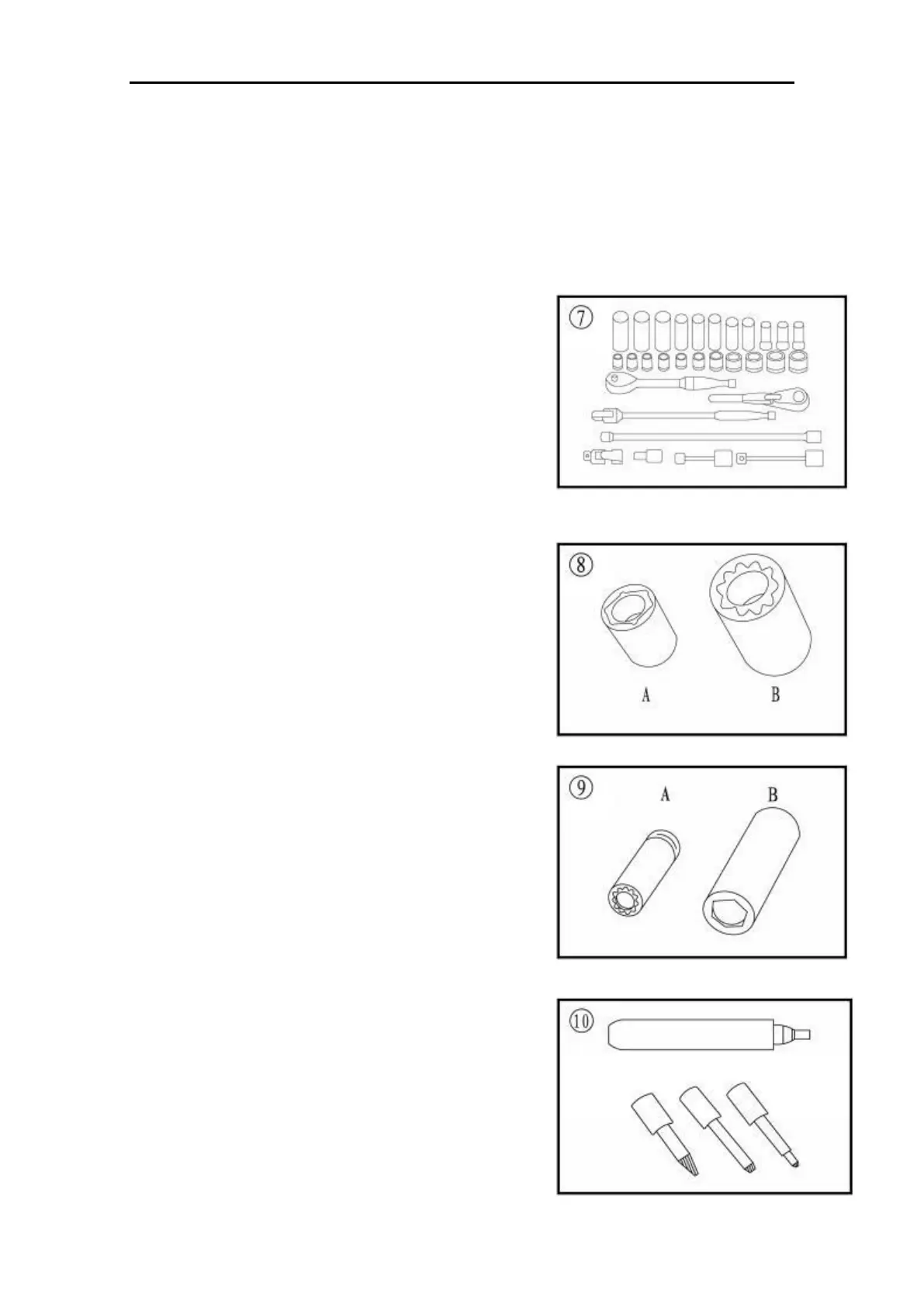
Sockets that attach to a ratchet handle (Figure 7)
are available with 6-point or 12-point openings
(Figure 8) and different drive sizes. The drive size
indicates the size of the square hole that accepts the
ratchet handle. The number stamped on the socket is
the size of the work area and must the fastener head


 To Next Page
 Loading...