which the tool contacts the object. This feel for the equipment produces more accurate
measurements and reduces the risk of damaging the tool or component. Refer to the
following sections for specific measuring tools.
Feeler Gauge
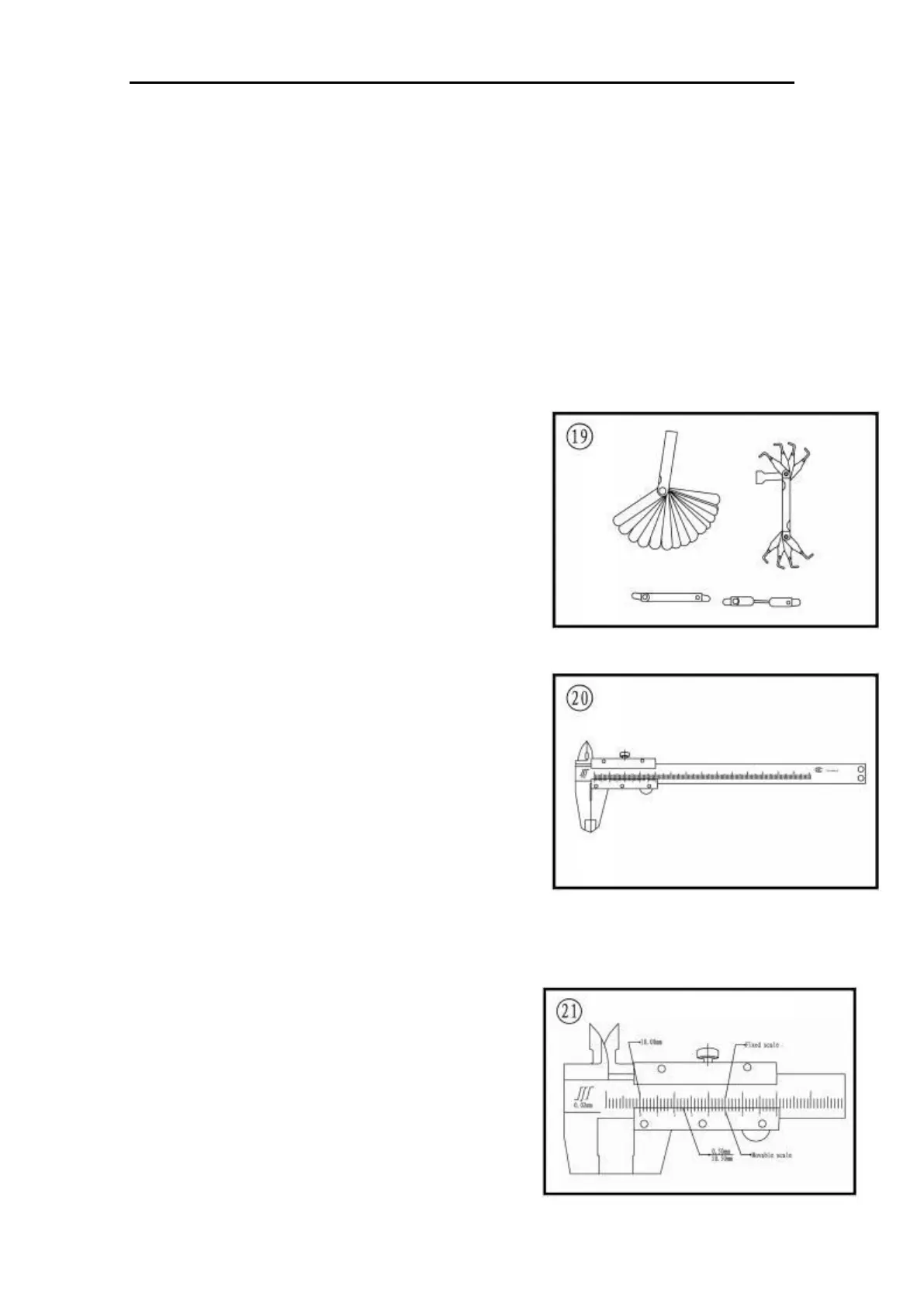
Use feeler or thickness gauges (Figure19) for measuring the distance between two
surfaces.
A feeler gauge set consists of an assortment of
steel strips of graduated thickness. Each blade is
marked with its thickness. Blades can be of various
lengths and angles for different procedures.
A common use for a feeler gauge is to measure
valve clearance. Use wire (round) type gauges to
measure spark plug gap.
Calipers
Calipers (Figure 20) are excellent tools for obtaining inside, outside and depth
measurements. Although not as precise as a
micrometer, they allow reasonable precision, typically
to within 0.02mm or 0.05 mm (0.001 in.). Most
calipers have a range up to 150 mm (6 in.).
Calipers are available in dial, venire or digital
versions. Dial calipers have a dial readout that
provides convenient reading. Venire calipers have
marked scales that must be compared to determine
the measurement. The digital caliper uses a liquid-
crystal display (LCD) to show the measurement.
Properly maintain the measuring surfaces of the caliper. There must not be any dirt
or burrs between the tool and the object being measured. Never force the caliper to
close around an object. Close the caliper around the highest point so it can be removed
with a slight drag. Some calipers require calibration.
Always refer to the manufacturer’s instructions when
using a new or unfamiliar caliper.
To read a vernire. Calipers refer to Figure 21.
The fixed scale is marked in l-mm increments. Ten
individual lines on the fixed scale equal 1 cm. The
movable scale is marked in 0.05 mm (hundredth)
increments. To obtain a reading, establish the first
number by the location of the 0 line on the movable
scale in relation to the first line to the left on the


 To Next Page
 Loading...