Micrometers that cover a wider range of measurements are available. These use a
large frame with interchangeable anvils of various lengths. This type of micrometer
offers a cost savings, but its overall size may make it less convenient.
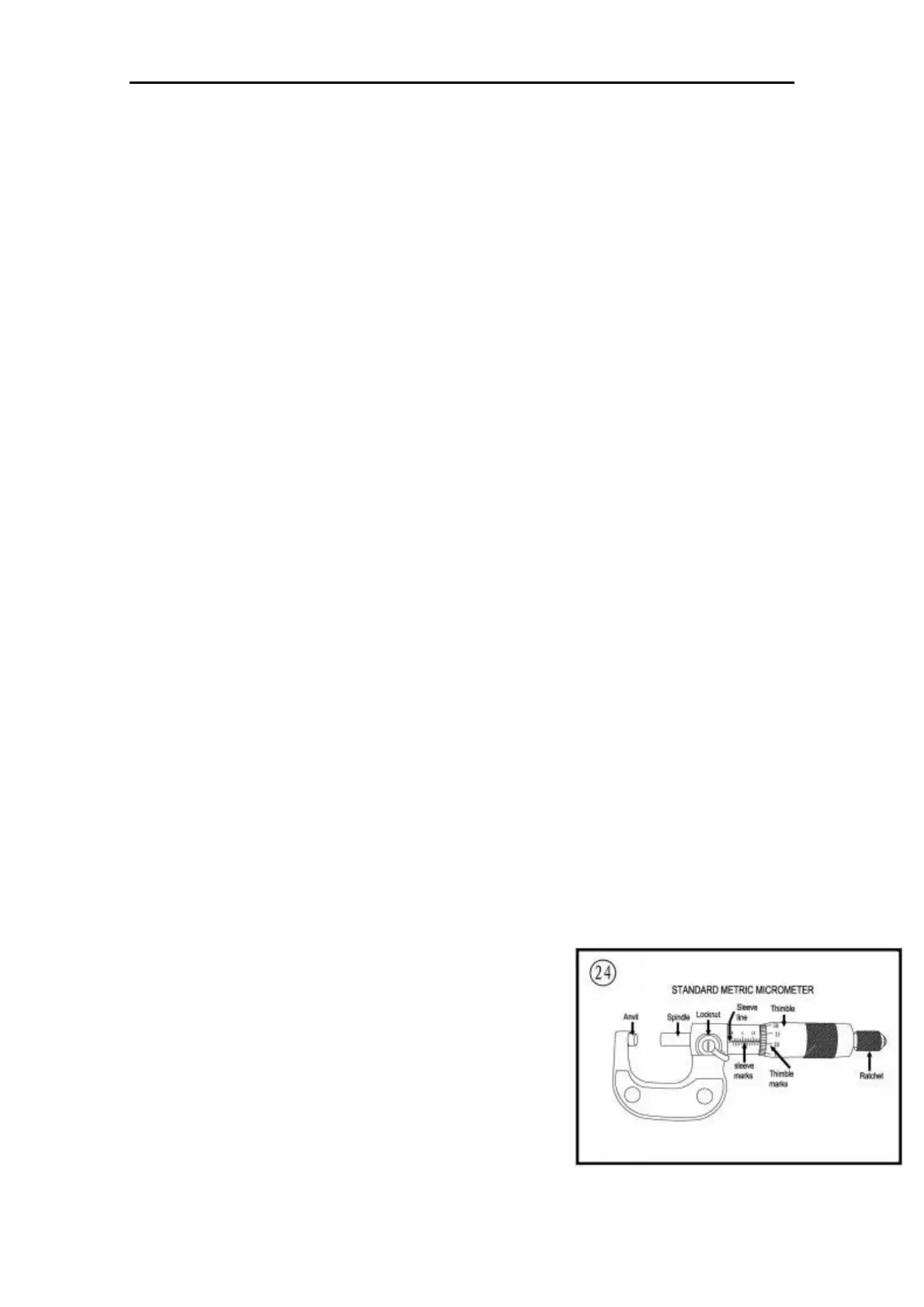
When reading a micrometer, numbers are taken from different scales and added
together. The following sections describe how to adjust, care for and read the
measurements of various types of outside micrometers.
For accurate results, properly maintain the measuring surfaces of the micrometer.
There cannot be any dirt or burrs between the tool and the measured object. Never
force the micrometer to close around an object. Close the micrometer around the
highest point so it can be removed with a slight drag.
Adjustment
Before using a micrometer, check its adjustment as follows:
1. Clean the anvil and spindle faces.
2A. To check a 0-1 in. or 0-25 mm micrometer:
a. Turn the thimble until the spindle contacts the anvil. If the micrometer has a ratchet
stop, use it to ensure that the proper amount of pressure is applied.
b. If the adjustment is correct, the 0 mark on the thimble will align exactly with the 0
mark on the sleeve line. If the marks do not align, the micrometer is out of adjustment.
c. Follow the manufacturer’s instructions to adjust the micrometer.
2B. To check a micrometer larger than 1 in. or 25 mm use the standard gauge supplied
by the manufacturer. A standard gauge is a steel block, disc or rod that is
machined to an exact size.
a. Place the standard gauge between the spindle and anvil, and measure its outside
diameter or length. If the micrometer has a ratchet stop, use it to ensure that the
proper amount of pressure is applied.
b. If the adjustment is correct, the 0 mark on the thimble will align exactly with the 0
mark on the sleeve line. If the marks do not align, the micrometer is out of
adjustment.
c. Follow the manufacturer’s instructions to adjust the micrometer.
Care
Micrometers are precision instruments. They must be
used and maintained with great care. Note the following:
1. Store micrometers in protective cases or separate
padded drawers in a tool box.


 To Next Page
 Loading...