Removal
While bearing are normally removed only when
damaged, there may be times when it is necessary
to remove a bearing that is in good condition.
However, improper bearing removal will damage the
bearing and possibly the shaft or case. Note the
following when removing bearings:
1. When using a puller to remove a bearing from
a shaft, take care that the shaft is not damaged.
Always place a piece of metal between the end
of the shaft and the puller screw. In addition,
place the puller arms next to the inner bearing
race. See Figure 42.
2. When using a hammer to remove a bearing
from a shaft. do not strike the hammer directly
against the shaft. Instead, use a brass or
aluminum rod between the hammer and shaft
(Figure 43) and make sure to support both
bearing races with wooden blocks as shown.
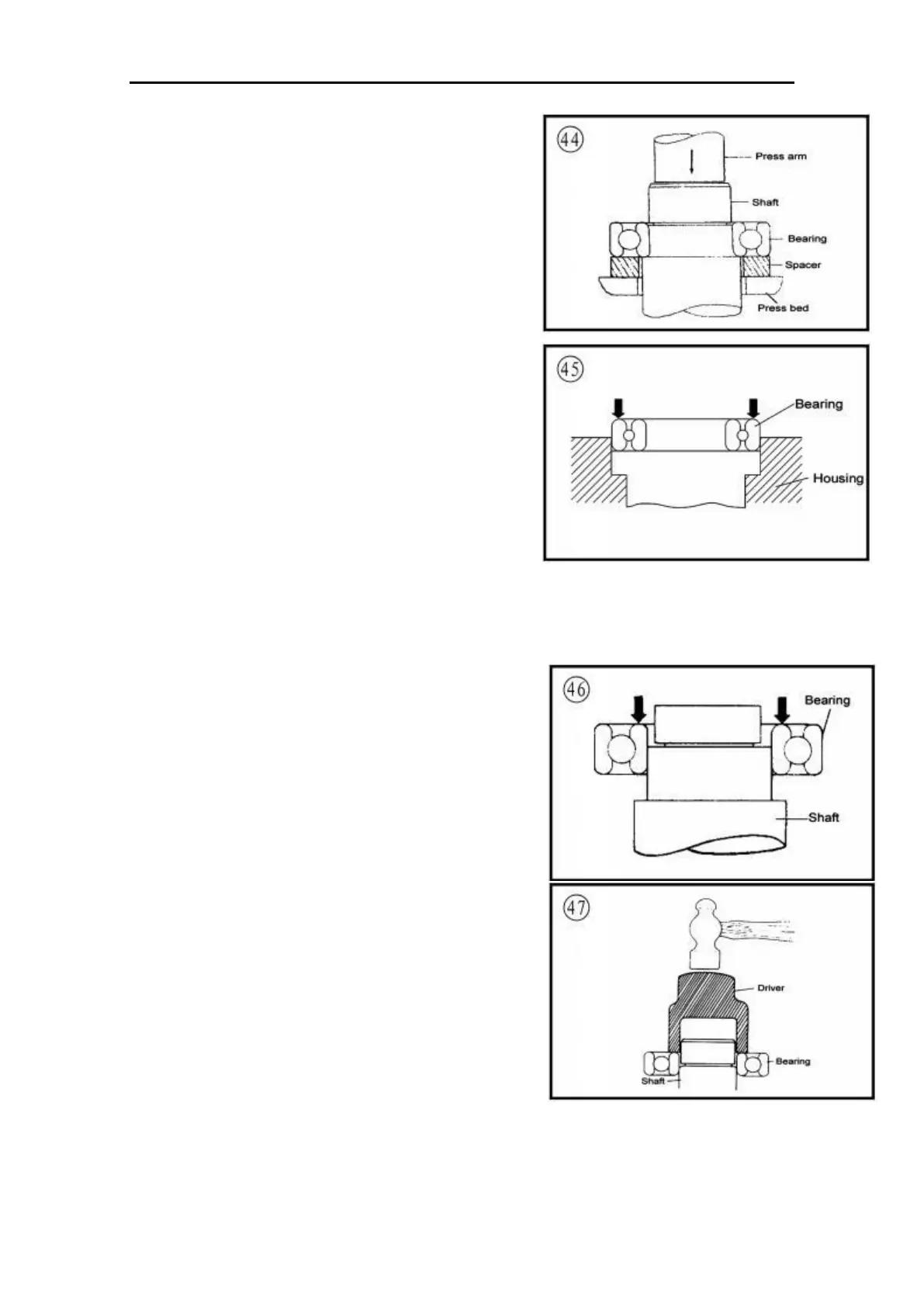
3. The ideal method of bearing removal is with a
hydraulic press. Note the following when using a press:
a. Always support the inner and outer bearing races with a suitable size wooden
or aluminum spacer (Figure 44). If only the outer race is supported, pressure
applie against the balls and/or the inner race will damage them.
b. Always make sure the press arm (Figure
44) aligns with the center of the shaft. If the
arm is not centered, it may damage the
bearing and/or shaft.
c. The moment the shaft is free of the
bearing. It drops to the floor. Secure or
hold the shaft to prevent it from falling.
Installation
1. When installing a bearing in a housing, apply
pressure to the outer bearing race (Figure 45).
When installing a bearing on a shaft, apply
pressure to the inner bearing race (Figure 46).


 To Next Page
 Loading...