---------------------------------LCD-III
Do
to
D
13
are
discrete I/O's
of
common for input and
output,
D14
and
Dl5
require a
mask
option in 3 types.
When
the crystal oscillation for timer is selected and the
latches
of
D14
and D
1s
are
not connected to the terminals,
D14
and
Dl5
can
be
used
as
I-bit general purpose registers
that can
be
set, reset and tested. Furthennore,
if
there
is
internal halt mode. latch
of
D
15
is
used
as
a register for
internal halt mode specially.
In such case, since D
15
means internal halt state and
DiS
=
"1"
means operating state,
LSI
can be
in
internal halt state by
resetting
D1s
using an instruction.
The
pre scaler keeps its
operation in internal halt state. Therefore,
Dl5
may be set by
overflow output pulse from the prescaler to return to
operat-
ing
state. Refer to
HALT
FUNCTION
for details
of
internal
halt mode.
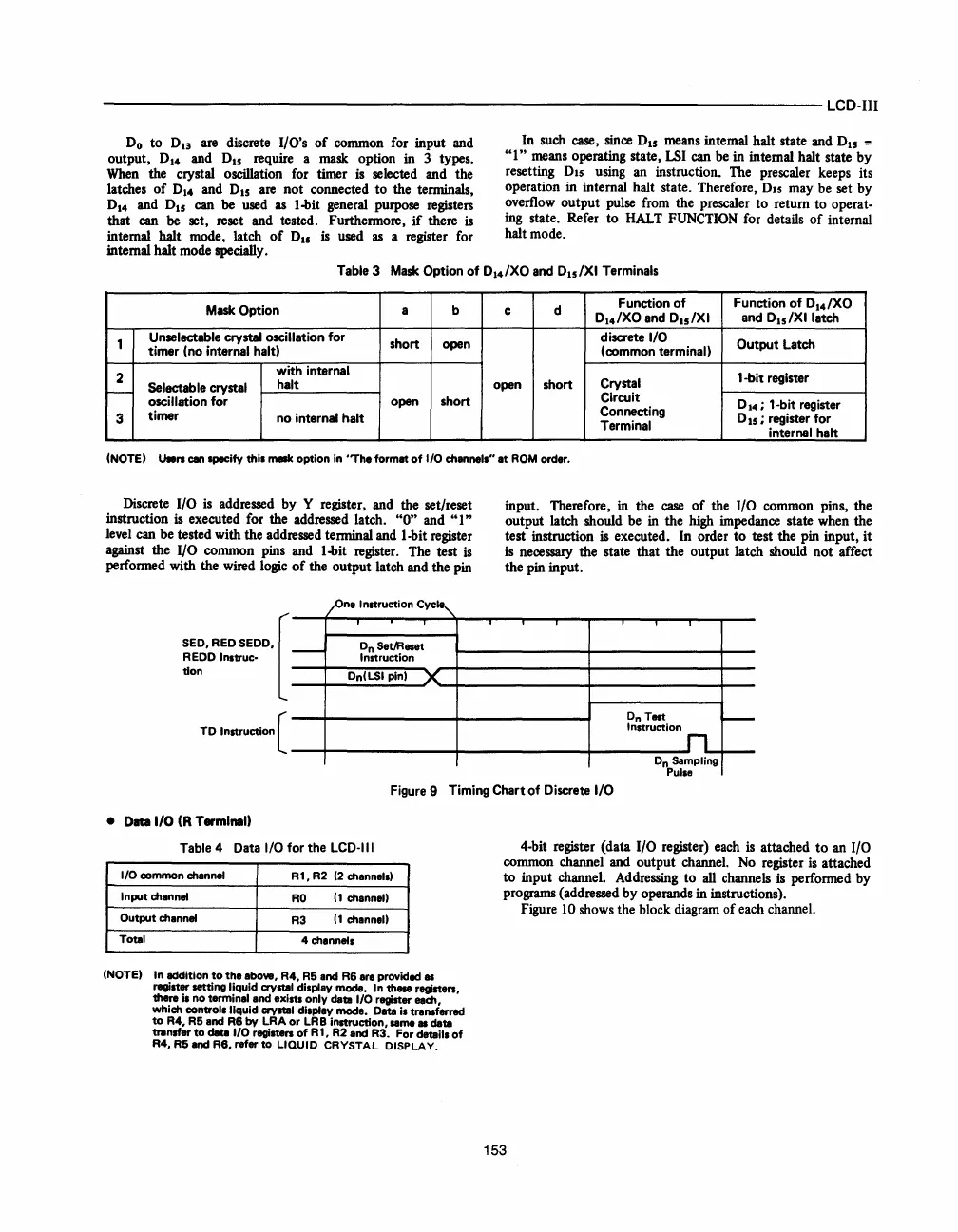
Table 3
Mask
Option
of
D
14
/XO and
Du/XI
Terminals
Mask
Option a b
c d
Function
of
Function
of
D
14
/XO
D
14
/XO and DiS/XI
and
Du/Xllatch
1
Unselectable crystal oscillation for
short
open
discrete
I/O
Output
Latch
timer (no
internal halt) (common terminal)
2
with internal
1-bit register
Selectable crystal
halt
open
short
Crystal
-
Circuit
oscillation for
open
short
0
14
;
'-bit
register
3
timer
no
internal halt
Connecting
0
15
; register for
Terminal
internal halt
(NOTE)
Ulen
C3"I specify
thil
mesic
option
in
"The
format
of
I/O channell"
at
ROM
ordar.
Discrete I/O
is
addressed by Y register, and the set/reset
instruction
is
executed for the addressed latch.
"0"
and
"1"
level
can be tested with the addressed terminal and I-bit register
against the
I/O common pins and I-bit register. The test
is
performed with the wired logic
of
the output latch and the pin
SED, RED SEDD, [
REDO Inltruc-
tlon
TO Instruction [
-
o I st
t'
C
Ie
j'
na n rue
Ion
ye
.,
On
SetlRaset
Instruction
Dn(LSI
pin)
X
input. Therefore, in the
case
of
the I/O common pins, the
output latch should be in the
high impedance state when the
test instruction
is executed. In order
to
test the pin input, it
is
necessary the state that the output latch should not affect
the pin input.
On
Test
~
Instruction
JL
~
On
Sampling
Pulle
Figure 9 Timing Chart
of
Discrete I/O
• Data I/O
(R
T.minaU
Table 4 Data I/O for the
LCD-III
I/O common channel
R 1, R2
(2
channell)
Input channel
RO
C1
channel)
Output channel
R3
C1
channal)
Total
4 channels
(NOTE)
In
addition
to
the
abollll, R4, R5 and R6 ara providad as
register letting liquid crystal dilplay
mode.
In
thasa registen,
there
il
no terminal and exists only data I/O register each
which controll liquid crystal dilplay mode. Data il transferred
to
R4, R5 and R6
by
LRA
or
LRB
instructlon,l8me as
data
transfar
to
data I/O registen
of
R1, R2 and R3. For dataill
of
R4,
R5and
RS, refer
to
LIQUID CRYSTAL DISPLAY.
4-bit register (data I/O register) each
is
attached
to
an I/O
common channel and output channel.
No
register
is
attached
to
input channel. Addressing to
all
channels
is
perfonned by
programs (addressed by operands in instructions).
Figure 10 shows the block diagram of each channel.
153


 To Next Page
 Loading...