---------------------------------LCD-III
• Extension
of
Display Function
Number
of
display digits can be increased
by
externally con-
necting an
LCD
driver LSI
8044100H
to the LCD-III.
The HD44IooH consists
of
shift registers and latch and
liquid crystal
drive
circuit.
When
connected with the LCD-III,
the
8044IooH
is
used
as
a circuit for segment.
In
the LCD-III,
display data for 128 segments
is
sent to the 32-bit shift register
from
RAM
constantly.
When
R42
is
set to
"0",
the RI channel
outputs the 32nd stage output D
of
the shift register, shift
clock CL2, latch clock
CLI
and
AC
signal
M.
Therefore, up to
96 segment terminals from
SEG33
to
SEG·i28
can be added by
directly connecting the HD44looH.
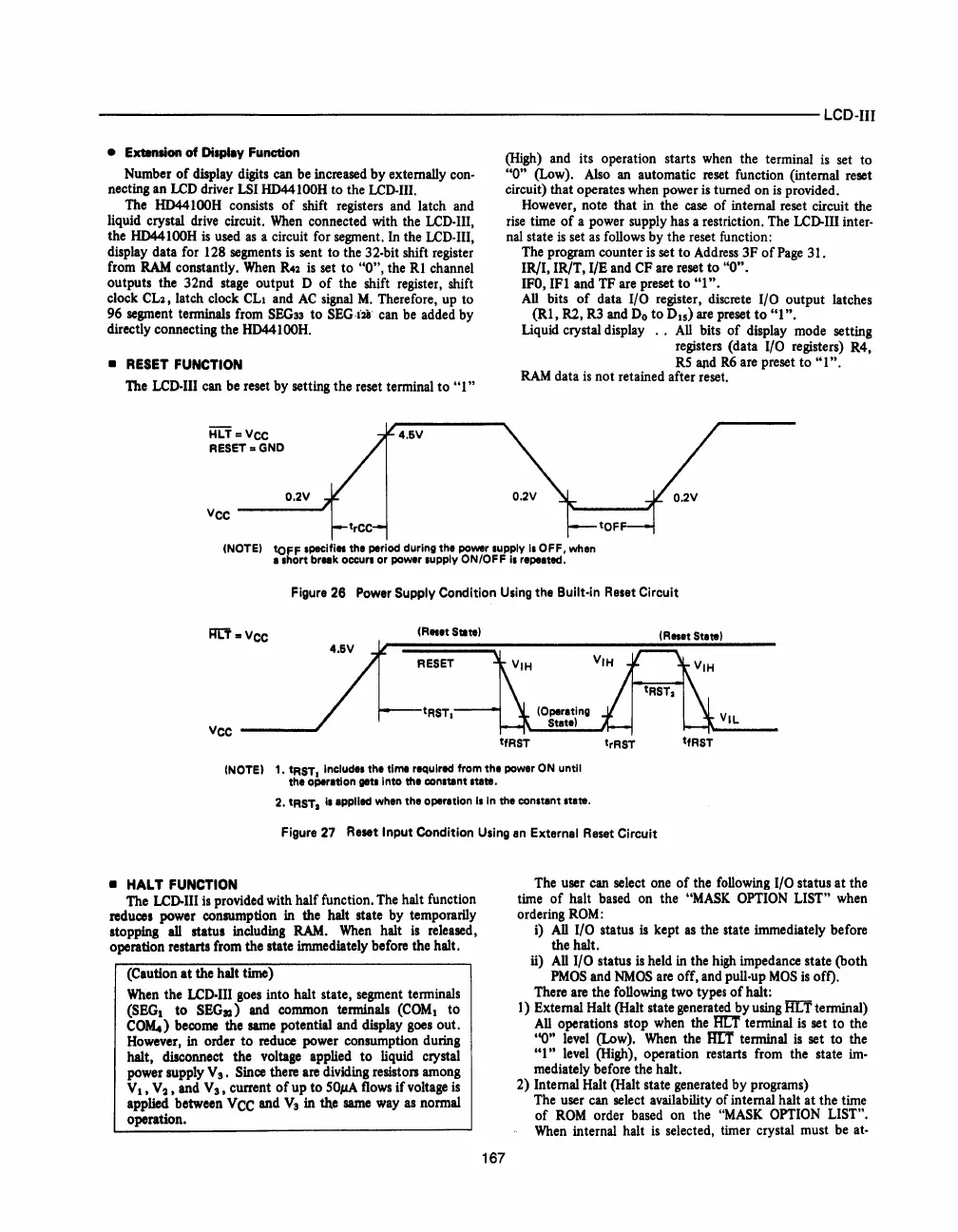
• RESET FUNCTION
The LCD·III can be reset by setting the reset terminal
to
"1"
HLT
=
vee
RESET ..
GND
Vee
4.6V
O.2V
(High) and its operation starts when the terminal
is
set to
"0"
(Low).
Also
an automatic reset function (internal reset
circuit) that operates when power
is
turned on
is
provided.
However, note that in the
case
of
internal reset circuit the
rise
time
of
a power supply has a restriction. The LCD-III inter-
nal state
is
set
as
follows by the reset function:
The program counter
is
set to Address
3F
of
Page
31.
IR/I, IR/T, I/E and CF are reset
to
"0".
IFO,
IFI
and TF are preset
to
"1".
All
bits
of
data I/O register, discrete I/O output latches
(Rl,
R2, R3 and
Do
to
DIS)
are preset
to
"1".
Liquid crystal display
..
All
bits
of
display mode setting
registers (data
I/O registers) R4,
RS
and
R6
are preset
to
"1".
RAM
data
is
not retained after reset.
(NOTE)
tOFF lpeelfl
..
the period during the power lupply
II
OFF. when
• Ihort
bruk
occurl or power lupply ON/OFF il r.pelted.
Figure 26 Power Supply Condition Using the Built-in
Reset
Circuit
m::T
..
Vee
Vee
----"
tfRST
trRST
tfRST
(NOTE)
1. tRST. Includ
..
the time required from the pow.r
ON
until
the
operltlon
getllnto
the
conltlnt
nltt.
2. tRST
2
II
.pplled
wh.n
the operltlon
II
In
the
conlt.nt
It.tt.
Figure
27
Reset
Input Condition Using
an
External
Reset
Circuit
•
HALT
FUNCTION
The LCD-III
is
provided with half function. The halt function
reduces power consumption in the halt state by temporarily
stopping
all status including
RAM.
When
halt
is
released,
operation restarts from the state immediately before the halt.
(Caution
at
the halt time)
When
the LCD·III goes into halt state, segment terminals
(SEG
1
to
SEG
32
) and common terminals
(COM
I
to
COM.) become the
same
potential and display goes out.
However, in order
to
reduce power consumption during
halt, disconnect the voltage applied
to
liquid crystal
power supply V 3.
Since there are dividing resistors among
V
I,
V 2 , and Va, current
of
up
to
SOItA
flows
if
voltage
is
applied between
VCC
and
Va
in the
same
way
as
normal
operation.
167
The user can select one
of
the following I/O status at the
time
of
halt based on the
"MASK
OPTION LIST" when
ordering
ROM:
i)
All
I/O status
is
kept
as
the state immediately before
the halt.
ii)
All
I/O status
is
held in the high impedance state (both
PMOS
and
NMOS
are off, and pull.up
MOS
is
off).
There are the following two types
of
halt:
1) External Halt (Halt state generated by using
HIT terminal)
All
operations stop when the
m:T
terminal
is
set to the
''0'' level (Low).
When
the
HI:T
terminal
is
set
to
the
"1"
level (High), operation restarts from the state im·
mediately before the halt.
2) Internal Halt (Halt state generated by programs)
The user can select aVailability
of
internal halt at the time
of
ROM
order based on the
"MASK
OPTION LIST".
When
internal halt
is
selected, timer crystal must be at-


 To Next Page
 Loading...