Need help?
Do you have a question about the Hitachi DS 14DBSL and is the answer not in the manual?
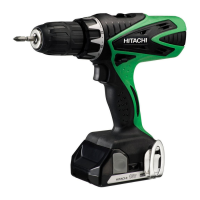
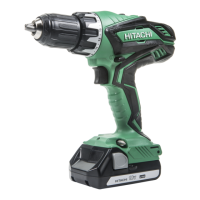
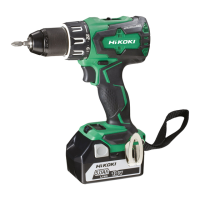
This document describes the Hitachi DS14DBSL/DS18DBSL Cordless Driver Drill and DV18DBSL Cordless Combi Drill. These tools are designed for driving and removing machine screws, wood screws, and tapping screws, as well as drilling into various metals and woods. The DV18DBSL model also supports impact drilling into brick and concrete blocks.
The device operates on a DC current with a rated voltage of 14.4V – 18V. For the DS14DBSL model, the no-load speed ranges from 0-350 min⁻¹ (low speed) to 0-1500 min⁻¹ (high speed). For the DS18DBSL model, the no-load speed ranges from 0-400 min⁻¹ (low speed) to 0-1800 min⁻¹ (high speed). For the DV18DBSL model, the no-load speed ranges from 0-400 min⁻¹ (low speed) to 0-1800 min⁻¹ (high speed). The impact rate for the DV18DBSL is 0-6000 Bpm (low speed) and 0-27000 Bpm (high speed). The drill chuck capacity for all models is 1.5 mm to 13 mm. The weight of the DS14DBSL/DS18DBSL with a BSL1430C/BSL1830C battery attached is 1.6 kg. The DV18DBSL with a BSL1830C battery attached is 1.7 kg. Measured A-weighted sound power levels are 83 dB (A) for DS14DBSL, 87 dB (A) for DS18DBSL, and 100 dB (A) for DV18DBSL, with an uncertainty K of 3 dB (A). Measured A-weighted sound pressure levels are 72 dB (A) for DS14DBSL, 76 dB (A) for DS18DBSL, and 89 dB (A) for DV18DBSL, with an uncertainty K of 3 dB (A). Vibration emission values for drilling into metal are ah, D < 2.5 m/s² for DS14DBSL/DS18DBSL, with an uncertainty K of 1.5 m/s². For impact drilling into concrete (DV18DBSL), the vibration emission value is ah, ID = 7.5 m/s², with an uncertainty K of 1.5 m/s².
The tool is equipped with a rechargeable battery (1) that is inserted into the charger (2) for power. The charging process is indicated by a pilot lamp (4) that blinks red (1-second intervals) when connecting the charger to a receptacle, lights continuously in red during charging, and blinks red (1-second intervals) when fully charged. The pilot lamp also indicates overheating standby (blinks red at 1-second intervals) or charging impossible (flickers red at 0.1-second intervals). The tool features a clutch dial (6) for tightening torque adjustment (3), a shift knob (9) for changing rotational speed (6), and a trigger switch (3) for operation (12). The rotational direction can be reversed (11). A remaining battery indicator lamp (8) shows the battery's charge level: nearly empty (recharge soonest possible), half, or enough. The tool includes an LED light (9) for illumination. Bits are mounted into the keyless chuck (10) by tightening the sleeve (7). An auxiliary handle (if supplied) should be used for control. The tool is equipped with a temperature protection circuit to protect the motor. If the unit overheats, operation stops automatically, and the tool should be allowed to cool before resuming use. The motor may stop if overloaded or if its rotation is locked during use as a drill. Using the battery in cold conditions (below 0°C) may temporarily weaken tightening torque and reduce work amount.
Regular inspection of the tool (1) is recommended, including sharpening or replacing dull tools. All mounting screws (2) should be regularly inspected and tightened. The motor unit winding (3) should be protected from damage, oil, or water. The exterior of the tool (4) should be cleaned with a soft, dry cloth or a cloth moistened with soapy water. Chlorine solvents, gasoline, or paint thinner should not be used. The tool should be stored (5) in a place where the temperature is less than 40°C and out of reach of children. Lithium-ion batteries should be fully charged before storage. Prolonged storage with a low charge may lead to performance deterioration, but this can often be recovered by repeated charging and use (two to five times). If battery life remains extremely short, new batteries should be purchased. The device includes safeguard functions indicated by the LED light (Fig. 13, Table 3). These include overburden protection (LED blinks at 0.1-second intervals) and temperature protection (LED blinks at 0.5-second intervals). Corrective actions are provided for each. Troubleshooting information is available in a table, covering issues like the tool not running, sudden stops, bit attachment problems, switch operation, drilling performance, pilot lamp indications, and battery usage/charging time. For unresolved issues, contact an authorized service center.

 To Next Page
 General