
 Need help?
Do you have a question about the Hitachi HD44780 and is the answer not in the manual?
Pin for adjusting the display contrast level.
Register Select pin to differentiate between command and data.
Read/Write pin to select data read or write operation.
Enable signal to latch instructions or data into the module.
Configure the RS pin and load the data for writing.
Activate the Enable signal to latch the data.
Observe the minimum E pulse width (PWEH) requirement.
Deactivate the Enable signal after the pulse.
Wait for the minimum E cycle time (tcyce) before next operation.
Mapping of LCD control and data pins to AVR microcontroller pins.
Mapping of remaining LCD pins to AVR microcontroller pins.
Step 1: Clears the entire display content.
Step 2: Configures interface, lines, and character font.
Step 3: Sets display, cursor, and blinking states.
Step 4: Defines cursor movement and display shift.
Initial steps after power-on, including wait times.
First function set command, assuming 8-bit interface.
Second function set command, switching to 4-bit interface.
Command to clear the display content.
Command to set entry mode parameters.
Initial steps after power-on, including wait times.
First function set command, configuring for 8-bit interface.
Command to clear the display content.
Command to set entry mode parameters.
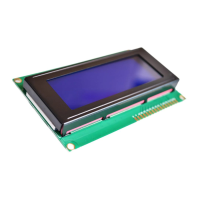
This document describes an LCD module, specifically one compatible with the Hitachi HD44780 controller, designed for displaying text and simple graphics. It offers a straightforward interface for integration into various electronic projects and systems.
The module's primary function is to provide a visual output for microcontrollers and other digital systems. It features a 5x8 character dot matrix display, capable of showing standard alphanumeric characters and some custom symbols. The internal memory includes an 80x8-bit display RAM (DDRAM) for storing the characters currently visible on the screen and a 64x8-bit character generator RAM (CGRAM) which allows users to define up to eight custom characters. This flexibility enables the display of specialized symbols or small graphical elements not available in the standard character set. The module supports both 4-bit and 8-bit interface modes, offering flexibility in terms of the number of microcontroller pins required for communication.
For usage, the module requires a 5V power supply (VDD) and a ground connection (Vss). A contrast adjustment pin (Vo) allows users to fine-tune the display's visibility, which is crucial for optimal viewing under different lighting conditions and viewing angles. The interface includes several control pins: Register Select (RS), Read/Write (R/W), and Enable (E). The RS pin determines whether the data bus is used for commands (RS=0) or data (RS=1). The R/W pin controls the direction of data flow, allowing the microcontroller to either write data/commands to the LCD (R/W=0) or read status/data from it (R/W=1). The E pin is used to latch data or commands into the LCD module. Data is transferred via an 8-bit data bus (DB0-DB7), which can be configured for 4-bit operation to save microcontroller pins.
The quick guide for a standard write operation involves setting the RS pin and the data on the data bus, then setting the E pin high, waiting for a specified duration (PWEH), clearing the E pin low, and finally waiting for the instruction cycle to complete (tcycE). This sequence ensures proper data transfer and command execution.
The module's instruction set is comprehensive, allowing for various operations. Users can designate functions such as display format (e.g., 1-line or 2-line display, 5x8 or 5x10 dot character font) and data length (4-bit or 8-bit interface). It also supports setting internal RAM addresses for both DDRAM and CGRAM, facilitating precise control over character placement and custom character definition. Data transfer instructions allow writing characters to the display and reading data from its memory. Miscellaneous functions include clearing the display, returning the cursor to the home position, setting the entry mode (cursor increment/decrement, display shift), controlling the display (on/off, cursor on/off, blinking), and shifting the cursor or display content.
The initialization procedure is critical for proper operation and differs slightly between 4-bit and 8-bit interface modes. It involves a sequence of commands sent to the module after power-on, with specific time delays to ensure the internal circuitry stabilizes. For both modes, the process typically starts with a power-on delay, followed by a series of "Function Set" commands to configure the interface data length, number of display lines, and character font. After these initial configurations, the display is turned off, cleared, and the entry mode is set. The internal reset procedure outlines a standard sequence: display clear, function set (8-bit interface, 1-line display, 5x8 dot font), display on/off control (all off), and entry mode set (increment by 1, no shift).
Maintenance features are minimal for this type of module, as it is a sealed electronic component. The primary "maintenance" involves ensuring proper electrical connections and power supply. The contrast adjustment (Vo) is a user-accessible feature that allows for visual optimization, which can be considered a form of ongoing adjustment rather than traditional maintenance. The module's robust design, without moving parts, contributes to its reliability and low maintenance requirements. The ability to read the busy flag (BF) and address counter contents allows the microcontroller to monitor the module's internal operations, which is useful for debugging and ensuring that instructions are not sent while the module is still processing a previous command. This helps prevent errors and ensures smooth operation.
 General
| Type | LCD controller |
|---|---|
| Interface | Parallel |
| Data Bus Width | 4-bit or 8-bit |
| Operating Voltage | 4.5V to 5.5V |
| Package | DIP, SOP |
| Display Lines | 1 or 2 |
| Character Size | 5x8 dots or 5x10 dots |
| Temperature Range | 0°C to +50°C (Standard) / -20°C to +70°C (Extended) |
| Character Font | 5x8 dots |
| Character Code | ASCII |
| Display Modes | Display ON/OFF, Cursor ON/OFF |
| Instruction Set | Standard HD44780 instruction set |
| Display Format | Character display |




 To Next Page