HITACHI
SR-2004
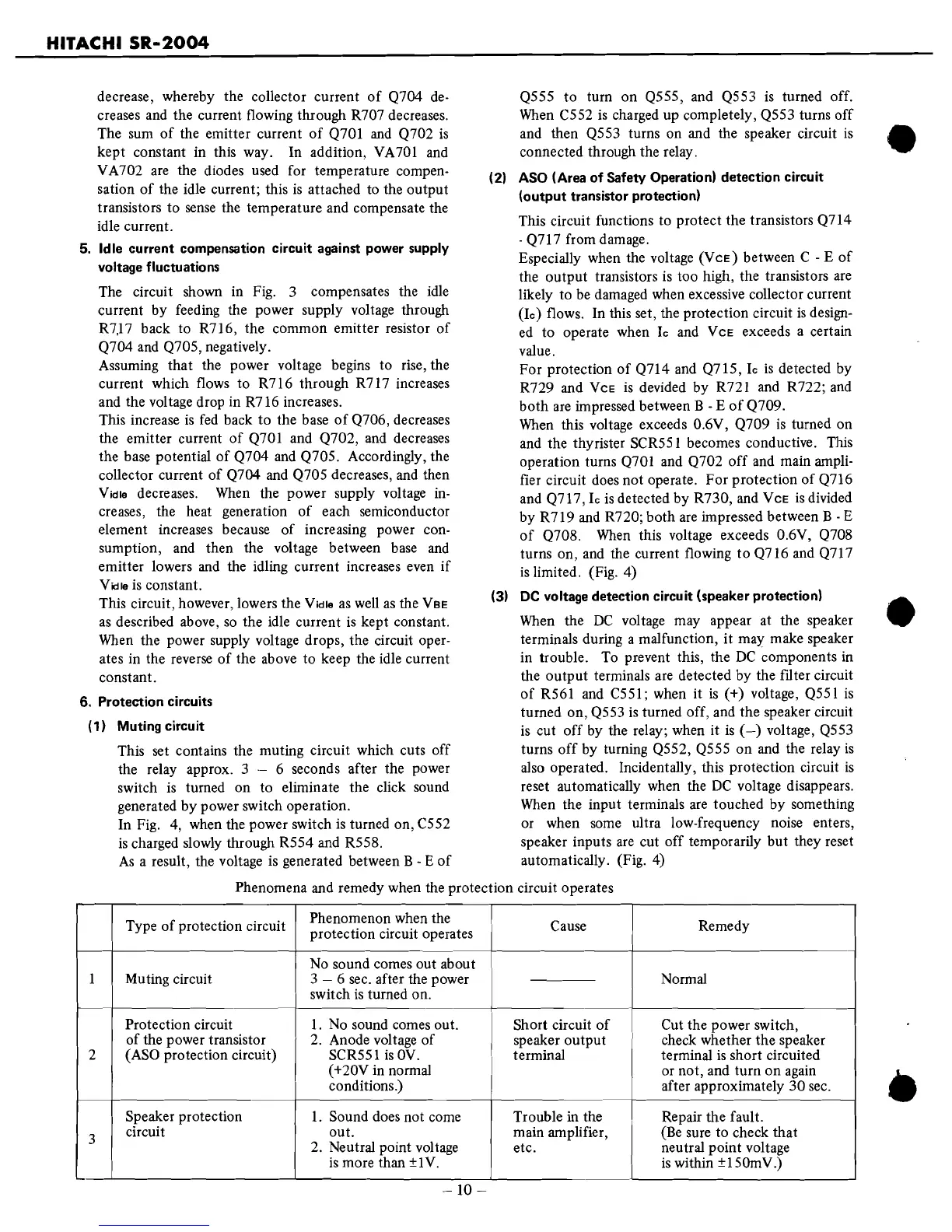
decrease, whereby the collector current
of
Q704
de-
creases and the current flowing through R707 decreases.
The sum
of
the emitter current
of
Q701
and
Q702
is
kept constant in this way. In addition,
VA
701
and
VA702 are the diodes used for temperature compen-
sation
of
the idle current; this
is
attached to the output
transistors to
sense
the temperature and compensate the
idle current.
5. Idle current compensation circuit against power supply
voltage fluctuations
The circuit shown in Fig. 3 compensates the idle
current by feeding the power supply voltage through
R7,17
back to R716, the common emitter resistor
of
Q704 and Q705, negatively.
Assuming that the power voltage begins to rise, the
current which flows to R716 through R717 increases
and the voltage drop in R716 increases.
This increase
is
fed
back to the base
of
Q706, decreases
the emitter current
of
Q701 and Q702, and decreases
the base potential
of
Q704 and Q705. Accordingly, the
collector current
of
Q704 and Q705 decreases, and then
Vidle
decreases.
When
the power supply voltage
in-
creases, the heat generation
of
each semiconductor
element increases because
of
increasing power con-
sumption, and then the voltage between base and
emitter lowers
and
the idling current increases even
if
Vidle
is
constant.
This circuit, however, lowers the
Vidle
as
well
as
the
VeE
as
described above,
so
the idle current
is
kept constant.
When
the power supply voltage drops, the circuit oper-
ates in the reverse
of
the above to keep the idle current
constant.
6.
Protection circuits
(1)
Muting circuit
This set contains the muting circuit which cuts off
the relay approx. 3 - 6 seconds after the power
switch
is
turned on to eliminate the click sound
generated by power switch operation.
In Fig.
4,
when the power switch
is
turned on, C552
is
charged slowly through R554 and R558.
As
a result, the voltage
is
generated between B - E
of
Q555 to turn on Q555, and Q553
is
turned off.
When
C552
is
charged up completely, Q553 turns off
and then Q553 turns on and the speaker circuit
is
connected through the relay.
(2) ASO (Area
of
Safety Operation) detection circuit
(output transistor protection)
This circuit functions to protect the transistors Q714
- Q717 from damage.
Especially when the voltage (V
CE)
between C - E
of
the output transistors
is
too high, the transistors are
likely to
be
damaged when excessive collector current
(Ie) flows. In this set, the protection circuit
is
design-
ed
to operate when
Ie
and V
CE
exceeds a certain
value.
For protection
of
Q714 and Q715,
Ie
is
detected by
R729 and
VCE
is
devided by R721 and R722; and
both
are
impressed between B - E
of
Q709.
When
this voltage exceeds 0.6V, Q709
is
turned on
and the thyrister SCR551 becomes conductive. This
operation turns
Q701
and Q702 off and main ampli-
fier circuit does not operate. For protection
of
Q716
and Q717,
Ie
is
detected by R730, and V
CE
is
divided
by R719 and R720;
both
are impressed between B - E
of
Q708.
When
this voltage exceeds 0.6V, Q708
turns on, and the current flowing
to
Q716 and Q717
is
limited. (Fig. 4)
(3)
DC
voltage detection circuit (speaker protection)
When the
DC
voltage may appear at the speaker
terminals during a malfunction,
it
may make speaker
in trouble. To prevent this, the
DC
components in
the output terminals are detected by the filter circuit
of
R561 and C551; when it
is
(+) voltage, Q551
is
turned on, Q553
is
turned off, and the speaker circuit
is
cut off by the relay; when it
is
(-)
voltage, Q553
turns
off
by turning Q552, Q555 on and the relay
is
also operated. Incidentally, this protection circuit
is
reset automatically when the
DC
voltage disappears.
When the input terminals are touched by something
or when some ultra low-frequency noise enters,
speaker inputs
are
cut off temporarily but they reset
automatically. (Fig. 4)
e
•
Phenomena and remedy when the protection circuit operates
Type
of
protection circuit
Phenomenon when the
Cause
Remedy
protection circuit operates
No sound comes out about
1 Muting circuit 3 - 6 sec. after the power Normal
switch
is
turned on.
Protection circuit
1.
No sound comes out. Short circuit
of
Cut the power switch,
of
the power transistor
2. Anode voltage
of
speaker output check whether the speaker
2 (ASO protection circuit) SCR551
is
OV.
terminal terminal
is
short circuited
(+20V in normal
or not, and turn on again
conditions.) after approximately
30
sec.
Speaker protection
1.
Sound does not come Trouble
in
the Repair the fault.
3
circuit
out.
main amplifier,
(Be
sure to check that
2. Neutral point voltage
etc. neutral point voltage
is
more than
±lV.
is
within ±150mV.)
-10-
•


 To Next Page
 Loading...