4
GENERAL
This manual reviews general rules which must be re-
spected during the installation and maintenance of air
conditioning systems.
Before starting the system installation read this
whole manual. Also please refer to the technical
manual and to the model being installed for more
details about its characteristics and accessories.
SAFETY PRECAUTIONS
Installation and maintenance of air conditioning equip-
ment can be dangerous because the system is under
pressure and includes electrical components.
Only qualified and trained service technicians
should be permitted to proceed with the instal-
lation, start up and provide maintenance and
service for this equipment.
Untrained personnel can perform only basic operations
such as cleaning of air filters.
All other operations have to be made by qualified and
technically trained personnel.
During every visit follow recommendations contained
in this manual, on stickers on the unit, and take gen-
eral safety precautions.
Strictly follows all safety codes. Use safety glasses and
work gloves.
Use a quenching cloth for brazing and unbrazing op-
erations.
WARNING:
- Before starting service or maintenance, turn off the
main power switch to avoid electrical shock and in-
jury.
- When repairing the unit, use original spare parts and
install them in the same place as the old parts.
- During the system operation, some elements of refrig-
eration cycle can reach temperatures above 70°C and
for this reason only qualified and trained technicians
should have access to the units components.
- Never install the units in explosive atmosphere.
EQUIPMENT RECEPTION
1. Inspect the packing. Inspect the unit. If it is dam-
aged, or if the shipment is incomplete, immediately
file a claim with the shipping company.
2. Check that the local power supply agrees with the
specification on the unit nameplate.
INSTALLATION LOCATION
Check the following points:
1. The construction must be able to support the unit
operating weight.
2. Allow sufficient space for servicing and air flow ac-
cess around the outdoor units.
3. Select a location free of dust or foreign matter which
may cause coils clogging.
4. When the outdoor unit is installed on the ground,
be sure to choose a location which cannot be flooded. It
is important to ensure at all time water evacuation
out of the unit (rain water, condensation water and
water from coil defrost in the case of heat pump sys-
tem).
5. Consult and respect all regulations concerning in-
stallation of air conditioning equipment.
6. Vibration isolators pads should be provided to pre-
vent noise transmission.
UNIT SUPPORT
Due to the size and the weight of air conditioning units
their base frame requires a support which should meet
the following conditions:
1. Support surface has to be large enough to distribute
unit weight on the building construction.
2. When the unit base has fixation holes they should
be used to keep it firmly fastened to the support.
3. The structure should support the units operational
weight.
CONDENSATE AND RAIN
WATER EVACUATION
CONDENSING UNITS: Units with centrifugal fans,
heat pump models, have a drain tube connection to
remove condensate and defrost water.
INDOOR UNITS: They have a drain pan to collect con-
densation water with drain tube connection.
DRAIN TUBE:
1. Use only galvanized steel, copper or plastic tube. Do
not use garden hose.
2. It is necessary to provide a flexible connection in
the drain piping to eliminate possible vibrations.
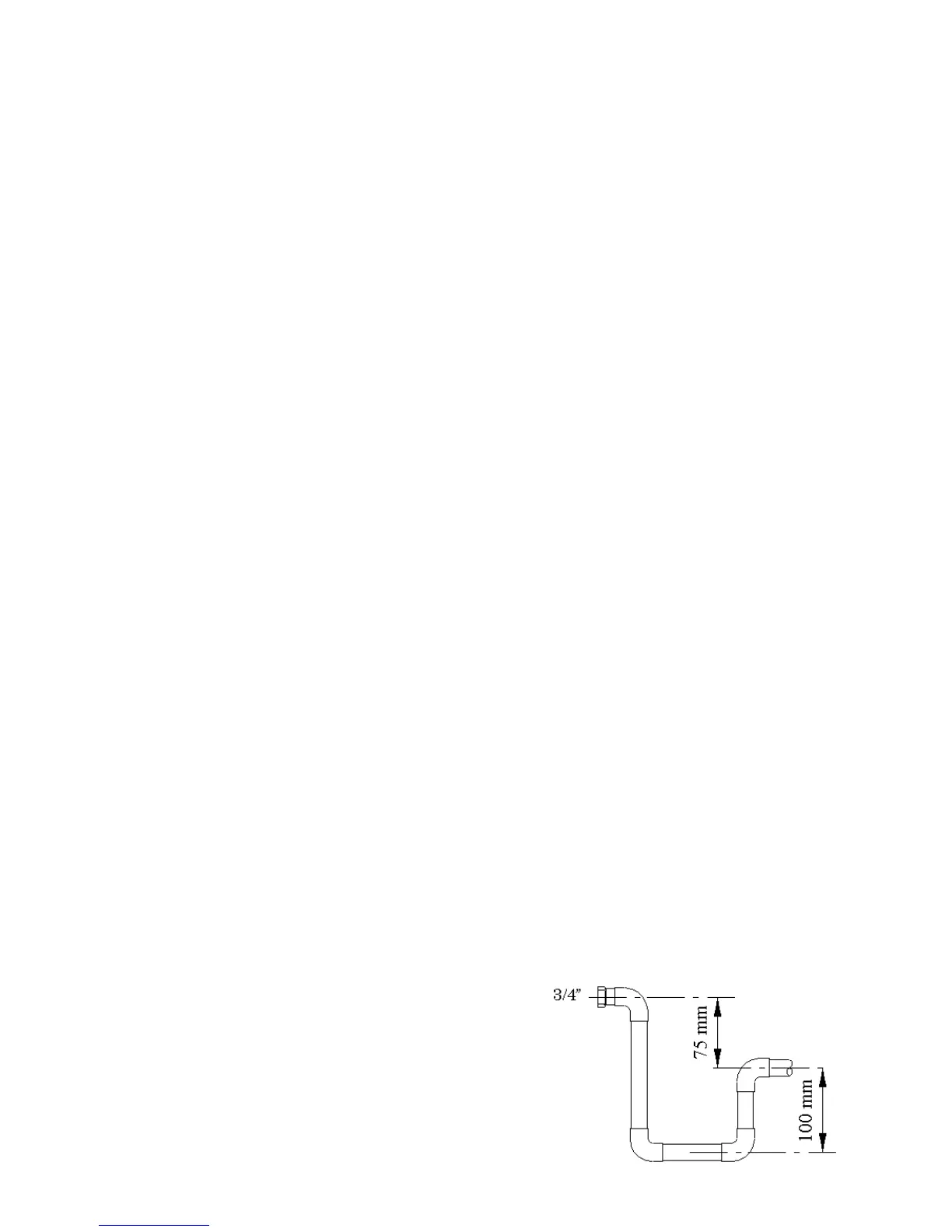
Fig. 1 - Exemple of
the trap to be
made by the ins-
taller.



 To Next Page