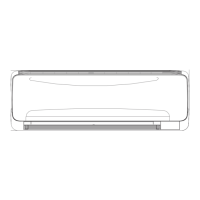
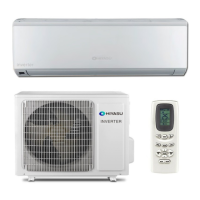
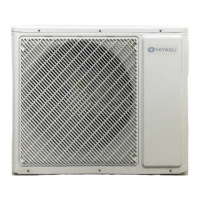
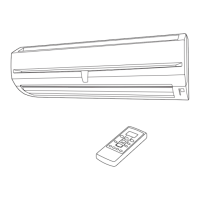
This document serves as a comprehensive manual for the Hiyasu Split Air Conditioner, covering operation, maintenance, and installation across multiple languages including Spanish, English, French, Portuguese, and Italian. The models covered are HS-18UIEK, HOS-18UIEK, HS-24UIEK, and HOS-24UIEK.
Function Description
The Hiyasu Split Air Conditioner offers both cooling and heating functionalities, designed to maintain a comfortable indoor environment.
Cooling Operation:
The air conditioner absorbs heat from the room and transfers it to the outdoor unit, thereby decreasing the ambient temperature. The cooling capacity is influenced by the outdoor ambient temperature. A key safety feature is "Freeze Protection," which stops the compressor if the indoor heat exchanger temperature drops below 0°C (32°F) to prevent frost formation, especially when operating in COOL mode at low ambient temperatures.
Heating Operation:
Conversely, for heating, the unit absorbs heat from the outdoors and transfers it to the indoor unit, increasing the room temperature. Heating capacity may decrease in very low outdoor ambient temperatures. The system also incorporates a "Defrosting" function. When outdoor temperatures are low and humidity is high, frost can build up on the outdoor unit, impairing heating efficiency. During auto defrosting, the air conditioner pauses operation, and both indoor and outdoor fans stop. The indoor indicator light flashes, and the outdoor unit may emit vapor, which is a normal part of the process. Once defrosting is complete, heating operation resumes automatically.
Anti-cold Air Function:
In HEAT mode, the indoor fan is designed not to operate for the first 2 minutes if the heat exchanger has not reached a certain temperature. This prevents cold air from being blown out immediately when heating starts, after auto defrosting, or during low-temperature heating.
Rest Heat Blow:
To dissipate residual heat from the indoor unit, the indoor fan may continue to run for a short period after the compressor stops. In HEAT mode, if the temperature reaches the set value, the compressor stops, but the indoor fan runs for another 60 seconds. If the unit is turned off in HEAT mode, the compressor stops, and the indoor fan runs for an additional 10 seconds.
Important Technical Specifications
Operating Temperature Range:
The operational temperature range (outdoor temperature) for cooling-only units is 18°C to 43°C (64°F to 109°F). For cooling and heating units, the range is -7°C to 43°C (19°F to 109°F).
- Maximum Cooling:
- Indoor DB/WB: 32°C/23°C (90°F/73°F)
- Outdoor DB/WB: 43°C/26°C (109°F/79°F)
- Maximum Heating:
- Indoor DB/WB: 27°C/-- (81°F/--)
- Outdoor DB/WB: 24°C/18°C (75°F/64°F)
Connection Pipe and Refrigerant Volume:
- Standard Length of Connection Pipe: 5m - 7.5m - 8m.
- Minimum Length of Connection Pipe: For units with a standard connection pipe of 5m, there is no minimum length limitation. For units with standard connection pipes of 7.5m and 8m, the minimum length is 3m.
- Maximum Length of Connection Pipe: Varies by capacity. For example, 5000 Btu/h (1465W) to 9000 Btu/h (2637W) units have a maximum length of 15m. Larger units like 18000 Btu/h (5274W) to 48000 Btu/h (14064W) can have a maximum length of 25m or 30m.
Additional Refrigerant Charging Amount (R22, R407C, R410A, R134a):
When the connection pipe length exceeds the standard length by 10m, 5ml of additional refrigerant oil should be added for every 5m of additional connection pipe. The additional refrigerant charging amount per meter varies based on the liquid pipe diameter. For example:
- Ø 6mm liquid pipe: 20 g/m (cooling only), 15 g/m (cooling & heating).
- Ø 12mm liquid pipe: 100 g/m (cooling only), 30 g/m (cooling & heating).
- Ø 19mm liquid pipe: 250 g/m (cooling only), 250 g/m (cooling & heating).
Electrical Specifications:
- The air conditioner is a Type I electric appliance and requires reliable earthing.
- The yellow-green wire is the earthing wire and should not be used for other purposes.
- Earth resistance must comply with national criteria.
- A dedicated power supply circuit and an all-pole disconnection switch with at least 3mm contact separation are required.
- Air switch capacity for 18-24K units is 25A.
Usage Features
Remote Control Operation:
The device is primarily controlled via a wireless remote.
- ON/OFF Button: Powers the unit on or off. Turning off cancels Timer and Sleep functions, but retains presetting time.
- MODE Button: Cycles through Auto, Cool, Dry, Fan, and Heat modes. Default is Auto. Temperature is not displayed in Auto mode. Initial temperature for Heat mode is 28°C (82°F), and 25°C (77°F) for other modes.
- FAN Button: Selects fan speed: Auto, Low, Middle, High. Default is Auto. In DRY mode, only Low fan speed is available.
- + / - Buttons: Adjusts the preset temperature. Continuous press for 2 seconds changes values rapidly. Temperature range is 16°C to 30°C (61°F to 86°F).
- SLEEP Button: Activates/deactivates Sleep mode. Default is off. Not available in Fan or Auto modes.
- TIMER ON/OFF Buttons: Sets scheduled on/off times.
- LIGHT Button: Toggles the display light on/off. Default is on.
- X-FAN Button: In COOL or DRY mode, this function runs the indoor fan for 10 minutes after shutdown to dry the indoor unit and prevent mold. Default is off. Not available in AUTO, FAN, or HEAT modes.
- TURBO Button: In Cool or Heat mode, activates/deactivates Turbo function for rapid cooling/heating at super-high fan speed.
- SWING UP AND DOWN Button: Adjusts the airflow direction. Pressing for 2 seconds stops the louver at its current position.
- Lock Function: Pressing + and - simultaneously locks/unlocks the remote.
- Fahrenheit/Centigrade Switch: Press MODE and - simultaneously when the unit is off to switch between °C and °F.
- New Defrost Function: If activated (MODE + X-FAN when off), the unit will complete defrosting even if turned off.
Emergency Operation:
If the remote control is lost or damaged, a manual switch on the main unit can be used. This sets the unit to AUTO mode, where temperature and fan speed cannot be adjusted. The microprocessor automatically selects COOL, HEAT, or FAN based on room temperature for comfort.
Energy Saving Tips:
- Avoid overcooling or overheating; moderate temperature settings save energy.
- Use blinds or curtains to block direct sunlight and outdoor air, aiding cooling and heating efficiency.
- Clean air filters every two weeks to prevent clogs, which reduce efficiency and waste energy.
Relative Humidity Tip:
Condensation may form at the air outlet during prolonged cooling or drying if relative humidity exceeds 80% (especially with open doors and windows).
Maintenance Features
General Maintenance:
- Always disconnect power before cleaning or maintenance.
- Do not splash water on the units to avoid electric shock.
- Clean units with a dry, soft cloth or a cloth slightly moistened with water or mild detergent (avoid volatile liquids like thinner or gasoline).
Front Panel Cleaning:
Remove the front panel, wipe it with a cloth dipped in water below 45°C (113°F), and dry it. Do not immerse the panel in water due to electronic components.
Air Filter Cleaning (Every 3 Months):
- Lift the front panel.
- Pull the air filter downwards to remove it.
- Clean the filter with a vacuum cleaner to remove dust. If dirty, wash with warm water and mild detergent.
- Dry the filters in the shade.
- Reinstall the filters following the arrow direction and close the panel.
- Note: Never use water above 45°C (113°F) to clean the air filter, as it may cause deformation or discoloration. Do not touch the indoor unit's fin to avoid injury.
Healthy Filter Installation and Maintenance:
- Forcibly pull the front panel from both ends to remove it.
- Mount the healthy filter onto the air filter. If it cannot be installed there, mount it on the front case.
- Mount the air filter correctly following the arrow direction and close the panel cover.
- Note: Silver ion filters cannot be cleaned with water. Active carbon, photocatalyst, LTC catalyst, formaldehyde eliminator, catechin, or mite-killing filters can be cleaned with water but not with brushes or hard objects. Dry them in the shade.
- Service Life: Healthy filters typically last one year. Silver ion filters are ineffective when their surface turns black (green).
Pre-use Checks:
- Ensure air outlet and inlet are unobstructed.
- Check if remote control batteries are replaced.
- Inspect the outdoor unit's installation stand for damage; contact a technician if damaged.
Post-use Maintenance:
- Switch off power.
- Clean filters and unit bodies (indoor and outdoor).
- Remove obstructions from the outdoor unit.
- Repaint rusted areas on the outdoor unit to prevent further spread.
This comprehensive overview provides essential information for the safe and efficient use of the Hiyasu Split Air Conditioner.

 Need help?
 General

 To Next Page