Need help?
Do you have a question about the HM Digital DM-1 and is the answer not in the manual?
Explains how to calculate the percent rejection rate of RO systems using a formula and example.
Details what is covered, not covered, and how to obtain warranty service for the product.
Covers implied warranties and specific exclusions for third-party products and accessories.
Measures TDS levels of two water lines to assess water filtration system performance.
Lists the parts included with the DM-1 TDS Monitor, such as the base unit and fittings.
Details technical specifications including TDS range, resolution, accuracy, and power source.
Explains the elements shown on the DM-1's screen display, including TDS level and indicator.
Provides step-by-step instructions for installing the DM-1 TDS monitor to a water system.
Guides users on how to use the DM-1, including selecting water lines and interpreting readings.
Explains the process for calibrating the DM-1, including using calibration solutions and adjustments.
Provides essential care instructions for the DM-1, focusing on sensor maintenance and avoiding damage.
Details the procedure for replacing the batteries in the DM-1 TDS monitor.
Answers common questions regarding TDS readings, fluctuations, alarms, and water softeners.
Addresses potential issues like 'Err' display, incorrect readings, faded display, and reversed sensors.
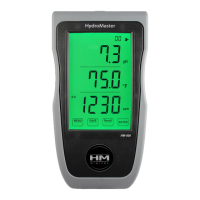
The HM Digital DUAL INLINE TDS MONITOR, model DM-1, is a device designed to measure the Total Dissolved Solids (TDS) levels of two different water lines simultaneously. This allows users to monitor the effectiveness of water filtration or purification systems, such as reverse osmosis (RO) systems, by comparing the TDS levels of incoming (tap) water and outgoing (filtered) water. The DM-1 is an ideal tool for determining if a filter cartridge, resin cartridge, or membrane is functioning effectively, providing continuous insight into system performance.
The DM-1 operates by measuring the total amount of inorganic elements, including minerals, salts, or metals dissolved in water. It expresses this quantity in parts per million (ppm) or mg/liter. The device is particularly useful for monitoring RO systems, which work by filtering tap water and rejecting waste water. By comparing the TDS levels of the "IN" line (typically connected to the source water) and the "OUT" line (typically connected to the product water), users can calculate the percent rejection rate of their system. A lower TDS level in drinking water is generally preferred, and the U.S. EPA's Secondary Regulations advise a maximum contamination level of 500 ppm for TDS.
The monitor features an LCD display that shows the TDS level. If the TDS level exceeds 999 ppm, an "x10" icon will appear, indicating that the displayed reading should be multiplied by 10 to get the actual TDS level. The DM-1 is factory calibrated to 342 ppm NaCl, a level suitable for most tap water and filtered water applications. However, it can be re-calibrated by the user as needed to ensure optimal accuracy.
To use the DM-1, the sensors are inserted into T-fittings, which are then integrated into the water lines. The "IN" line sensor is typically connected to the source water, and the "OUT" line sensor to the filtered water. The monitor unit itself can be attached to the water system using Velcro tape.
Once installed, the user can press the "POWER" button to turn on the device. A slide switch allows the user to select between displaying the TDS level of the "IN" line or the "OUT" line. For the most accurate reading, it is recommended to wait approximately 10 seconds after switching. The device has an auto shut-off feature that turns it off after 10 minutes of inactivity to conserve battery life.
Determining filter effectiveness involves comparing the IN and OUT water TDS readings. For an RO system, for example, a significant reduction in TDS from the IN to the OUT line indicates effective filtration. Users can calculate the percent rejection rate using the formula: ((Tap TDS - RO TDS) ÷ (Tap TDS)) x 100.
Calibration can be performed using a certified calibration solution (NaCl is recommended). The process involves disconnecting the T-fittings from their tubes, placing one T-fitting with the sensors into the calibration solution, and adjusting a screw on the rear of the unit until the displayed reading matches the solution's level. For still (not flowing) solutions, it's recommended to calibrate to 3% above the calibration solution level to account for the lack of flowing water.
The DM-1 requires minimal care. Users should avoid touching the sensor pins directly, as skin oils can adversely affect TDS measurements. If cleaning is necessary, the sensor pins can be cleaned with rubbing alcohol and allowed to air dry. It is also important to avoid frequently removing the fittings from the sensors, as this can strip the plastic off the sensor and potentially cause leaks. Excessive removal and insertion of fittings could ultimately scratch the sensor and lead to leakage.
If the display fades, the monitor does not power on, or the readings become incorrect, it may be time to change the batteries. The DM-1 uses two 1.5V batteries (model 357A). To replace them, the three metal screws on the rear of the unit are unscrewed, the back panel is removed, and the old batteries are replaced with new ones, ensuring correct polarity. After battery replacement, re-calibration is not necessary.
The DM-1 is not waterproof and should not be fully submerged in water. Any evidence of such damage will void the warranty. The product is warranted against material and workmanship for one year from the date of purchase, covering repair, parts, labor, or replacement at the company's option. Transportation charges for returning a defective product are not covered. The warranty does not cover damages from abuse, improper maintenance, tampering, wear and tear, water damage, or any other physical damage. Implied warranties are limited to five years from the date of purchase. Third-party products, such as batteries, fittings, and adhesives, are not covered under warranty.
 General
| Accuracy | +/- 2% |
|---|---|
| Measurement Range | 0-9990 ppm |
| Temperature Range | 0-80°C |
| Resolution | 1 ppm |
| ATC | Yes |
| Power Source | 2 x 1.5V button cell batteries |
| Battery life | Approximately 1000 hours of use |
| Weight | 79.4 g (2.8 oz) |


 To Next Page