7
Tel: +49 (0) 22 25 - 94 15 0 · Fax: +49 (0) 22 25 - 94 64 94 · info@dohse-aquaristik.de
5.2.2 Press the up arrow - or down arrow - key until the display shows (LS).
5.2.3 Press the menu - key again to confirm.
5.2.4 Use the
arrow keys
to set the desired lower temperature limit. The setting range is 20 – 50° C. Can be set in 0.1° C steps.
5.2.5 Press the menu - key again to complete the process.
For example: If you have defined an upper temperature limit of 28.2° C and a lower limit of 27.4° C, you will only be able to set the
temperature – as described in item 2 – within this range.
6. Resetting the day counter:
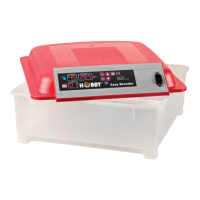
6.1 The Easy Breeder has an integrated day counter (called
“Day”
in the display). This means you can always see how long the eggs have been in the
incubator. To reset the day counter, press and hold the
Reset - key a few seconds. This will cause the counter to jump back to “O”.
7. Useful hints / Correct handling of the eggs / incubation table
7.1 Useful hints:
· Operate the Easy Breeder in a room with a constant temperature, because external temperature fluctuations can affect the incubator. It should be set
up away from heat sources and direct sunlight. Make sure it rests on a horizontal base and is free from vibrations or shock and is free-standing without
obstructions to the air flow.
· It may take several hours until the temperature stabilises at the desired level, depending on room and set temperature, sensor position and the number
of bowls with incubation material. We recommend you operate the incubator for one day without hatching eggs so that the incubation material can fully
absorb the heat.
· After this day of operation for the bowls with incubation material, add the eggs. Opening the Easy Breeder and the number as well as the intrinsic
temperature of the hatching eggs can cause a temperature drop, a gradual increase and temperature fluctuations. Please do not change the
programming during this period!
· During the incubation period, minor temperature and humidity fluctuations may also occur. This is caused by the room temperature, the number of
incubation bowls and eggs, the incubation material and the relative humidity in the room. This has no harmful effect on the incubation process. Constant
temperatures do not occur in natural environments either.
· In principle, the Easy Breeder should only be opened when needed (to inspect the eggs or replenish liquid) to ensure a constant climate.
Expert hint: Even when incubating only one clutch of eggs the incubator should be equipped with cricket boxes or other containers and filled with
moist substrate such as vermiculite , soil or similar material. This significantly increases the heat capacity of the entire system keeps temperature
fluctuations low. The incubator will also maintain its temperature much longer in the event of a power failure.
7.2 Correct handling of the eggs:
· Incubating the eggs in the Easy Breeder has the purpose of achieving as high a hatching rate as possible under controlled and optimum conditions and
protecting the eggs against external influences.
· Only collect the eggs once the female has completely finished depositing the eggs. This will ensure that the female is not subjected to stress, which may
cause a fatal retention of eggs.
· After egg deposition, remove the eggs from the terrarium. It is essential that the eggs are placed into the incubation substrate (e.g.: Vermiculit item no.:
36320 and 36325) in the same position as before their removal to prevent the poles of the eggs from shifting (reptile eggs do not have any retaining
chords („chalazas“) like birds have). This could cause the foetus to die.
· If you wish to mark the eggs, wait until they have fully hardened to avoid damaging the egg membrane. All eggs should always be handled with care.
· The moisture of the incubation substrate plays a key role in the development of the reptile eggs. Here the rule applies that soft-shelled eggs have a
higher moisture requirement than hard-shelled ones. Too little substrate moisture would extract moisture from the eggs and this loss of moisture would
be fatal for the developing animal.
· We can recommend vermiculite (e.g.: Vermiculit item no.: 36320 and 36325) as a good incubation substrate. With this substrate it is possible to regulate
the substrate moisture by means of adding water and the grain size. fine grained vermiculite (e.g.: Vermiculit 0 – 4 mm item no.: 36320) is recommended
for small and soft-shelled eggs. Coarser vermiculite (e.g.: Vermiculit 3 – 6 mm item no.: 36325) is recommended for large and hard-shelled eggs.
· Regularly check the moisture of the incubation substrate. When required, dose the water directly into the incubation substrate and not above the eggs.
· The time of hatching can differ greatly, even within the same clutch of eggs. Primarily this is caused by differences in temperature and humidity.
7.3 Incubation table: The table below contains the guidance values for a number of reptile species based on experience.
These do not guarantee successful breeding!
Incubation temperature in °C Duration of incubation:
Common agama Agama Agama 30 approx. 60 – 70 days
Green ameiva Ameiva Ameiva 30 approx. 130 days
Red-throated anole Anolis carolinensis 27 – 30 approx. 40 – 60 days
Knight anole Anolis equestris 27 – 30 approx. 70 – 100 days
Bahaman anole Anolis sagrei 27 – 30 approx. 40 – 60 days
Plumed basilisk Basiliscus plumifrons 30 approx. 55 – 65 days
Striped basilisk Basiliscus vittatus 30 approx. 50 – 70 days
Fischer's chameleon Kinyongia fisheri increasing from 17, 22 and 25 approx. 300 days
Kilimanjaro two-horned chameleon Kinyongia tavetanum day 22 – 23, night 18 approx.140 days


 To Next Page
 Loading...