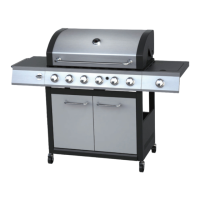
Even when your barbecue is covered for its protection, it must be inspected on a regular basis, as damp or
condensation can form, which may result in damage to the barbecue. It may be necessary to dry the barbecue and
the inside of the cover. It is possible for mould to grow on any fat remaining on parts of the barbecue. This should be
cleaned off smooth surfaces with hot soapy water.
Any rust that is found that does not come into contact with the food should be treated with a rust inhibitor and
painted with barbecue paint or a heat-resistant paint. A chrome cleaner may be used on chrome parts if required. To
prevent rusting, wipe chrome-plated parts with cooking oil after rinsing and drying.
Cooking Surfaces and Warming Rack
When the barbecue has cooled, clean with hot soapy water. To remove any food residue, use a mild cream cleaner on
a non-abrasive pad. Do not use scouring pads or powders, as they can permanently damage the finish. Rinse well and
dry thoroughly. Due to the weight of the cooking surfaces, we do not recommend cleaning in a dishwasher.
It is quite normal for surface rust to be present on the cooking surface. If rust appears between uses or in storage,
clean with a soft bristle brush. Be careful not to damage the cooking surface, re-oil and cure.
Burner
Provided that they are operating correctly, in normal usage, burning off the residue after cooking will keep the burners
clean.
The burners should be removed and cleaned annually, or whenever heavy build up is found, to ensure that there are
no signs of blockage (debris, insects) in either the burner portholes or the primary air inlet of the burners. Use a pipe
cleaner to clear obstructions.
When refitting the burners, be careful to check that the neck of the burner fits over the valve outlet. It is quite normal
for surface rust to be present on the burners. If rust appears between uses or in storage, clean with a soft bristle
brush.
Flame Tamer
Remove any food residue from the flame tamer surface with a plastic or wooden scraper or nylon-bristled brush. Do
not use a steel scraper or wire brush. Clean with hot soapy water and rinse well.
Drip Tray
After every use, empty and clean the drip tray of any fat or food particles, using a plastic or wooden scraper if
necessary.
Failure to keep it clean means excessive build up can result in a fat fire. This can be hazardous and severely damage the
barbecue. This is not a fault in the barbecue and is therefore not covered by the terms of the warranty. If required, the
tray can be washed in hot soapy water.
Barbecue Body
Regularly remove excess grease or fat from the barbecue body using a cloth wrung out in hot soapy water and dry
thoroughly. Excess fat and food debris can be removed from inside the body using a soft plastic or wooden scraper.
It is not necessary to remove all the grease from the body. If you need to clean fully, use hot soapy water and a cloth,
or nylon-bristled brush only. Do not use abrasives. Remove cooking surfaces and burners before full cleaning. Do not
immerse the gas controls or manifold in water. Check burner operation after carefully refitting into the body.
7


 To Next Page
 Loading...