Need help?
Do you have a question about the Honda CT110 Series and is the answer not in the manual?
Do not patch damaged tires or inner tubes; wheel balance may be impaired.
Inspect motorcycle daily before riding for safety and to prevent damage.
Never use petrol or low flash point solvents for cleaning the air cleaner.
Handle hot engine oil with care to avoid burns during oil change.
Spark plugs must be tightened securely; use correct heat range to prevent engine damage.
Valve clearance adjustment must be performed when the engine is cold.
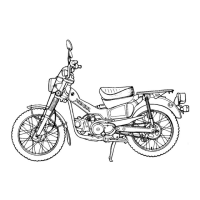
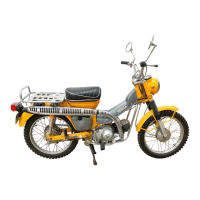
This document serves as an owner's manual for a Honda CT110 Series Motorcycle, specifically adapted for the "Hardknock Bobber" style. It emphasizes that while it provides guidance, the user is responsible for proper maintenance and safe operation. The manual covers essential aspects of the motorcycle's function, usage, and maintenance to ensure optimal performance and longevity.
The Honda CT110 Series Motorcycle is designed for general transportation, offering a balance of stability, comfort, and reliability. It features a robust engine and a drive chain system for power transmission. The motorcycle is equipped with standard controls for throttle, braking, and lighting, ensuring safe operation. Its design incorporates features for ease of starting, even in cold weather, and a system for managing engine oil and fuel. The electrical system includes an ignition switch, lights, and a battery, all crucial for the motorcycle's operation.
Before each ride, a pre-ride inspection is crucial to prevent serious damage or accidents. This inspection involves checking the engine oil level, fuel level, brake operation, tire condition and pressure, drive chain condition and slack, throttle smooth opening and closing, and the functionality of all lights and the engine stop switch. The battery electrolyte level also needs to be checked. Addressing any discrepancies before riding is paramount for safety.
Starting the motorcycle, especially a cold engine, requires specific steps: raising the choke lever to "Fully ON," opening the throttle slightly, and operating the kick starter with a rapid and continuous kick. It's important not to let the kick starter snap back freely to avoid engine case damage. The engine should then be warmed up until it runs smoothly with the choke lever "Fully OFF." For extremely cold weather, priming the engine by cranking it several times with the ignition switch OFF and choke lever "Fully ON" is recommended. If the engine is flooded, the engine stop switch should be turned off, the choke lever lowered to "Fully OFF," the throttle opened fully, and the engine cranked several times before attempting to start it normally.
During the initial 1,000 km (600 miles) of operation, known as the "running-in" period, it's advised not to operate the motorcycle at more than 80% of its maximum speed in any gear. Full throttle operation should be avoided, and the motorcycle should not be operated at a single speed for prolonged periods. This period is critical for newly machined surfaces to wear in properly, and timely running-in maintenance is designed to compensate for this initial wear, ensuring optimum service life and performance.
Regular maintenance is key to the motorcycle's performance and longevity. The manual provides a detailed maintenance schedule, indicating items to inspect, clean, adjust, lubricate, or replace at specific mileage or time intervals. Many of these tasks can be performed by a mechanically qualified owner with proper tools and service data, though some items, particularly those marked with asterisks, are recommended to be serviced by an authorized Honda dealer due to their technical complexity or safety implications.
Engine oil quality is a primary factor affecting engine service life. The engine oil level should be checked daily and maintained between the upper and lower marks on the dipstick. Running the engine with insufficient oil can cause serious engine damage. Oil changes should be performed with the engine at normal operating temperature to ensure complete draining. The manual specifies the recommended oil grade and quantity. Used engine oil should be disposed of responsibly, as it can cause skin cancer if repeatedly left in contact with the skin.
Tire pressure is crucial for stability, riding comfort, and tire life and should be checked frequently when the tires are cold. The manual provides recommended cold tire pressures and sizes. Tires should also be inspected for cuts, embedded nails, or other sharp objects. Damaged tires or inner tubes should be replaced by an authorized Honda dealer, as patching is not recommended and can impair tire reliability and wheel balance.
The air cleaner needs regular servicing, more frequently in dusty areas. This involves removing the air cleaner, washing it in a non-flammable or high flash point solvent, letting it dry, soaking it in gear oil, squeezing out the excess, and reinstalling it. Using petrol or low flash point solvents for cleaning the air cleaner is explicitly warned against due to fire or explosion risks.
Spark plug maintenance includes disconnecting the caps, cleaning around the base, removing the plug, inspecting electrodes and porcelain for deposits or erosion, and cleaning or replacing as needed. The spark plug gap must be checked and adjusted carefully. It's critical to tighten the spark plug securely to prevent engine damage and to use a plug with the proper heat range.
Valve clearance is another critical maintenance item. Excessive or insufficient clearance can cause noise, valve damage, and power loss. Checking and adjusting valve clearance must be done when the engine is cold, as clearance changes with engine temperature. The manual details the procedure for checking and adjusting the clearance using a feeler gauge.
Throttle operation needs to be smooth, and the throttle grip free play should be measured and adjusted if necessary. Idle speed adjustment is also covered, emphasizing that it should be done with the engine at normal operating temperature and not to compensate for faults in other systems.
Cam chain adjustment is required if the chain becomes noisy. The procedure involves loosening and tightening specific bolts while the engine is running at idle speed to achieve quiet operation.
The drive chain's service life depends on proper lubrication and adjustment. Poor maintenance can lead to premature wear or damage. More frequent maintenance is necessary under severe usage or in dusty conditions.
Cleaning the motorcycle regularly protects its finishes and allows for inspection of damage, wear, and oil leakage. High-pressure water should be avoided in certain areas like wheel hubs, ignition switch, and carburetor to prevent damage. After cleaning, the motorcycle should be thoroughly rinsed, dried, and the drive chain lubricated. Brakes should be tested after washing, as performance may be impaired temporarily.
For extended storage, specific steps are outlined to prevent deterioration. These include changing the engine oil, draining the fuel tank and carburetor, spraying rust-inhibiting oil inside the fuel tank, removing the spark plug and adding engine oil to the cylinder, operating the kick starter to distribute the oil, removing and storing the battery, washing and waxing the motorcycle, lubricating the drive chain, inflating tires to recommended pressures, and storing the motorcycle on blocks in a suitable environment.
 General
| Front Suspension | Telescopic fork |
|---|---|
| Front Brake | Drum |
| Rear Brake | Drum |
| Fuel System | Carburetor |
| Ignition | CDI |
| Starter | Kick |
| Final Drive | Chain |
| Displacement | 105 cc |
| Transmission | 4-speed |
| Rear Suspension | Swingarm |
| Carburetion | Keihin |
| Ground Clearance | 150 mm |

 To Next Page