
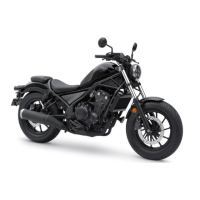
 Need help?
Do you have a question about the Honda Rebel 2020 Series and is the answer not in the manual?
 General
| Compression Ratio | 10.7:1 |
|---|---|
| Transmission | 6-speed |
| Final Drive | Chain |
| Front Tire | 130/90-16 |
| Rear Tire | 150/80-16 |
| Seat Height | 27.2 inches |
| Rake | 28 degrees |
| Trail | 4.3 inches |
| Induction | PGM-FI |
| Ignition | Full transistorized |
| Front Suspension | 41mm telescopic fork; 4.8 inches travel |
| Rear Suspension | Dual shocks, 3.8 inches travel |
| Front Brake | Single 296mm disc with hydraulic caliper |
| Rear Brake | Single 240mm disc with hydraulic caliper |
| Fuel Capacity | 3.0 gal |
| Bore and Stroke | 67 mm x 66.8 mm (Rebel 500) |
| Wheelbase | 58.7 inches |
Guidelines to enhance rider safety, including inspections and fuel handling.
Information and warning labels on the vehicle to alert about potential hazards.
Precautions for safe riding, including protective apparel and rider behavior.
Precautions for safe operation, including break-in, brakes, and riding conditions.
Identifies key parts of the motorcycle using a diagram.
Explains the functions and display elements of the instrument panel.
Describes the location and operation of various switches and controls.
Step-by-step instructions for starting the vehicle's engine.
Explains why regular vehicle maintenance is critical for safety and longevity.
Outlines the required maintenance tasks and their recommended intervals.
Core principles and safety rules for performing vehicle maintenance.
Guidance on checking, adding, and changing the engine oil and filter.
Steps to take if the engine fails to start or if the starter motor does not operate.
Explains common warning indicators and what they mean.
Guidance for emergency tire repair and wheel removal.
Solutions for battery issues and burned-out light bulbs.
Recommendations for cleaning and polishing the vehicle to maintain its condition.
Guidelines for proper storage of the vehicle during off-season or extended periods.
Explains the VIN and engine serial number for identification and registration.
Explains vehicle warranty coverage and the process for service and repairs.
Key physical dimensions and weight specifications of the vehicle.
Technical data including tire specs, oil, brake fluid, and spark plugs.
Ratings for main and other fuses used in the vehicle.
Important torque values for various fasteners and components.




 To Next Page