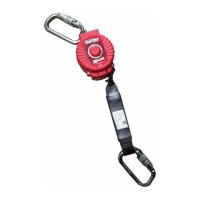
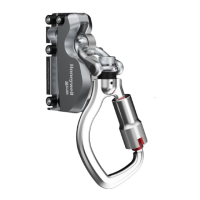
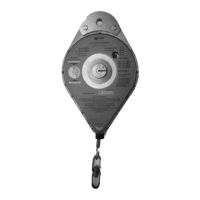
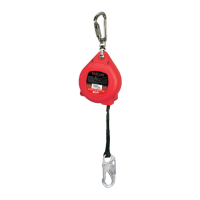
CARABINER
Connector conforming to standard EN 362.
When the carabiner is used for attachment to an anchorage points, check that the recommenda-
tions of the "ANCHORAGE POINT" paragraph are complied with.
WHEN CONNECTING THE CARABINER, CHECK THAT THE LOCKING SYSTEM IS PROP
ERLY POSITIONED.
ATTENTION
The carabiner is an essential element as concerns your safety.
Therefore we advise the following:
9 Assign the connector to one particular whenever possible,
9 before each use, check in particular for any signs of the formation, signs of wear and that the
locking system operates properly.
9 do not attach and release several times during the working day if it features a manual lock.
SIMILARLY IF THE KARABINER HAS BEEN USED TO ARREST A FALL, FOR SAFETY REA
SONS, IT IS ESSENTIAL TO REURN IT FOR CHECKING.
CLEARANCE
Before each use, make sure there is sufficient clearance under the user’s feet to avoid collision
with the structure or the ground. The air clearance must fit with the fall factor (see fall arrester
instruction manual).
Considering a 100 kg weight and a fall factor of 2 (least favourable case), clearance D is arrest
distance H (2L+1.75m) plus an additional distance of lm. (except in particular cases: see specific
manual)
PERIODIC EXAMINATION
These instructions must be kept with the product. Fill in the identification sheet while entering
information about marking. This periodic examination is designed to check the efficiency and
strength of the equipment and is indispensable to protect the user. (refer to the «checks before
use» paragraph)
This equipment must be examined at least once every year by a qualified person and in strict com-
pliance with the manufacturer’s instructions (except in particular cases: see specific manual); the
check must be registered on the attached sheet.
The frequency of the examination may need to be increased according to the regulations, for in-
tensive use or under harsh environmental conditions.
The product markings must be legible.
MAINTENANCE & STORAGE
Good maintenance and appropriate storage of your PPE will prolong the working-life of your prod-
uct, while guaranteeing your safety. Ensure that the following recommendations are implemented
to the letter:
9 clean with mild soap and water Never use acid or alkali solvents.
9 allow components to dry in a ventilated place away from any direct flame or any other source
of heat. Store in a room sheltered from humidity and ultraviolet rays,
9 avoid corrosive, overheated or refrigerated atmospheres.
LIFE DURATION
The maximal life of PPE that is predominantly textile is evaluated as being 10 years after the date
of manufacture ; the maximal life of PPE that is predominantly metal is evaluated as being un-
limited but, however, this maximal life is reduced to 10 years after the date of manufacture for
non-opening products (except in some specific cases – see the specific manual). However, the
following factors may reduce the performance of the product and its lifespan : in correct storage,
improper use, fall arrest, deformation, contact with chemical products (alkali and acid),exposure
to sources of heat > 50°C.
TRANSPORT
During transport, make sure that your PPE is stored in a cool, dry, noncorrosive atmosphere, away
from ultraviolet light etc. …
13



 To Next Page
 Loading...