Need help?
Do you have a question about the Hoover H-FRIDGE 300 and is the answer not in the manual?
Provides essential safety precautions and warnings for using the appliance safely and preventing hazards.
Covers critical warnings and guidelines for the safe and correct installation of the appliance.
Details electrical requirements, plug compatibility, and earthing instructions for safe operation.
Offers important instructions and warnings for the correct and safe operation of the appliance during daily use.
Details the physical dimensions of the appliance, essential for installation planning and placement.
Explains how to adjust the thermostat for optimal cooling and freezing, including specific settings and their uses.
Provides important advice and warnings regarding ambient temperature, door openings, and appliance efficiency.
Instructions on how to use and fill the ice tray for making ice cubes, including removal tips.
Guidance on using the plastic scraper for removing frost build-up in the freezer compartment safely.
Details on accessing and removing the freezer box for easier food storage and retrieval.
Information on the fresh dial for controlling air and humidity in the crisper for optimal food preservation.
Provides recommendations for storing various foods in the refrigerator to maintain freshness and prevent contamination.
Details on storing frozen food, freezing fresh food, making ice cubes, and handling frozen items safely.
Explains the process of defrosting both the refrigerator and freezer compartments for effective maintenance.
Guidelines for packing and moving the appliance to prevent damage during transit or relocation.
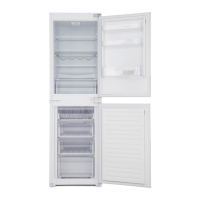
This document is a user manual for a built-in freezer-fridge appliance, providing essential information on safety, operation, maintenance, and technical data.
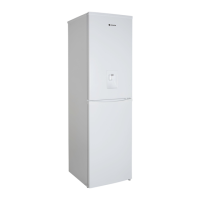
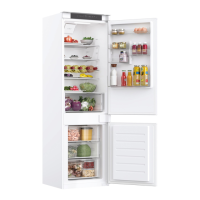
This appliance is a built-in freezer-fridge designed for household and domestic use, specifically for cooling and storing food. It features a refrigerator compartment for fresh food and a freezer compartment for frozen food and ice making. The appliance uses R600a as a refrigerant, which is environmentally friendly. It is intended to be integrated into kitchen units.
The appliance's temperature is regulated by a thermostat, which automatically controls the temperature inside both the refrigerator and freezer compartments. Users can adjust the cooling intensity by rotating the thermostat knob to higher numbers, from 1 to 5, with 5 providing the coldest temperatures suitable for freezing fresh food. An important note advises against rotating the knob beyond position 1, as this will stop the appliance from working.
For optimal performance, it is recommended to operate the fridge in ambient temperatures above 10°C. When first switched on, the appliance should run for 24 hours to reach its operating temperature, during which time the door should not be opened frequently, and a large quantity of food should not be stored inside. In case of a power cut, the appliance should be unplugged to prevent compressor damage, and re-plugged 5 to 10 minutes after power is restored.
The appliance includes various accessories to facilitate food storage. The freezer box allows for easy access to frozen items and can be removed by pulling it out and lifting the front. The crisper, located in the refrigerator compartment, has a "fresh dial" that can be opened when the crisper is full to control air and humidity, extending the life of food stored within.
Regarding food storage, it is recommended to store liquids in sealed containers in the refrigerator to reduce humidity and frost formation. Warm food should be allowed to cool to room temperature before being placed in the refrigerator to ensure adequate air circulation. Raw meat and fish should be loosely wrapped and stored on the glass shelf just above the vegetable bin, where the air is cooler. Loose fruit and vegetable items should be stored in the crisper containers, with separate storage for ethylene-sensitive and ethylene-releaser fruits and vegetables to prevent spoilage. Hot food should not be placed directly into the refrigerator. Meat products and fruit/vegetables should not be stored together to avoid cross-contamination. Foods should be in closed containers or covered to prevent moisture and odors.
For the freezer compartment, it is used for storing pre-frozen food, freezing fresh food, and making ice cubes. Fresh food should be properly wrapped and sealed in airtight packaging before freezing. It is advised not to store fresh food next to frozen food to prevent thawing. Thawed frozen food should be consumed within a short period and never refrozen. The maximum amount of fresh food that can be frozen in 24 hours is indicated on the appliance label. The fast freezing shelf, typically the upper shelf, is designed for quickly freezing home cooking and other foods.
Regular cleaning and maintenance are crucial for the appliance's longevity and efficiency. Before cleaning, the unit must be disconnected from the power supply. The appliance should not be washed by pouring water directly on it, and abrasive products, detergents, or soaps should be avoided. Instead, it should be cleaned regularly with a solution of bicarbonate of soda and lukewarm water, then rinsed with clean water and dried carefully. All removable parts should be cleaned separately by hand with soap and water, not in a dishwasher. The condenser should be cleaned with a brush at least twice a year to save energy and increase productivity.
Defrosting of the refrigerator compartment occurs automatically, with water collected by an evaporation tray and evaporating naturally. The evaporation tray and water drain hole should be cleaned periodically to prevent water from collecting at the bottom of the refrigerator. This can be done by pouring half a glass of water down the drain hole.
For the freezer compartment, small amounts of frost can accumulate. This thin frost can be removed with a brush or plastic scraper. Sharp metal objects should not be used, as they can puncture the refrigerator circuit. For heavy ice deposits, the appliance should be disconnected from the mains supply, emptied, and the contents wrapped in thick blankets or paper to keep cool. Defrosting is most effective when the freezer is nearly empty and should be done quickly. To accelerate defrosting, bowls of warm water can be placed in the freezer compartment. After defrosting, the interior should be cleaned with warm water and bicarbonate of soda, dried thoroughly, and all removable parts reassembled. The appliance should be reconnected to the mains supply and left for 2 to 3 hours on setting number '5' before reintroducing food.
In case of LED lighting issues, the user should contact the help desk, as replacement should only be done by authorized personnel. Spare parts such as thermostats, temperature sensors, printed circuit boards, light sources, door handles, door hinges, trays, baskets, and door gaskets are available for a minimum period after the model's last unit is placed on the market.
For troubleshooting, if the refrigerator is not working properly, users should check for power, mains connection, thermostat setting, and socket functionality. If the appliance performs poorly, checks include overloading, proper door closure, dust on the condenser, and sufficient space around the appliance. Noises like bubbling, splashing, and water flowing are considered normal during operation and defrosting. Cracking noises occur during automatic defrosting or due to material expansion, while clicking noises indicate the thermostat switching the compressor on/off. Motor noise signifies normal compressor operation. If water collects at the bottom of the refrigerator, the drain hole should be checked for clogs. If problems persist after following these instructions, the nearest authorized service center should be consulted.
 General
| Appliance placement | Freestanding |
|---|---|
| Product colour | White |
| Door hinge | Right |
| Reversible doors | Yes |
| Number of compressors | 1 |
| Cooling System | Static |
| Fridge interior light | Yes |
| Lamp type | LED |
| Number of shelves/baskets in fridge | 4 |
| Egg balcony | Yes |
| Bottle rack | Yes |
| Freezing capacity | 4 kg/24h |
| Ice cube tray | Yes |
| Star rating | 4 |
| Height | 1760 mm |

 To Next Page