Need help?
Do you have a question about the Horiba Scientific LAQUAtwin CA-11 and is the answer not in the manual?
Requirements for calibration, including using standard solutions.
Instructions for setting the low calibration value using the standard solution.
Instructions for setting the high calibration value using the standard solution.
Provides solutions for common errors like faulty meter, internal board issues, or calibration errors.
Explanation of error codes and their meanings for troubleshooting.
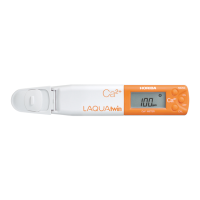
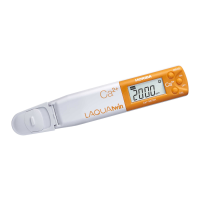
The HORIBA LAQUAtwin is a portable, compact meter designed for quick and accurate measurement of various ions, including Calcium (CA-11), Potassium (K-11), Sodium (NA-11), and Nitrate (NO3-11). It is a user-friendly device suitable for both field and laboratory use, allowing for efficient monitoring of water quality and other solutions.
The LAQUAtwin operates on the principle of an Ion Selective Electrode (ISE), which measures the concentration of specific ions in a solution. The device features a sensor that comes into direct contact with the sample, and the resulting electrical potential is converted into a concentration reading displayed on the LCD screen.
The meter offers two stability modes:
A unique feature of the LAQUAtwin is its multiplying compensation function, which allows users to apply a compensation coefficient (ranging from 0.01 to 9.90) to the measured value. The compensated result is then displayed alongside the measured value, providing flexibility for specific application requirements.
The device also includes a backlight function for improved visibility in low-light conditions, which can be toggled on or off through the settings menu.
The LAQUAtwin is designed for ease of use, with a straightforward interface and intuitive operation.
The sensor is easily attached and detached from the meter. To attach, the sensor slides onto the meter, ensuring the "A" mark on the meter aligns with the hole "a" on the sensor. Detachment involves lifting the sensor tongue tip and sliding it away. It's crucial to handle the waterproof gasket carefully to avoid twisting.
The meter is switched on or off by pressing the ON/OFF key for approximately 1 second.
Calibration is a critical step before measurement to ensure accuracy. The LAQUAtwin supports up to two calibration points, allowing for a wider measurement range and improved precision.
The settings menu allows users to customize the meter to their specific needs. It is accessed by simultaneously pressing and holding the MEAS and ON/OFF keys for approximately 3 seconds while the meter is off.
This feature is available only in A.S. Stability mode and is generally not necessary unless the temperature value is incorrect. It involves preparing a reference thermometer, allowing the meter and thermometer to reach the same temperature, viewing the temperature with MEAS, and then adjusting the value to match the thermometer using MEAS, confirming with CAL.
For small sample volumes (50 µL to 100 µL), a sampling sheet can be used. The sheet is taken with tweezers, wiped across the sample, and then the normal measurement steps are followed.
For samples with tiny particles (e.g., soil extract) that might influence measurement results, a sampling sheet holder and cover can be used. The sensor cover is replaced with the sheet holder, the sheet is opened, a sampling sheet is placed on the sensor, and the holder is closed. A few drops of the sample are then placed on the sheet holder, and normal measurement steps are followed.
In A.S. Stability mode, users can view temperature, mV, or units by repeatedly pressing the MEAS key from the measurement screen.
The meter uses two CR2032 batteries, placed with the plus sides (+) upwards. To install, the sensor is detached, batteries are slid into the case, and the sensor is reattached. To remove, a ball-point pen or other tool can be used to pry the batteries out of the clips.
Proper maintenance ensures the longevity and accuracy of the LAQUAtwin meter.
Before using the sensor for the first time or after several days of disuse, electrode conditioning is required. This involves placing drops of a 2000 ppm standard solution on the sensor for a few hours, then disposing of the solution and rinsing the sensor with DI or tap water. Calibration should be performed after conditioning.
Calibration data should be cleared in specific situations:
All settings will be reset, and calibration data will be deleted. To perform a factory reset, power off the meter, then simultaneously press and hold MEAS, ON/OFF, and CAL keys for approximately 3 seconds. Press CAL to confirm or ON/OFF to cancel. If resetting does not resolve an issue, the meter may need to be replaced.
 General
| Resolution (ppm) | 1 ppm |
|---|---|
| Accuracy (ppm) | ±10% of reading |
| Minimum Sample Volume | 0.3 mL |
| Operating Temperature | 5 to 40°C |
| IP Rating | IP67 |
| Measurement Method | Ion selective electrode method |
| Calibration | 1 or 2-point calibration |
| Temperature Compensation | Automatic |
| Operating Humidity | 85% or less (no condensation) |
| Power Supply | 2 x CR2032 batteries |
| Battery Life | Approximately 400 hours |
| Dimensions | 164 x 29 x 20 mm |

 To Next Page