reduce the draw weight so you may quickly re-adjust to the prior weight the
next time you shoot.
6. Lubricate the axles of the eccentric wheels from time to time (WD 40 is
excellent).
Do not oil the coble grooves of the wheels.
7. To assure best results, we recommend the use of Hoyt/Easton replacement
ports,
strings, cables, etc.
DRAW LENGTH ADJUSTMENTS
First, check to see that your bow is set at your desired draw length. The Hoyt/
Easton bows equipped with Irl-drow wheels" ore set In the center slot from
the factory and con be adjusted for a one Inch longer or one inch shorter
draw length. If you hove purchased a bow without the trl-drow system, you
con,
to a limited degree, shorten the draw length by using a shorter
bowstring.
If you cannot obtain your proper draw length, return the bow to
your archery pro shop for a different size wheel.
NOTE:
Although the use of a longer string would hove the opposite effect of
lengthening the draw, factory setting allows little adjustment In this direction.
Lengthening the draw in this manner can cause cable overlap, and hence,
create unnecessary campllcatlons.
A slight weight change will accompany any change in draw length and
may be compensated by tightening or loosening the limb weight adjust-
ment bolts. Occasionally, however, the full amount of peak weight may be
lost when reducing draw length.
With "energy wheels," the draw length con be changed
by the following methods.
1.
Using an Alien wrench, begin by loosening each limb weight adjustment
bolt two turns (counterclockwise), alternating be-
tween the top and bottom limb (remember to keep
track at the exact number of turns In order to return
your poundage to the original weight). Continue
loosening each bolt until there is enough coble
slack to move the cables to the desired slots. After
placing cables In desired shorter draw length (-) or
longer draw length
(-t-),
alternately re-tlghten limb
weight adjustment bolts (two turns at a time) while ensuring cables remain in
proper slots. Do not draw bow when limbs ore in relaxed state.
2.
Using a string changer or long bowstring, leave the bow set at the original
weight. Place the string changer or long string (6" to 8" longer than regular
string) on each unused teardrop of the cables. Pull string changer to remove
regular bowstring and relax changer to get slock in the cables. When using
the long string, lower the long bowstring to the floor and stand on It. Next, pull
the bow up until the limbs flex enough to remove the regular bowstring; now
let the bow relax. The cables should be slock enough to move to the desired
slots.
To reset, simply reverse the procedure, making sure the cables remain
in place.
SEHING BOW WEIGHT
Adjusting the weight of your compound bow is very easy Using the Allen
wrench supplied with your bow simply turn the limb weight adjustment bolts
clockwise to Increase poundage or counterclockwise to reduce poundage.
One full 360° turn of the limb weight adjustment bolt will effectively Increase
or decrease heavy weight bows approximately four pounds per turn and
lightweight bows approximately two pounds per
turn.
After setting bow
weight, be sure to check tiller.
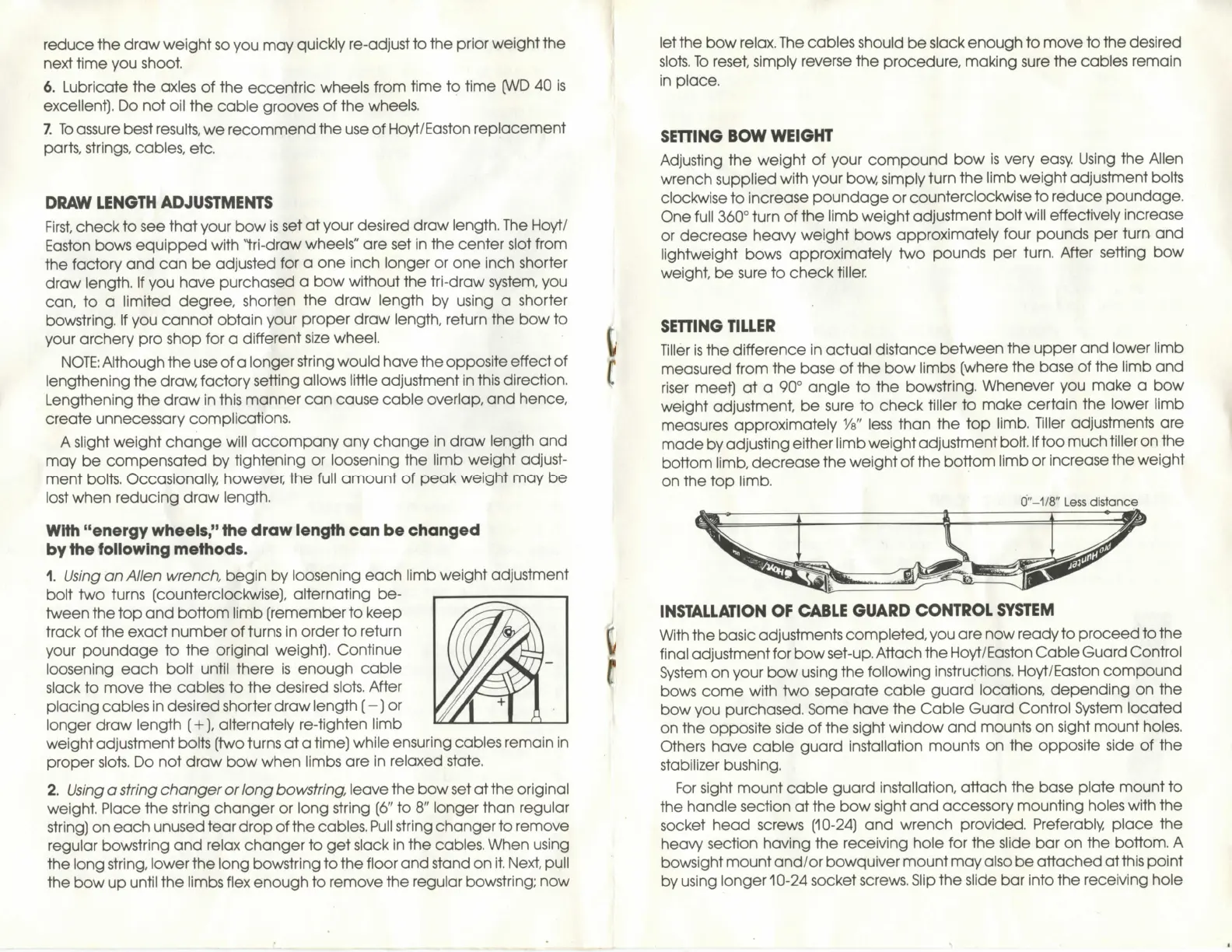
SEniNG TILLER
Tiller Is the difference In actual distance between the upper and lower limb
measured from the base of the bow limbs (where the base of the limb and
riser meet) at a 90° angle to the bowstring. Whenever you moke a bow
weight adjustment, be sure to check tiller to moke certain the lower limb
measures approximately VB" less than the top limb. Tiller adjustments are
made by adjusting either limb weight adjustment bolt.
If
too much tiller on the
bottom limb, decrease the weight of the bottom limb or Increase the weight
on the top limb.
0"-1/8" Less distance
INSTALLATION OF CABLE GUARD CONTROL SYSTEM
With the basic adjustments completed, you ore now ready to proceed to the
final adjustment for bow set-up. Attach the Hoyt/Easton Coble Guard Control
System on your bow using the following Instructions. Hoyt/Easton compound
bows come with two separate cable guard locations, depending on the
bow you purchased. Some hove the Coble Guard Control System located
on the opposite side of the sight window and mounts on sight mount holes.
Others hove coble guard Installation mounts on the opposite side of the
stabilizer bushing. ,sy-:
For sight mount coble guard installation, attach the base plate mount to
the handle section at the bow sight and accessory mounting holes with the
socket head screws (10-24) and wrench provided. Preferably, place the
heavy section having the receiving hale for the slide bar on the bottom. A
bowslght mount and/or bowqulver mount may also be attached at this point
by using longer 10-24 socket screws. Slip the slide bar into the receiving hole



 To Next Page
 Loading...