EasyManua.ls Logo

HP 3335A - Connector and Interface Descriptions; Front and Rear Panel Connectors; External Level Input; HP-IB System Operations

HP 3335A
38 pages
Print Icon
To Next Page IconTo Next Page
To Previous Page IconTo Previous Page
Loading...
Model
3335A
If
the
3335A
is
under
remote
control,
it
can
be
returned
to
local
control
(control
by
keyboard
inputs)
by
activating
the
LOCAL
key
providing
a
local
lockout
command
has
not
been
sent
by
the
HP-IB
system
controller.
3-56.
Front
Panel
Output
Connectors.
A
(RGSS
The
output
of
the
-hp-
3335A
is
directly
coupled.
Do
not
allow
external
dc
currents
to
develop
more
than
S
volts
across
the
output
terminals.
For
Option
002/004
and
Option
003
the
de
voltage
across
the
output
should
not
be
greater
than
10
volts.
3-57.
The
front
panel.
contains
the
instrument
output
con-
nectors
located
in
the
right-most
group
labeled
OUTPUT
and
the
SWEEP
OUTPUT
located
in
the
FREQUENCY
group.
The
output
connectors
provide
the
programmed
output.
The
SWEEP
OUTPUT
provides
a
de
voltage
between
O
and
+
2
V
proportional
to
the
sweep
when
the
Synthesizer
is
in
the
sweep
mode.
When
not
in
the
sweep
mode
the
SWEEP
OUTPUT
is
+
1
V.
During
the
sweep,
the
SWEEP
OUTPUT
is
proportional
to
the
frequency
and
can
be
used
to
drive
the
horizontal
sweep
of
a
plotter
or
an
oscilloscope.
3-58.
Rear
Panel
BNC
Connectors.
3-59.
40/N
Input.
This
is
the
input
for
the
reference
fre-
quency
that
essentially
determines
the
frequency
accuracy
and
stability
of
the
-hp-
3335A.
As
the
name
of
the
input
suggests,
the
reference
frequency
must
be
an
integral
sub
multiple
of
40
MHz
(ie.,
40,
20,
13.333,
10,
etc.).
The
40
MHz
master
oscillator
in
the
-hp-
3335A
is
phase
locked
to
this
signal.
Lock
will
occur
with
40/N
INPUT
levels
as
low
as
-7
dBm.
When
an
external
frequency
reference
is
not
used,
the
10
MHz
REFerence
OVEN
OUTPUT
is
coupled
to
this
input
with
the
BNC-to-BNC
adapter.
3-60.
10
MHz
REFerence
OVEN
OUTPUT.
This
is
a
refer-
ence
frequency
that
is
coupled
to
the
40/N
INPUT
when-
ever.
an
externa]
frequency
reference
is
not
used.
When
it
is
used,
its
accuracy
and
stability
determine
the
accuracy
and
stability
of
the
-hp-
3335A
output
frequency.
The
para-
meters
of
this
output
are
described
in
Table
1-1.
They
depend
on
the
Option
selected.
3-61.
10
MHz
OUTPUT.
This
output
is
used
to
lock
the
phase
of
other
synthesizers
to
the
phase
of
the
-hp-
3335A.
Its
output
level
and
output
impedance
are
typically
around
0
dBm
and
50
ohms.
3-62.
EXTernal
LEVEL
INPUT.
This
input
is
selected
using
the
INTERNAL
LEVEL/EXT
LEVEL
INPUT
switch
located
on
the
rear
panel.
When
it is
selected,
the
dc
level
on
this
input
determines
the
output
amplitude.
The
sensi-
tivity
is
non-linear,
however,
it
is
typically
about
.5
V
rms
output
per
de
volt
input.
With
O
volts
dc
on
this
input,
the
maximum
output
amplitude
of
the
-hp-
3335A
is
nominally
.5
volts
rms
into
50
ohms
(or
75
ohms).
An
“UN—
Section
HI
LEVELED”
annunciator
on
the
front
panel
will
light
whenever
this
input
is
selected.
3-63.
Remote
Programming.
3-64.
This
part
of
Section
HI
contains
a
brief
description
of
the
HP—IB
operation
and
includes
programming
infor-
mation
for
operating
the
Model
3335A
on
the
HP—IB.
H
also
includes
information
on
the
HP~IB
connector,
HP~IB
logic
levels
and
programming
codes.
3-65.
The
HP—iB.
The
HP--IB
is
a
carefully
defined
instru-
mentation
interface
which
simplifies
the
integration
of
instruments,
calculators
and
computers
into
systems.
The
3335A
is
a
fully
programmable
instrument
interfacing
with
the
HP—IB
by
means
of
a
rear
panel
HP—IB
connector
(see
Figure
3-1).
The
HP—IB
connector
is
directly
compatible
with
the
mating
connectors
on
the
-hp-
10631
(A,
B
or
©)
HP—IB
Cable
Assemblies.
3-66.
HP—IB
Logic
Levels.
The
3335A
HP~—IB
lines
use
standard
TTL
levels
and
are
low-true.
The
logic
levels
are:
Low
=
digital
ground
or
0
V
to
+0.4
V
de
High
=
open
or
+2.5
V
de
to
+5
V
de
3-67.
isolation.
The
3335A
is
located
from
the
HP--IB
by
optical
couplers.
The
components
located
on
the
HP—IB
side
of
the
optical
couplers
are
powered
by
a
separate
+5
V
power
supply
deriving
power
from
an
ungrounded
secondary
transformer
winding.
This
provides
isolation
of
the
instrument
from
the
bus.
3-68.
Capability.
The
capability
of
a
device
connected
to
the
HP—IB
is
specified
by
its
interface
functions.
The
inter-
face
functions
of
the
3335A
are
listed
in
Table
3-2
and
indi-
cate
the
particular capability
of
that
function
as
defined
in
Appendix
C
of
IEEE
Std
488-1975.
The
interface
func-
tions
indicate
what
activity
a
device
will
respond
to
or
that
which
it is
capable
of
initiating.
Each
item
indicating
a
device
capability
appears
on
the
rear
panel
next
to
the
HP—IB
connector.
3-69.
The
instrument
will
recognize
a
preset
“listen”
address
and
accept
bit-parallel,
word
(byte)-serial
ASCH-
coded
data.
All
data
is
received
through
the
Data
Input/
Output
(DIO)
lines
of
the
HP—IB.
The
data
transfer
is
con-
trolled
by
“handshake”
lines
DAV,
NRFD
and
NDAC.
Figure
3-2
illustrates
the
“handshake”
sequence
of
events
and
describes
each
event
during
the
transfer
of
data.
More
detailed
information
is
obtainable
by
ordering
a
copy
of
“Condensed
Description
of
the
Hewlett-Packard
Interface
Bus”,
-hp-
Part
No.
59401-90030,
Microfiche
Part
No.
59401-90090.
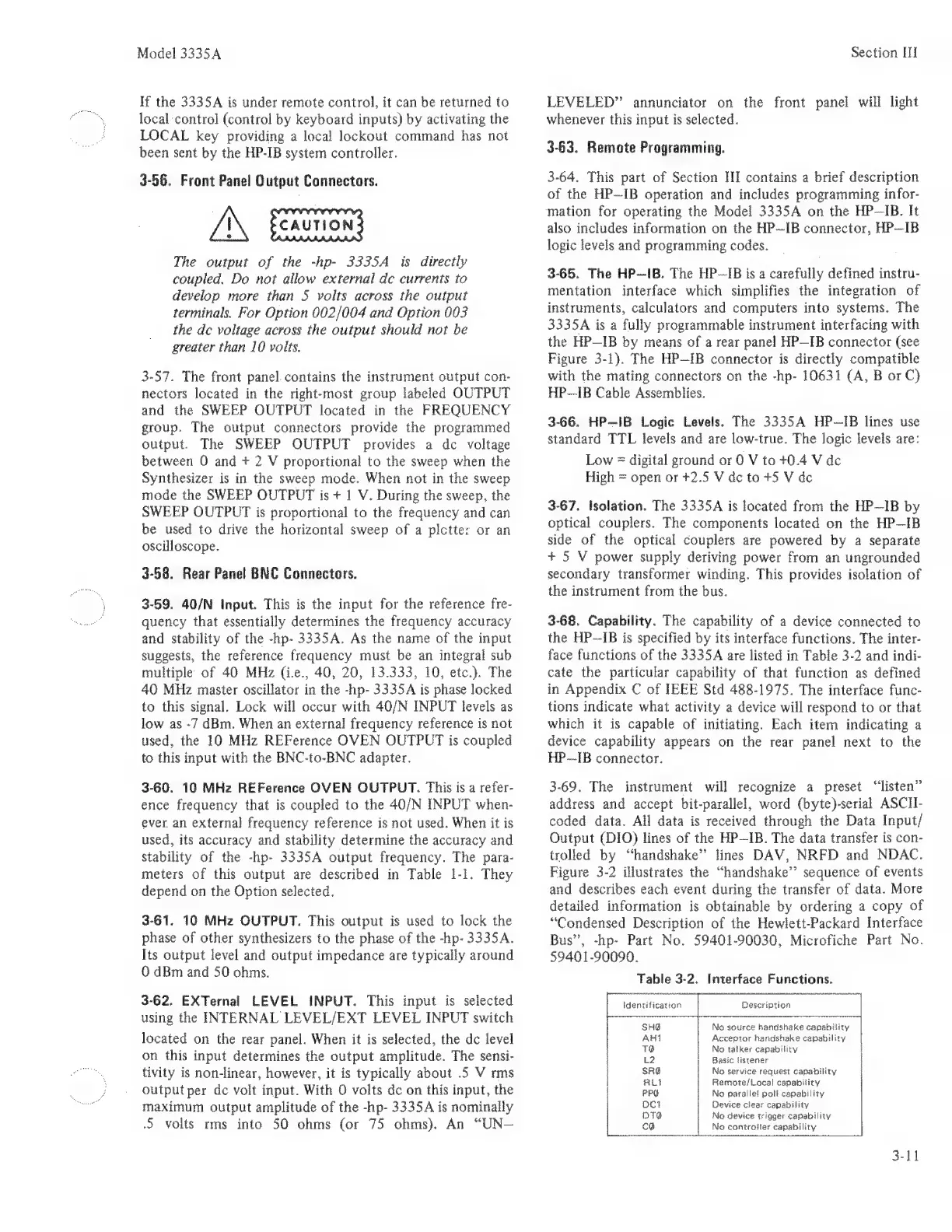
Table
3-2.
Interface
Functions.
Identification
Description
SHG
No
source
handshake
capability
AH]
Acceptor
handshake
capability
No
talker
capability
i
L2
Basic
listener
SRE
No
service
request
capability
Remote/Local
capability
No
paralle!
poll
capability
Device
clear
capability
No
device
trigger
capability
No
controler
capability
ovo
zs
aug
a
EE
A

Related product manuals