EasyManua.ls Logo

HP 339A - Distortion Analyzer Performance Tests; Fundamental Rejection and Induced Distortion Test

HP 339A
125 pages
Print Icon
To Next Page IconTo Next Page
To Previous Page IconTo Previous Page
Loading...
Model
339A
Section IV
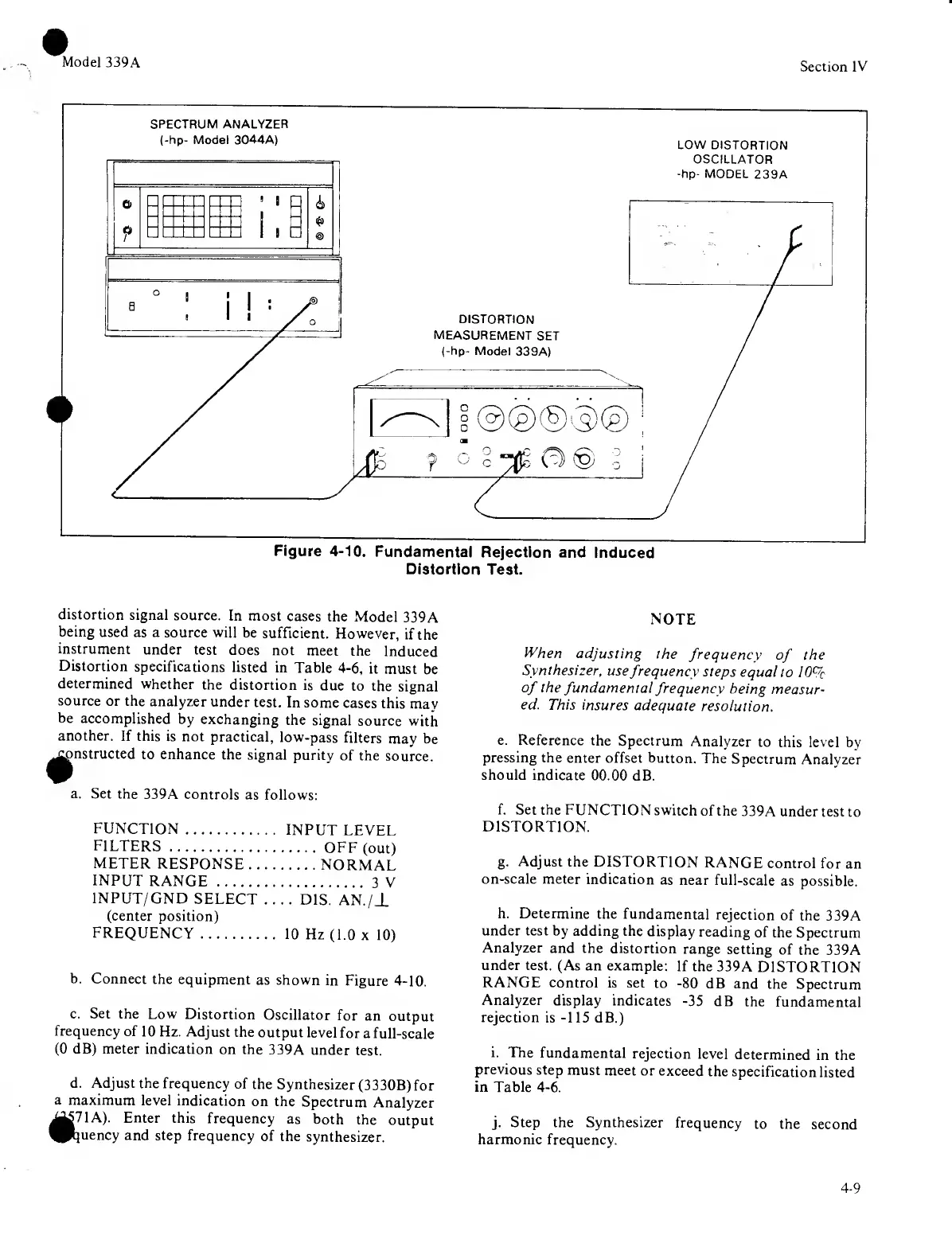
Figure 4-10.
Fundamental
Rejection and
Induced
Distortion
Test.
distortion
signal
source.
In
most
cases the
Model
339A
being
used as a
source will be
sufficient.
However,
if
the
instrument
under test
does
not
meet
the
Induced
Distortion
specifications
listed
in Table
4-6, it
must
be
determined
whether
the distortion
is
due
to the
signal
source
or the
analyzer
under
test. In some
cases
this
may
be
accomplished
by exchanging
the signal
source
with
another.
If this
is not
practical,
low-pass
filters
may be
^nstructed
to enhance
the signal
purity
of the
source.
a.
Set the
339A controls
as
follows:
FUNCTION
INPUT
LEVEL
FILTERS
OFF
(out)
METER
RESPONSE
NORMAL
INPUT
RANGE
3
V
INPUT/GND
SELECT
....
DIS.
AN./_L
(center
position)
FREQUENCY
10
Hz
(1.0 x
10)
b.
Connect
the equipment
as shown
in
Figure
4-10.
c. Set
the Low
Distortion
Oscillator
for
an
output
frequency
of
10 Hz. Adjust
the
output level
for
a
full-scale
(0
dB) meter
indication
on the
339A
under
test.
d. Adjust the
frequency
of the
Synthesizer
(3330B) for
a
maximum
level indication
on the
Spectrum
Analyzer
M571A).
Enter
this
frequency
as
both
the
output
^Piuency
and
step frequency
of
the
synthesizer.
NOTE
When
adjusting
the
frequency
of
the
Synthesizer,
use
frequency steps
equal
to
10
%
of
the
fundamental
frequency being
measur-
ed.
This insures
adequate
resolution.
e. Reference
the
Spectrum
Analyzer
to
this
level
by
pressing the
enter offset button.
The
Spectrum
Analyzer
should indicate
00.00 dB.
f. Set the
FUNCTION
switch
of
the
339A under test
to
DISTORTION.
g.
Adjust
the DISTORTION
RANGE
control for
an
on-scale meter
indication
as
near full-scale
as possible.
h. Determine
the
fundamental
rejection
of the
339A
under test
by
adding
the
display
reading
of
the Spectrum
Analyzer
and the distortion
range
setting
of the
339A
under test.
(As an example:
If
the
339A
DISTORTION
RANGE control
is set
to
-80
dB and
the
Spectrum
Analyzer display
indicates -35
dB
the
fundamental
rejection is
-115
dB.)
i. The
fundamental
rejection
level
determined
in the
previous
step
must meet
or exceed
the
specification
listed
in Table
4-6.
j.
Step
the Synthesizer
frequency
to the
second
harmonic frequency.
4-9

Related product manuals