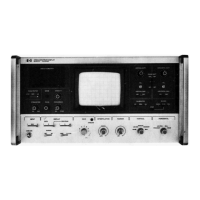
Model
3455A
SERVICE GROUP
C
Section VIII
lifting RS2 and R64, the
other circuits are causing the
malfunction (absolute amp, squaring amp,
etc.).
8-C-6 Absoivta
AmplHiar Circuitry.
8-C-7. If the
waveshape at TPS appears to be
incorrect, try the
following
checks
(except where
noted, the input signal should be a 10
V, 100 Hz
sinewave).
a. To
check
if
other circuits on the A14 board causes
failures in the absolute
amplifier, the ab-
solute
amplifier can be isolated. This can be
accomplished by lifting RS2 and R53. The
amplifier
should now be operating correctly.
Troubleshoot the amplifier circuit,
if defective.
b.
Check the power supply
voltages at pins 4 and 7 of U7. Pin
4 should
be
approximately -IS
V
and pin 7 approximately +
15 V.
c. Check
for an approximately 2.8
V peak to peak
sinewave
at U4 pin 6.
Troubleshoot
U6
and
associated circuitry, if necessary.
d. If the
sinewave
at U4
pin 6 has oscillations,
reduce
C22
to
10
pF (part number in
parts
list).
Do
not reduce C22
below
10
pF, as the
frequency response of the ac convertor may be
affected.
e. The
cathode/anode junction of CR5 and
CR4 should have a
sinewave with
slight
distortion at
the
zero crossover point. Replace CR4
or CRS, if necessary.
f. If the
signal at TPS is distorted, CR4 may
have leakage. CR4 and CRS can be
interchanged.
g.
If QI4 or QIS
appear defective, check
with
an ohmmeter and
replace, if necessary.
8-C-8.
Squaring Amplifiar,
Integrator, and Antilog Circuitry.
8-C-9.
The squaring amplifier, integrator, and antilog
circuits are connected by feedback paths.
Isolation of these circuits
may be difficult. There are,
however, some checks used to help
troubleshoot
these circuits (except
where
noted, the
input signal should be a 10 V, 100 Hz
sinewave).
a. In some cases it is possible to
isolate the integrator from the
other
circuits on the
A15 board.
This can be accomplished by
shorting TP6 to the cathode of CR3. The reading
at TPl should be ap-
proximately zero. If there are
great offsets at TPl. troubleshoot the
integrator.
b. Apply a
100 mV, 100 Hz sinewave
to
the input terminals of the 345SA.
The instrument should
be in the 10
V range and display approximately .10(X)
V.
Check for dc
readings of + .82 V at TP4,
-9
V
at
TP3,
-.48
V at TP2, and +
.067 V
at TPl.
These readings may be helpful in isolating the squar-
ing amp, integrator, and antilog
circuits.
c. Reapply a 10
V,
100
Hz sinewave
to the
input of the 34SSA. The instrument
should be on the
10
V
range. Check for dc readings of
approximately + .66 V at TP4,
-1.15 V
at
TP3,
-.6
V at TP2, and
-I- 6.7
V
at TPl.
Again,
these readings
may be helpful in isolating the
squaring amp, integrator, and
antilog circuits.
d. Check
the power supply
voltages
of Ul, U2,
and
U3.
Pins
7
of the op-amps
should be approx-
imately -I-
15
V
and pins
4
should be
approximately
-
IS
V.
e.
Check for a
voltage
drop
of approximately + 3.3
V
across R36. If this
voltage drop is incorrect,
Q12 or Q13
and their associated
circuitry may be
defective.
f. For parasitic
oscillations at TP3 change R36 to
649
0
(part number:
0698-4460).
g. If
the display of the 3455A
indicates an
overload
condition
with
a
good waveshape at TPS,
8-61


 To Next Page
 Loading...