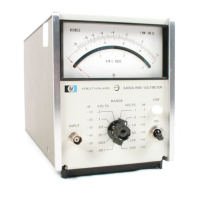
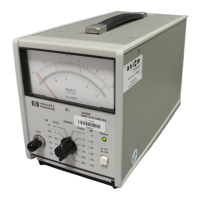
Model 3455A
SERVICE
GROUP C
Section
VIII
Again, ihe input
of
the
3455A should
be
shorted and very little deviation
should
be
noted.
d.
Short the input of the 345SA and measure
the
dc
voltage at TP3. If the voltage is very jumpy,
troubleshoot the squaring
amplifier circuits.
e. Short
the cathode of CR3 to TP6 and measure the
voltage
at TPl. This
voltage
may jump
around a little more than at the other test
points. If the voltage is extremely jumpy, troubleshoot the
integrator circuit. If the
voltage
is
relatively steady, the antilog or square root circuit may be noisy.
8-C-lS. The
above
procedure
(paragraph
8-C-14)
should isolate most areas on the ac convertor
board that may cause noise. A
few
other
hints and checks, given
below,
may be helpful for specific
noise.
a. Noise on all ranges
with the input shorted: Check for
*2
mV
to
-3
mV
at U2 pin 2. If the
voltage
is
out
of
the correct range, it may cause a noisy zero indication. The
padding
resistor (R21) may
have
little or no effect in padding U2. This condition is usually caused by
a leaky
Q9B or
CR2. Replace
Q9
or CR2, if necessary.
b. Noisy
when low frequency signal is applied to the 34S5A: The fast ac
switching circuitry
may
be
defective. The following checks can be made to troubleshoot this circuit.
1. Apply a I
V,
100 Hz
signal
to
the input of the 34SSA, with the instrument set to the 1 V
range and to the
normal
ac
function.
2. With an oscilloscope,
check
the
signal
at
TPl. The signal should be approximately +6.7
V
dc,
with
no ripple, if the
signal has ripple on it and the dc
level
is incorrect, perform the next
step.
3. Set the
34SSA
to
the fast ac
function. Measure the voltage at the junction of R4 and RS
and the
gate levels of
Q2
and Q8.
The voltage should be approximately
-
IS V dc. Next, set the
3455A to the normal ac
function. The gate
levels
of Q2 and
Q8
should be
approximately
zero,
and the Junction
of R4 and RS should be
approximately + IS V dc. The gate levels of
Q3
and
Q4
should be complimentary to the gate
levels of
Q2
and
Q8.
c. Noisy in the fast ac mode: Check for a
defective R9.
d.
Other noise: If the 30 V regulator (A10U36) is
defective,
it may cause bursts of RF
with
heat.
This may
show
up
as noise on all functions and ranges of the 34SSA. It
would
be,
however,
more
noticeable in
the ac function.
8-C-16. Miscellaneous Troubleshooting (Schematic 3}.
a. 10 kHz reading high: Check for the correct
high frequency padding of R89. In order
to
obtain
optimum accuracy
over
the entire
frequency range of the 345SA, R89 should be padded approximate-
ly 4000 counts high
with
a 1
V, 1 MHz input. Use the
following
procedure.
1. The 34SSA should be turned on and
warmed
up for at least
1/2 hour. All shields and
covers should be in place.
2. Perform the
RMS convertor adjustment in Section
V
of this manual.
3. Apply a 1
V,
1 MHz
sinewave
to the input of the
3455A. Pad R89
for
a reading approx-
imately 4000 counts high. Check the accuracy
of
the ac
convertor.
b.
General hints:
Give
iheac
convertor
board a good mechanical inspection. Make
sure ail relays,
op-amps, capacitors, and FETs are
not touching
the ground plane, shields, or each
other.
c.
Reading
above
100
V
erratic: Check for
relay
cases
touching the ground plane.
d. Arcing at 1000
V
ac:
Check for capacitors touching the shield or ground plane.
8-63


 To Next Page
 Loading...