Model
8901B
Service
discriminating only noise and speeds recovery of the audio circuits from tuning-induced transients. The
Controller also activates squelch during certain other measurement modes.
The signal from the FM
IF
Limiters also drives the Counter via the Counter
IF
Buffer.
FM
Calibrator Assembly
(A51)
The heart of the
FM
Calibrator
is
a
10.1
MHz VCO. A
10
kHz trapezoidal wave is applied
to
the tune
line of the VCO, which generates FM. During the calibration measurement, the VCO input
is
switched
to the upper frequency,
fv,
and the frequency
is
measured by the Counter. Then the VCO input
is
switched to the lower frequency,
fL,
and the frequency
is
again measured. The Controller calculates
the peak deviation as
fv
-
fL
FM=-
2.
A measurement of residual FM is also made on the unmodulated VCO and entered into the calculation of
the FM calibration factor. The FM signal is then measured, and the calibration factor
is
calculated and
shown on the display. The sensitivity
of
the VCO and tune voltage are designed
to
give approximately
34
kHz peak deviation.
To prevent ringing of the demodulated signal in the audio circuits, the modulation signal
is
given a
slow risetime by the Trapezoid Generator-a
soft
limiter which receives its input from the Triangle
Generator. The Triangle Generator and Mode Control comparator together form a relaxation oscillator.
The output from the Mode Control comparator switches between a positive and negative output current.
The Triangle Generator (an integrator) generates
a
negative
or
positive ramp depending on its input.
When
its
output reaches the Mode Control reference, the comparator output switches to initiate a
ramp in the opposite direction.
Special Function
12
controls the FM Calibrator and permits its use with another Modulation Analyzer
or
modulation analyzer.
AM Calibrator Assembly
(A50)
The RF input to the AM Calibrator
is
the unmodulated
10.1
MHz from the FM Calibrator. The
signal passes through a Limiter to the inputs of two similar Amplifiers
(A
and
B)
and through
to two similar Modulators
(A
and
B).
Current Source
B
switches Modulator
B
on and
off
while
Current Source
A
latches Modulator A
on.
The outputs from the
two
Modulators are summed in
the Summing Amplifier, and the summed signal appears
(after
attenuation) at the CALIBRATION
AMFM OUTPUT connector.
If
both signal paths are identical, the output from the calibrator
is
periodically toggling between a specific
RF
level and twice that level.
This
produces
33.33%
AM.
Rather than relying of the
two
signal paths being identical, the AM
is
computed by careful, static
measurement of the signal levels from the Modulators during a calibration sequence. First, Modulator
A
is
switched
off
and the voltage from the AmplifierfDetector is measured with Modulator
B
on, via
the
xl
DC Amplifier
(VB).
This voltage
is
also measured via the
x10
DC Amplifier
(VIos).
Then
Modulator B
is
switched
off,
Modulator
A
switched on, and the level is measured via the
x10
DC
Amplifier
(Vl~~).
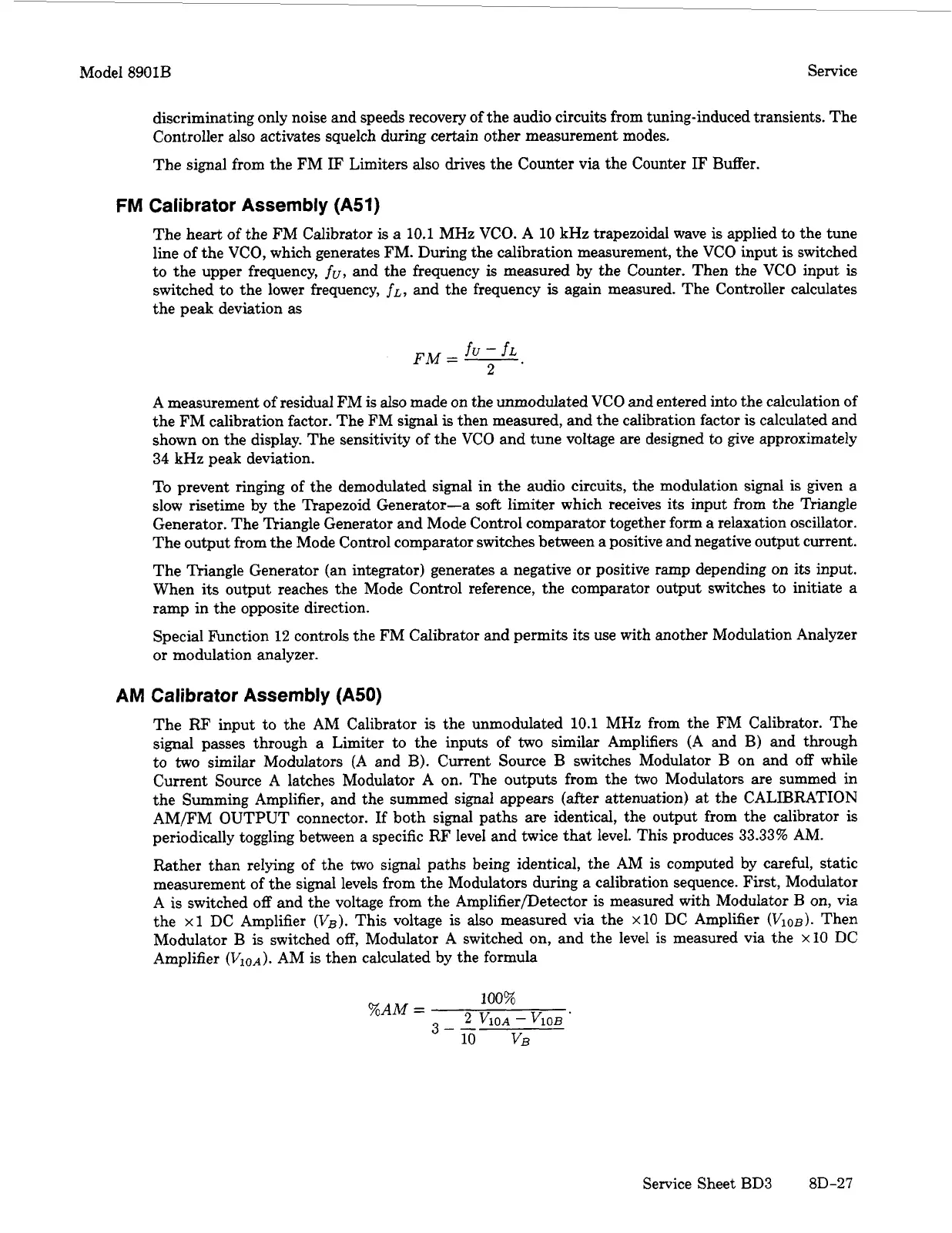
AM is then calculated by the formula
Service Sheet
BD3
8D-27


 To Next Page
 Loading...