
 Need help?
Do you have a question about the HP ProBook 430 G8 and is the answer not in the manual?
Items with a surface area greater than 10 sq cm.
All Li-Ion batteries, including detachable notebook keyboard and RTC coin cells.
Components such as mercury in lamps, display backlights, scanner lamps, switches.
Displays with a surface area greater than 100 sq cm, including LED backlights.
CRT components.
Capacitors and condensers containing PCB or PCT.
Electrolytic capacitors larger than 2.5 cm in diameter or height.
External electrical cables, such as DC cables for power supply.
Gas discharge lamps.
Plastics weighing over 25 grams containing Brominated Flame Retardants.
Toner cartridges, print heads, tubes, vent chambers, and service stations.
Asbestos-containing components and waste materials.
Parts and materials containing refractory ceramic fibers.
Parts and materials containing radioactive substances.
A T8 size screwdriver for specific disassembly tasks.
General purpose screwdriver for various disassembly steps.
Steps to remove the base cover and access internal components.
Sequential steps for releasing batteries, fans, cables, and main boards.
Procedure to release hinge screws and remove the hinge assembly.
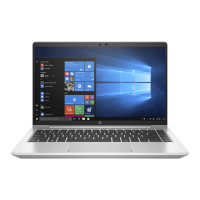
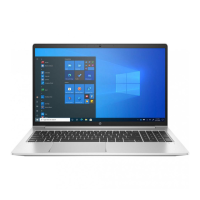
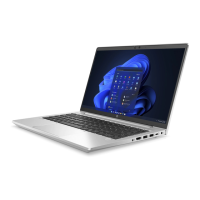
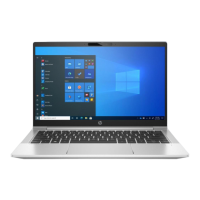
This document outlines the disassembly instructions for the HP ProBook 430 G8 Notebook PC (HSN-Q27C), a device designed for general computing tasks. The primary function of this document is to guide end-of-life recyclers and treatment facilities in the proper removal of components and materials that require selective treatment, as mandated by the EU directive 2012/19/EC (WEEE). This ensures environmentally responsible disposal and recycling practices.
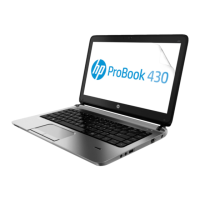
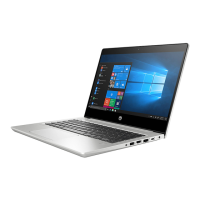
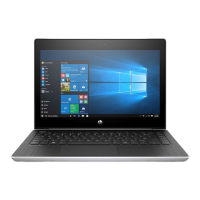
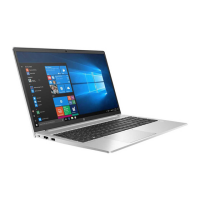
The HP ProBook 430 G8 is a notebook PC, serving as a portable personal computer for various applications, from productivity and communication to entertainment. Its core function is to process information, store data, and facilitate user interaction through a graphical interface. As a notebook, it integrates essential components such as a display, keyboard, and pointing device into a compact, mobile form factor. The device relies on a combination of printed circuit boards (PCBs), a central processing unit (CPU), memory modules, and storage devices to perform its computing functions. Power is supplied by a Li-Ion battery, enabling cordless operation, and an external power supply for charging and continuous use. The display, likely an LCD, provides visual output, while various internal cables and connectors facilitate communication between different modules. The presence of a fan indicates active cooling to maintain optimal operating temperatures for internal components. The device also incorporates several peripheral interfaces, such as USB (including Type-C), for connecting external devices and accessories. Network connectivity is provided through WLAN antenna cables, enabling wireless internet access. The inclusion of components like a Smart-Card Board and Finger-Printer Cable suggests features for enhanced security and user authentication, catering to professional or sensitive data environments. The overall design aims for a balance of performance, portability, and security features typical of a business-oriented notebook.
As a notebook PC, the HP ProBook 430 G8 offers a range of usage features common to its category. Its portability allows users to work or consume media on the go, without being tethered to a fixed location. The integrated keyboard and pointing device (likely a touchpad) provide the primary means of user input, enabling typing, navigation, and interaction with software applications. The display serves as the visual interface, presenting information, documents, and multimedia content. The Li-Ion battery provides a period of untethered operation, with its capacity determining the duration of use away from a power outlet. The external power supply is used for charging the battery and for powering the notebook when a wall outlet is available. Connectivity options, such as USB ports, allow for the attachment of external peripherals like mice, keyboards, external storage drives, and other accessories, expanding the device's functionality. The Type-C BKT (bracket) suggests support for USB Type-C, which often offers versatile connectivity for data transfer, video output, and power delivery. Wireless networking capabilities (WLAN) enable internet access and communication without physical cables, facilitating mobile productivity and online activities. Features like a Smart-Card Board and Finger-Printer are indicative of enhanced security measures, allowing for secure login, data protection, and compliance with corporate security policies. These features are particularly valuable in professional settings where data privacy and access control are critical. The presence of a fan ensures that the internal components remain cool during operation, preventing overheating and maintaining stable performance, especially during demanding tasks. The overall design prioritizes a user experience that is both functional and secure for a mobile computing environment.
The document primarily focuses on end-of-life disassembly for recycling, rather than routine user maintenance. However, the detailed disassembly steps provide insight into how the device might be serviced or repaired by qualified technicians. The modular design, where components like the base cover, battery, fan, main board, and various cables are individually removable, suggests that specific parts can be replaced if they fail. For instance, the instructions detail how to release the base cover screws, indicating that access to internal components is possible for maintenance or upgrades. The ability to release the battery via screws and a cable implies that the battery can be replaced if its capacity degrades over time, a common maintenance item for portable electronics. Similarly, the fan can be removed, suggesting that it could be cleaned or replaced if it becomes noisy or inefficient. The detailed steps for releasing various cables (DC-IN, Speaker, RTC-Battery, Finger-Printer, NFC, Backlight, KB, Smart-Card, EDP, WLAN antenna) indicate that these components are also replaceable, allowing for repairs of specific functionalities without needing to replace the entire device. The instructions also highlight the importance of sorting plastic materials into resin streams for recycling based on ISO 11469 markings, which is a maintenance consideration for the device's environmental footprint at the end of its life. While not explicitly user-serviceable, the design facilitates component-level repair and replacement by technicians, extending the device's lifespan and reducing electronic waste. The document's emphasis on selective treatment of materials like PCBs, batteries, and LCDs underscores a commitment to environmental maintenance, ensuring that hazardous or valuable materials are handled appropriately during disposal.
 General
| RAM | Up to 32 GB DDR4-3200 SDRAM |
|---|---|
| Storage | Up to 1 TB PCIe NVMe SSD |
| Weight | Starting at 1.28 kg (2.82 lbs) |
| Battery | HP Long Life 3-cell, 45 Wh Li-ion |
| Webcam | 720p HD camera |
| Processor | Intel Core i5/i7 |
| Display | 13.3" diagonal, FHD (1920 x 1080), anti-glare, 250 nits, 45% NTSC |
| Graphics | Intel Iris Xe Graphics |
| Operating System | Windows 10 Pro |
| Ports | 1 x HDMI 1.4b, 1 x headphone/microphone combo |
| Wireless | Intel Wi-Fi 6 AX201 (2x2) and Bluetooth 5 combo |


 To Next Page