1-25
Introducing the Switch
Switch Features
Switch Features
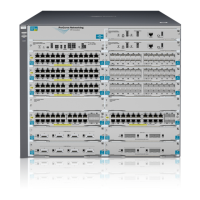
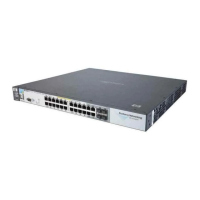
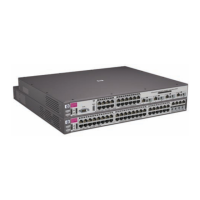
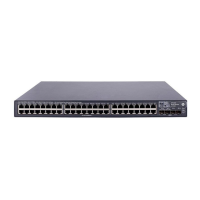
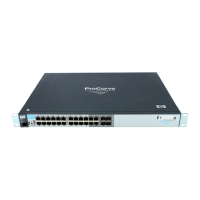
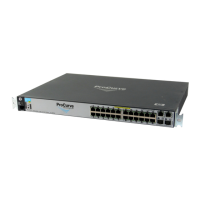
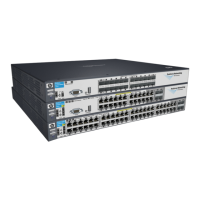
The features of the 3500, 3500yl and 6200yl Switches include:
■ The 3500yl have 24 or 48 auto-sensing 10/100/1000Base-T RJ-45 ports. The
3500 have 20 or 44 auto-sensing 10/100Base-T RJ-45 ports.
■ Four dual-personality ports—either the auto sensing 10/100/1000Base-T
RJ-45 or the SFP (mini-GBIC) transceivers can be used for each port.
■ The 6200yl provides 24 mini-GBIC ports.
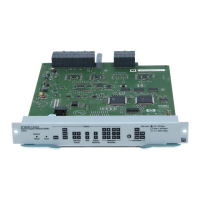
■ One module slot is provided in the back of the yl switches to support a
series of transceivers to provide connectivity to other switch boxes, to a
10 Gig concentrator or to any Ethernet compatible uplink.
■ An auxiliary (USB) port for processing a USB command file.
■ The switches can be connected to an HP ProCurve RPS/EPS and receive
redundant power from that unit. If the internal power supply in the switch
fails, the RPS/EPS unit will immediately provide all the power necessary
to keep the switch running.
■ Power over Ethernet (PoE) operation—the 3500-24-PoE, 3500-48-PoE and
3500yl-24G-PWR, 3500-48G-PWR switches are IEEE 802.3af standard
compliant and provide up to 15.4 W per port to power IP phones, wireless
access points, web cameras, and more. For more information, see the HP
ProCurve Power over Ethernet (PoE/PoE+) Planning and Implementa-
tion Guide which is on the HP ProCurve Web site, www.hp.com/go/
procurve/manuals.
■ Power over Ethernet (PoE+) operation—the 3500yl-24G-PoE+ and 3500-
48G-PoE+ switches are IEEE 802.3at standard compliant and provide up
to 30 W per port to power IP phones, wireless access points, web cameras,
and more. For more information, see the HP ProCurve Power over
Ethernet (PoE/PoE+) Planning and Implementation Guide which is on
the HP ProCurve Web site, www.hp.com/go/procurve/manuals.
■ Plug-and-play networking—all ports are enabled—just connect the
network cables to active network devices and your switched network is
operational.
■ Auto MDI/MDI-X on all 10/100 and 10/100/1000 twisted-pair ports, meaning
that all connections can be made using straight-through twisted-
pair cables. Cross-over cables are not required, although they will also
work. The pin operation of each port is automatically adjusted for the
attached device: if the switch detects that another switch or hub is
connected to the port, it configures the port as MDI; if the switch detects
that an end-node device is connected to the port, it configures the port as
MDI-X.


 To Next Page
 Loading...