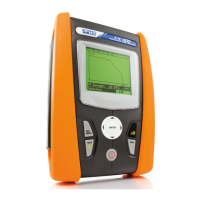
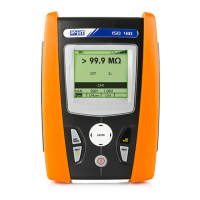
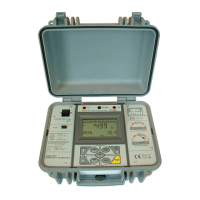
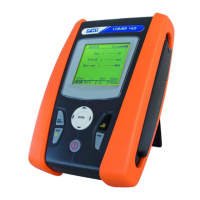
This document describes the SOLAR I-Vw, SOLAR I-Ve, I-V400w, and I-V500w instruments, which are designed for testing photovoltaic systems.
Function Description
The instruments are designed to perform complete yield tests on single-phase and three-phase PV installations. They calculate the I-V curve, measure the DC/AC inverter characteristics, and determine the maximum power point (MPPT) of photovoltaic plants. The devices are capable of measuring the DC power generated by the photovoltaic field and the AC power supplied by the inverter.
The instruments can perform the following tests:
- Check Single-phase PV installations (EFF – SOLAR I-Vw and SOLAR I-Ve):
- DC voltage and current measurements (1000V for SOLAR I-Vw / I-V400w, 1500V for SOLAR I-Ve / I-V500w).
- AC TRMS voltage and current measurements.
- DC/AC TRMS power measurement.
- Solar irradiation (W/m²) measured by use of a reference cell connected to unit SOLAR-02.
- Module and environment temperature measured by means of a probe connected to SOLAR-02.
- Use of compensation relationships on PDC measurements.
- Immediate evaluation of result OK/NO of a test.
- Checks with programmable IP from 5s to 60min.
- Testing Single/Three-phase PV systems (MPP – SOLAR I-Vw, SOLAR I-Ve + MPP300):
- Measurement of 3 DC voltages and currents.
- Measurement of 3 DC string power and total DC power.
- Measurement of 3 AC TRMS voltages and currents.
- Measurement of total AC power.
- Irradiation (W/m²) measured by means of a reference cell connected to SOLAR-02.
- Module and environment temperature measured by means of a probe connected to SOLAR-02.
- Application of compensation relationships to DC efficiency.
- Immediate evaluation of result OK/NO of a test.
- Parameter recording of a PV system with 5s to 60min programmable IP.
- I-V Curve Measurement:
- Voltage, current, power of PV module/string (1000VDC, 15ADC for SOLAR I-Vw / I-V400w; 1500VDC, 15ADC for SOLAR I-Ve / I-V500w).
- Activation of manual or automatic measurement.
- PV module/string temperature measurement.
- Irradiance measurement (W/m²) by using a reference cell.
- Numerical and graphical results of I-V curve with 4-wire method.
- Comparison of results with standard conditions (STC) and OK/NO final response.
- Internal customizable database for definition up to 30 PV modules.
- Annual degradation evaluation of PV modules/strings/fields.
- Internal memory for saving test and Optical/USB interface for PC connection.
- Quick Check (IVCK):
- Fast test of open voltage and short circuit current up to 1000V DC, 15A (SOLAR I-Vw / I-V400w) and up to 1500VDC, 15A (SOLAR I-Ve / I-V500w).
- Activation of manual or automatic measurement.
- Immediate evaluation (OK/NO) of test results.
Important Technical Specifications
VDC Voltage (SOLAR I-Vw / I-V400w):
- Range: 15.0 – 999.9 V
- Resolution: 0.1 V
- Accuracy: ±(0.5%rdg + 2dgt)
VDC Voltage (SOLAR I-Ve / I-V500w):
- Range: 15.0 – 99.9 V, 100.0 – 1499.0 V
- Resolution: 0.1 V, 0.3 V
- Accuracy: ±(0.5%rdg + 2dgt)
AC TRMS Voltage:
- Range: 50.0 – 265.0 V
- Resolution: 0.1 V
- Accuracy: ±(0.5%rdg + 2dgt)
- Max crest factor: 1.5
DC Current (by external transducer clamp):
- Range: -1100 – -5 mV, 5 – 1100 mV
- Resolution: 0.1 mV
- Accuracy: ±(0.5%rdg + 0.6mV)
AC TRMS Current (by external transducer clamp):
- Range: 1 – 1200 mV
- Resolution: 0.1 mV
- Accuracy: ±(0.5%rdg + 0.6mV)
- Max crest factor: 2.0
DC Power (Vmis > 150V) (SOLAR I-Vw / I-V400w):
- FS clamp [A]: 1-10, 10-100, 100-1000
- Range [W]: 0.000k-9.999k, 10.00k-99.99k, 0.00k-99.99k, 100.0k-999.9k
- Resolution [W]: 0.001k, 0.01k, 0.1k
- Accuracy: ±(0.7%rdg + 3dgt) (Imis < 10%FS), ±(0.7%rdg) (Imis ≥ 10%FS)
Frequency:
- Range: 47.5 – 63.0 Hz
- Resolution: 0.1 Hz
- Accuracy: ±(0.2%rdg + 1dgt)
Irradiance (with reference cell):
- Range: 1.0 – 65.0 mV
- Resolution: 0.1 mV
- Accuracy: ±(1.0%rdg + 5dgt)
Temperature (with auxiliary probe):
- Range: -20.0 – 100.0 °C
- Resolution: 0.1 °C
- Accuracy: ±(1.0%rdg + 1°C)
General Safety:
- Instrument safety: IEC/EN61010-1
- EMC: IEC/EN61326-1
- Technical literature: IEC/EN61187
- Accessory safety: IEC/EN61010-031
- Measurements: IEC/EN60891 (I-V curve test), IEC/EN 60904-5 (Temperature measurement)
- Insulation: Double insulation
- Pollution level: 2
- Category of measure: CAT II 1000V DC, CAT III 300V to ground (Max 1000V among inputs P1, P2, C1, C2 for SOLAR I-Vw / I-V400w; Max 1500V among inputs P1, P2, C1, C2 for SOLAR I-Ve / I-V500w)
Display and Memory:
- Display: LCD custom, 128x128 pxl, backlighted
- Memory capacity: 256kbytes
- Saved data: 99 yield tests (SOLAR I-Vw/I-Ve); 249 I-V, 999IVCK
- PC interface: optical/USB and WiFi
RF Module Specifications:
- Frequency range: 2.400 ÷ 2.4835GHz
- R&TTE category: Class 1
- Max transmission power: 30µW
- Max distance of RF connection: 1m
PV Yield Test (SOLAR I-Vw or SOLAR I-Ve):
- Integration period (IP): 5,10,30,60,120,300,600,900,1800,3600s
- Memory autonomy SOLAR-02: approx 1.5 hours (@ PI = 5s), approx 8 days (@ PI = 600s)
- Max distance RF connection: 1m (3.3 ft)
- Memory of SOLAR-02 - MPP300: approx. 1.5 hours (@ PI = 5s), approx. 8 days (@ PI = 600s)
Power Supply:
- Battery type: 6 x1.5 V alkaline type AA LR06
- Consumption: 1W
- Low battery indication: symbol "1" is displayed
- Battery life: approx 120 hours (PV Yield test), approx 249 I-V curve test, 999 IVCK test
- Auto power off: after 5 minutes of idleness
Mechanical Data:
- Dimensions (L x W x H): 235 x 165 x 75mm ; 9 x 6 x 3in
- Weight (batteries included): 1.2kg (42 ounces)
Environment Conditions:
- Reference temperature: 23° ± 5°C (73°F ± 41°F)
- Working temperature: 0 ÷ 40°C (32°F ÷ 104°F)
- Relative humidity allowed: <80%RH
- Storage temperature: -10 ÷ 60°C (14°F ÷ 140°F)
- Storage humidity: <80%RH
- Max height of use: 2000m (6562 ft)
Usage Features
The instrument features a user-friendly interface with a main menu that allows selection of different measurement modes:
- I-V Test: For I-V curve measurements.
- EFF (Yield Test): For efficiency and performance ratio tests.
- SET (Settings): To configure various instrument parameters.
- DB (Modules): To manage the internal database of PV module characteristics.
- MEM (Data Recall): To recall and view stored measurement data.
- PC (PC Connection): To connect the instrument to a PC for data transfer.
Keypad Description:
- ON/OFF key: To switch on/off the instrument.
- ESC/MENU key: To exit the selected menu without confirming and to activate menu management.
- Arrows (▲▼◄►) keys: To move the cursor through the different screens, set desired programming parameters, confirm modifications, and select functions from the menu.
- ENTER key: To confirm modifications and selected programming parameters, and to select the function from the menu.
- GO/STOP key: To start measurements.
- SAVE key: To save measured values.
- HELP key (long pressure): To display an indicative outline of the connections between the instrument and the system being tested.
- Light key (short pressure): To turn on the display’s backlighting.
Display Description:
The display is a graphic module with a resolution of 128 x 128 dots. It shows the system date/hour and battery charge indicator. The bottom part of the display shows the functionality of the ENTER key and the active mode. A flashing symbol "1" indicates that the instrument is currently searching for a radio connection with the selected remote unit (SOLAR-02 or MPP300).
Initial Screen:
When turning on the instrument, the display shows the initial screen for a few seconds, including:
- The instrument’s model.
- The manufacturer’s name.
- Internal presence of modules for RF (Radio Frequency) and WiFi connection.
- The serial number (SN) of the instrument.
- The firmware version (FW) in the instrument’s memory.
- The date of the last calibration (Calibration date).
Instrument Settings:
The settings menu allows configuration of:
- General: Measurement units, Date/Time, Remote unit/Solarim, Irradiance, DC Clamp (SOLAR I-Vw or SOLAR I-Ve).
- EFF Settings: Settings for testing PV systems (SOLAR I-Vw or SOLAR I-Ve).
- DB (Module Database): To manage the PV module database.
Connecting to a PC:
The instrument can be connected to a PC via an optical/USB cable (C2006) or via WiFi. Data management software (TopView) is required for data transfer.
Maintenance Features
General:
The instrument is a precision instrument. Users should observe recommendations for use and storage to prevent damage. Avoid high humidity, high temperatures, and direct sunlight. Always switch off the instrument after use. If unused for a long time, remove batteries to prevent leakage and internal circuit damage.
Battery Replacement:
When the low battery symbol "1" appears on the LCD display, or if the meter gives a "low battery" message during a test, batteries need to be replaced. This operation should be carried out by skilled technicians only, ensuring all cables are removed from the input leads.
- Switch off the instrument by pressing and holding the ON/OFF key.
- Remove cables from the input leads.
- Unscrew the cover fastening screw from the battery compartment and remove it.
- Remove all batteries and replace with new ones of the same type, respecting polarities.
- Restore the battery compartment cover and fasten it.
- Dispose of used batteries in appropriate containers.
Instrument Cleaning:
Use a dry and soft cloth to clean the instrument. Do not use wet cloths, solvents, or water.
End of Life:
The symbol "1" indicates that the equipment, batteries, and accessories must be collected separately and disposed of in the right way.

 Need help?
 General

 To Next Page