EasyManua.ls Logo

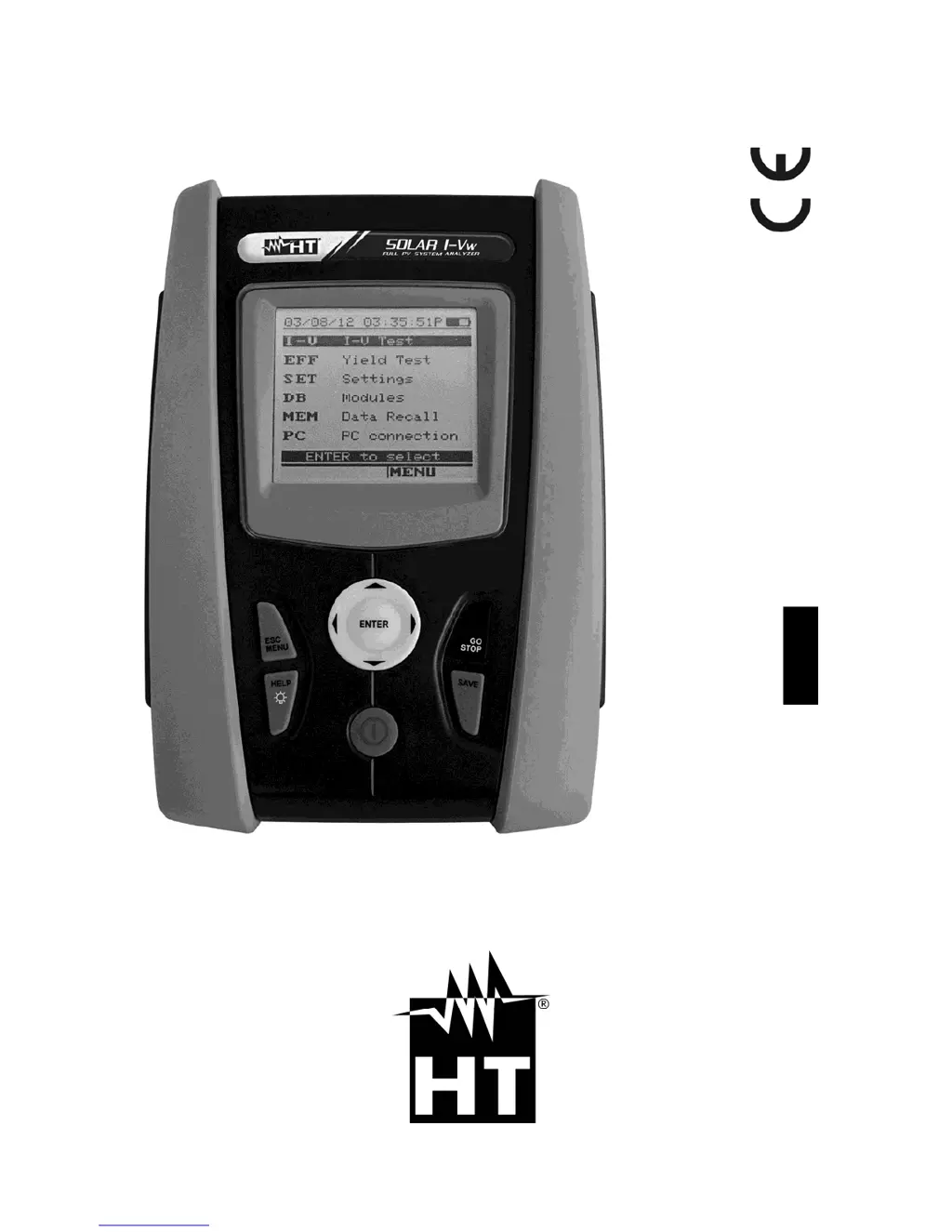
HT SOLAR I-Ve - User Manual

Default Icon
80 pages
Print Icon
To Next Page IconTo Next Page
Loading...
Copyright HT ITALIA 2017 Release EN 2.00 - 24/03/2017
I-V400w – SOLAR I-Ww
I-V500w – SOLAR I-Ve
User manual

Table of Contents

Questions and Answers

  • D
    Dawn JenkinsAug 7, 2025
    Why is the short circuit current high on my HT SOLAR I-Ve?
    • B
      Barbara PierceAug 7, 2025
      A high short circuit current in HT Measuring Instruments can occur if the irradiance sensor is not correctly oriented. Ensure it is properly oriented. Another cause might be shades or dirt on the irradiance sensor; in this case, clean the irradiance sensor or remove any obstruction. Also, verify that the module selection is correct in the PV system configuration and set the instrument properly. If the sensor is defective, replace it.
  • J
    James HardyAug 12, 2025
    What to do if the short circuit current is low on HT SOLAR I-Ve?
    • S
      staceyjohnsonAug 12, 2025
      Low short circuit current in HT Measuring Instruments can be caused by several factors. Ensure the irradiance sensor is correctly oriented. Reflections on the sensor can also cause this issue, so set the instrument properly. Check for environmental contaminants on the modules, such as soiling, dirt, snow, or debris, and clean the modules or remove any obstructions. Far distance obstructions (shading) may also be the cause, or aging; check the modules for blindness or humidity and replace affected modules if necessary. Also, ensure that the module selection is correct in the PV system configuration.
  • M
    Matthew BradyAug 17, 2025
    Why is the open circuit voltage low on my HT SOLAR I-Ve?
    • C
      Caleb WashingtonAug 17, 2025
      A low open circuit voltage in HT Measuring Instruments may be due to a low temperature measurement; attach the thermocouple properly to a typical temperature location. It can also result from an incorrect number of module selections in the PV system configuration; in this case, select the AUTO mode. Shorted bypass diodes could also be the cause; set the instrument properly. In some cases, replacing affected modules is also a solution.
  • C
    Caleb HernandezAug 21, 2025
    How to fix a non-linear characteristic curve on HT SOLAR I-Ve Measuring Instruments?
    • C
      Christina SimpsonAug 22, 2025
      A characteristic curve that is not linear in HT Measuring Instruments may be due to unsteady irradiation during measurement; re-test when clouds are gone. Leopard spot clouds shading the modules can also cause this; repeat measurement at an irradiation of minimum 700W/m2 (IEC/EN61829). Also, low irradiation during measurement can be the reason.
  • K
    Kerri JimenezAug 27, 2025
    What causes a low current ratio Impp/Isc in HT SOLAR I-Ve?
    • D
      Diana Phillips MDAug 27, 2025
      A low current ratio Impp/Isc in HT Measuring Instruments can occur due to soiling across modules; clean the modules. Tapered shades can also cause this; un-shade the modules. A small current mismatch may be the reason; check the current match. Degradation of cell shunt resistance can also be a factor; replace affected modules.
  • A
    Alexander CooperSep 1, 2025
    What to do if the voltage ratio Vmpp/Voc is low on HT Measuring Instruments?
    • A
      Ashley SmithSep 1, 2025
      A low voltage ratio Vmpp/Voc in HT Measuring Instruments can be caused by a voltage drop on cables to the PV module string; check cables, connectors, contacts, and string wirings. Also, check cable length and cross section. Check modules for bad connections or oxidation. Replacing affected modules might also be necessary.

Summary

Safety Precautions and Procedures

1.1. Preliminary Instructions

General instructions for safe use and preparation of the instrument.

1.2. During Use

Recommendations and instructions for safe operation of the instrument.

General Description

2.2. Instrument Features

Lists the various tests and functions the instrument can perform.

Main Menu

5.1. SET - Instrument Settings

Configuration options for instrument settings like language, date, and units.

5.2. EFF - Settings for Testing PV Systems

Settings related to PV system testing, including inverter and plant parameters.

5.3. DB - Module Database

Managing the database of PV modules for accurate testing.

How to Operate

6.1. Testing PV Systems (SOLAR I-VW or SOLAR I-VE)

Procedures for testing PV systems with single/multi-MPPT inverters.

6.2. I-V Curve Measurement

Detailed guide on performing I-V curve measurements.

6.3. Quick Check on PV Modules and Strings (IVCK)

Instructions for performing rapid PV module and string checks.

6.3.1. General Information

Overview of the IVCK function for rapid PV checks.

6.3.2. Preliminary Settings

Configuration steps before performing IVCK tests.

6.3.3. Fast Check IVCK Without Irradiance Measurement

Procedure for IVCK tests without irradiance data.

6.3.4. Fast Check IVCK With Irradiance Measurement

Procedure for IVCK tests including irradiance measurement.

Storing Data

Connecting the Instrument to a PC

Technical Specifications

HT SOLAR I-Ve Specifications

General IconGeneral
BrandHT
ModelSOLAR I-Ve
CategoryMeasuring Instruments
LanguageEnglish

Related product manuals