
 Need help?
Do you have a question about the Huawei MediaPad T3 10 and is the answer not in the manual?
This document serves as a Quick Start Guide for the HUAWEI MediaPad T3 10, providing essential information for its setup, operation, and maintenance. It covers various aspects from initial device overview to safety guidelines, regulatory compliance, and disposal information, ensuring users can effectively and safely utilize their new device.
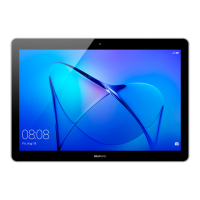
The HUAWEI MediaPad T3 10 is a portable electronic device designed for various functions, including communication, entertainment, and productivity. It features a front camera for video calls and selfies, and a rear camera for capturing photos and videos. The device includes a microphone for audio input, a headset jack for private listening, and a speaker for audio output. A Micro-USB port is provided for charging and data transfer, and a card tray allows for the insertion of a SIM card and a microSD card to expand storage or enable cellular connectivity. The device is powered by a battery and can be charged using a compatible power adapter. It operates on various frequency bands, including GSM, WCDMA, LTE, Wi-Fi, and Bluetooth, enabling wireless communication and internet access. The device runs on a specific software version, which may receive updates from the manufacturer to improve functionality and fix bugs.
To begin using the HUAWEI MediaPad T3 10, users should first familiarize themselves with its physical layout. The device can be powered on by pressing and holding the power button until the screen illuminates. To power off, the power button should be pressed and held, followed by touching the appropriate on-screen option. In cases where the device becomes unresponsive, a forced restart can be performed by pressing and holding the power button until the device vibrates.
Setting up the device involves inserting the necessary cards. The card tray accommodates both a SIM card and a microSD card. It is crucial to ensure that the device is powered off before inserting or removing any cards. When inserting, the cards must be correctly aligned within the tray, and the tray itself should be level to prevent damage. An eject pin is provided to open the card tray; users should exercise caution to avoid scratching the device or injuring themselves with the pin. It is important to use only standard SIM and microSD cards, as cut or modified cards may not be recognized and could damage the card tray.
For further assistance and information, the device offers several resources. Users can access online user guides, forums for community support, and service center information directly from the device's interface. Additionally, Huawei's official website provides user guides, frequently asked questions, and contact information for support hotlines specific to different countries or regions. Legal information, safety information, authentication details, and certification logos related to the product can also be accessed through the device's settings menu.
The device's wireless capabilities allow for connectivity to various networks. It supports WLAN for internet access, with specific restrictions on frequency bands depending on the region (e.g., indoor use only for 5150 to 5350 MHz in the EU). Bluetooth functionality enables connection to other compatible devices. When using the device in an aircraft, it is essential to follow the provided instructions to avoid disrupting wireless networks or creating hazards.
Maintaining the HUAWEI MediaPad T3 10 involves adhering to several safety and operational guidelines to ensure its longevity and safe performance. To prevent hearing damage, it is recommended to avoid listening at high volume levels for extended periods. Only approved or compatible power adapters, chargers, and batteries should be used, as unauthorized accessories can damage the device, shorten its lifespan, or pose fire or explosion risks.
The device operates optimally within a temperature range of 0 °C to 35 °C and should be stored between -40 °C and +70 °C. It is important to keep the device and its battery away from excessive heat and direct sunlight, and not to place them on or near heating devices such as microwave ovens, stoves, or radiators.
When charging, the power adapter should be plugged into an easily accessible socket near the device. The charger should be unplugged from both the electric socket and the device when not in use. The device should not be used, stored, or transported in environments where flammable or explosive materials are present, such as petrol stations or chemical plants, as this increases the risk of explosion or fire.
To prevent damage to internal circuits, the device should not be used in dusty, smoky, damp, or dirty environments, or near strong magnetic fields.
Disposal of the device, its battery, and accessories must be done according to local regulations. They should not be discarded with normal household waste. Proper collection and recycling are crucial for conserving valuable materials, protecting human health, and safeguarding the environment. Improper handling or recycling can be harmful. Information on proper disposal can be obtained from local authorities, retailers, or Huawei's website.
The device complies with regulations regarding the restriction of hazardous substances, such as EU REACH, RoHS, and Battery regulations. Further details on conformity can be found on Huawei's certification website.
For individuals with pacemakers, a minimum distance of 15 cm should be maintained between the pacemaker and the wireless device to prevent interference. The device should be held on the side opposite the pacemaker and not carried in a front pocket.
When driving, local laws and regulations must be adhered to, and the device should not be used to reduce the risk of accidents. If a call must be made or answered, the vehicle should be stopped in a safe location first.
In areas with potentially explosive atmospheres, the device must be powered off, and all signs and instructions complied with. This includes refueling points, fuel depots, storage and distribution areas, chemical plants, and areas where blasting operations are in progress.
All software versions released by the manufacturer are verified and compliant with relevant rules. RF parameters are not user-accessible or changeable. Information on accessories and software updates can be found in the Declaration of Conformity.
 General
| Resolution | 1280 × 800 lpi |
|---|---|
| Connectivity technology | Wireless |
| LED backlight | No |
| Pixel density | 157 ppi |
| Display diagonal | 9.6 \ |
| Touch technology | Multi-touch |
| Display brightness | 300 cd/m² |
| Display resolution | 1280 x 800 pixels |
| Processor cores | 4 |
| Processor model | MSM8917 |
| Processor family | Qualcomm Snapdragon |
| Processor frequency | 5 GHz |
| Internal memory | 3 GB |
| Internal memory type | - |
| Maximum internal memory | 32 GB |
| Card reader integrated | Yes |
| Internal storage capacity | - GB |
| Sustainability certificates | ENERGY STAR |
| Cables included | Micro-USB |
| Rear camera type | Single camera |
| Rear camera resolution (numeric) | 5 MP |
| Front camera resolution (numeric) | 2 MP |
| Battery capacity | 4800 mAh |
| Platform | Android |
| Wi-Fi standards | 802.11a, 802.11b, 802.11g, Wi-Fi 4 (802.11n) |
| Top Wi-Fi standard | 802.11a |
| HDMI ports quantity | 0 |
| Mini-USB 2.0 ports quantity | 1 |
| Device type | Mobile tablet |
| Form factor | Slate |
| Product color | Gray |
| Audio formats supported | 3GP, AAC, AMR, FLAC, M4A, MID, MP3, OGG, WAV |
| Video formats supported | 3G2, 3GP, AVI, DIVX, FLV, M4V, MKV, MOV, MP43, TS, WEBM |
 Weight and Dimensions
| Depth | 7.95 mm |
|---|---|
| Width | 229.8 mm |
| Height | 159.8 mm |
| Weight | 460 g |






 To Next Page