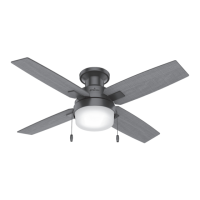
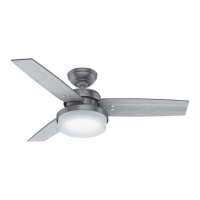
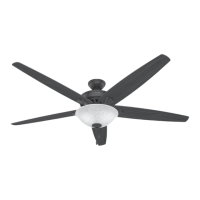
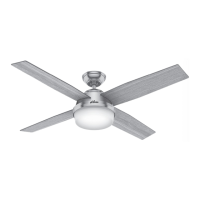
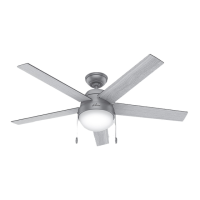
This document provides installation and operation instructions for the Swanson ceiling fan, available in New Bronze (50881), Matte Silver (50882), and Fresh White (50885) finishes. The fan has a weight of 15.2 lbs (6.9 kg).
Function Description
The Swanson ceiling fan is designed to provide comfort and improve air circulation in residential or office environments. It features a multi-blade design with an integrated light kit, offering both illumination and air movement. The fan operates by rotating its blades to create airflow, which can be adjusted for direction to suit seasonal needs. The light kit provides ambient lighting, making the fan a dual-purpose fixture. The fan is intended for direct mounting to a building structure or a fan-rated outlet box capable of supporting at least 70 lbs (31.8 kg).
Usage Features
- Installation: The manual provides a quick install guide with step-by-step instructions for assembly. It outlines the necessary tools, including a ladder, screwdriver, pliers, and wire strippers, with optional tools like a drill and 9/64" drill bit for specific mounting scenarios.
- Mounting Options: The fan can be secured using either machine screws (for existing ceiling fan-rated outlet boxes) or wood screws (for support structures with an approved electrical outlet box). Pilot holes are recommended for wood screw installations.
- Downrod Assembly: The fan utilizes a downrod for hanging, and instructions are provided for both standard and alternative downrod lengths. Proper assembly of the downrod and secure seating of the hanger ball in the ceiling bracket are emphasized for safety.
- Blade Installation: The blades are attached to blade irons, which are then secured to the motor. The manual advises removing shipping blocks from the motor before blade iron installation and saving the screws for this step.
- Light Kit Installation: The fan includes a light kit with multiple sockets. Users are instructed to install bulbs of the same type and wattage as necessary. A pull chain pendant is connected to a short chain from the switch housing for operation.
- Wiring: Detailed wiring instructions are provided for both single-switch and dual-switch configurations.
- Grounding: The manual stresses the importance of grounding the ceiling fan, connecting all grounding wires (green, green/yellow stripe, or bare copper) from the ceiling, downrod, and hanging bracket.
- Single Switch: For a single-switch setup, the white (grounded) wire from the ceiling connects to the white wire from the fan, and the black (ungrounded) wire from the ceiling connects to both the black and blue wires from the fan.
- Dual Switch: In a dual-switch configuration, the white (grounded) wire from the ceiling connects to the white wire from the fan. The black (ungrounded) wire from the ceiling connects to the black wire from the fan, and a second ungrounded (light) wire from the ceiling connects to the blue wire from the fan.
- Wire Connections: Users are instructed to hold bare metal leads together, place a wire connector over them, and twist clockwise until tight. Splices should be pushed carefully back into the outlet box, with grounded and ungrounded wires spread apart.
- Operation: The fan is operated via a pull chain. It also features a motor reversing switch, allowing users to change the direction of blade rotation for different seasonal needs (e.g., downdraft for cooling in summer, updraft for heat circulation in winter).
- Safety Warnings: The manual includes several warnings to ensure safe installation and operation:
- Mounting: Emphasizes mounting the fan directly to a building structure or a fan-rated outlet box.
- Power Disconnection: Instructs users to disconnect power at the circuit breakers before installation or servicing.
- Wall Control: Requires installation with an isolating wall control/switch.
- Blade Handling: Warns against bending blade brackets or inserting foreign objects between rotating blades.
- Grounding: Highlights the necessity of grounding the fan and consulting a qualified electrician if a ground wire is absent.
- Wiring Codes: All wiring must comply with national and local electrical codes (ANSI/NFPA 70).
- Fan Fall Hazard: Advises tightening setscrews with pliers and verifying downrod assembly by firmly pulling on the hanger ball.
- Fan Damage: Recommends lifting the fan by its housing or downrod to prevent damage.
- FCC Compliance: The device complies with Part 15 of the FCC Rules, designed to provide reasonable protection against harmful interference. Users are advised on measures to correct interference if it occurs.
Maintenance Features
- Troubleshooting: The manual provides a troubleshooting section to address common issues:
- Fan Doesn't Work: Suggestions include checking the power switch, pull chain, motor reversing switch, circuit breaker, blade spin freedom, and wiring connections.
- Excessive Wobbling: Recommendations include ensuring blades are properly installed, checking hanger ball seating, and using a provided balancing kit.
- Noisy Operation: Advises checking blade installation and inspecting blades for cracks.
- Cleaning: While not explicitly detailed, the troubleshooting section implies that proper maintenance includes ensuring blades are free from damage and correctly installed, which would typically involve periodic inspection and cleaning.
- Replacement Parts: The manual states that only Hunter replacement parts should be used.
- Warranty: Hunter provides a Limited Lifetime Warranty for the motor and a One-Year Limited Warranty for other parts. LED light kits may have a Three-Year Limited Warranty. Proof of purchase is required for warranty service. The warranty covers defects in material or workmanship but excludes labor costs, light bulbs (unless noted), remote control batteries, fans purchased outside the US, unauthorized dealer purchases, ordinary wear and tear, cosmetic blemishes, refurbished fans, and damage due to improper installation, misuse, abuse, care, or modifications. It also excludes improper voltage supply, power surges, and acts of God.

 Need help?
 General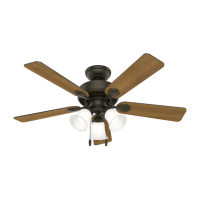

 To Next Page