EasyManua.ls Logo

Husqvarna Zig Zag - Buttonhole operations; Sewing buttonholes

Husqvarna Zig Zag
27 pages
Print Icon
To Next Page IconTo Next Page
To Previous Page IconTo Previous Page
Loading...
Buttonhole,[oot,
Butrtonhole
punch"
Snap fasteners,
hooks,
eyes,
e[c.
can be
sev/rl
on in
the
same
way.
Sewing
Eiumonholes"
Use the
burtonhole
presser
foor
for
sewing
buttonholes.
The
length
of
stitches
should
be
ser
for
very
short
zig-zag,
say
2
mm.
The
first
side
of
the burtonhole
is
se.wn
very
slightly
longer
than
rhe
intended
hole.
At
rhe
last
stitch
rhe
needle
should
be
ro
rhe
righr
and
rhe
machine
stopped
so
that
the
needle
remains
in
the
cloth.
Lifr
the
buttonhole
foot
and
turn
rhe
piece
of
work
round,
sew
one
stitch,
lift
the
presser
foot,
and
alter
rhe zig-zag
breadth
ro
4
mm
with
the
needle
still
in
the
clorh.
Lower
the presser
foot
and
sew
a few
braid
stitches,
which
musr
lie
very
close
rogether,
and
for
this
reason
the
cloth
should
be
pulled
gently
so
as
to
slow
the
feed.
Finish
the
lasr
stitch
ro
rhe
left.
\Mith
the
needle
down
in
the
cloth,
lift
ahe
presser
foot,
reser
the
zig-zag
breadth
ro 2
mm,
lower
the foor
and
sew
the
other
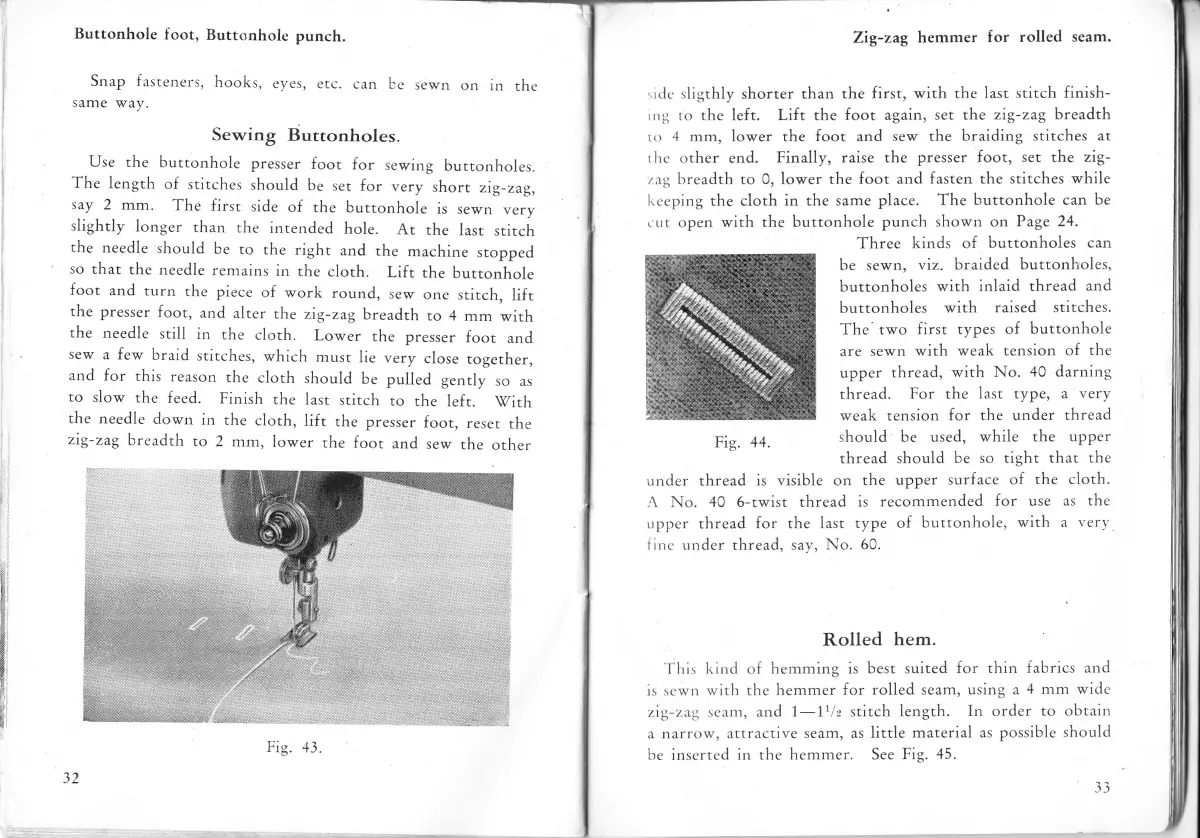
Fig.
43.
32
be
inscrtcd
in the
hemmer. See
Fig.
45.
Zig-zag
hemmer
for
rolled
seam.
,,itlc
sligthly
shorter
than the
first, with the
last
stitch finish-
r,l{
to the
left.
Lift
the
foot
again,
set the
zig-zag breadth
r rr
4
mm,
lower the
foot and
sew the
braiding
stitches at
r
lrc
other end.
Finally, raise the
presser
foot,
set
the
zig-
,,rii
breadth
to
0, lower
the
foot
and
fasten
the
stitches
while
liccping
the
cloth in the same
place" The
buttonhole can be
r'r.rt open with the
buttonhole
punch shown
on
Page 24.
Three
kinds
of
buttonholes
can
be sewn,
viz.
braided
buttonholes,
buttonholes
with
inlaid
thread and
buttonholes
with
raised
stitches"
The two
first types
of
buttonhole
are
sewn
with weak
tension
of
the
upper
thread,
with No.
40 darning
thread.
For the last
type,
a Yery
weak tension
for
the
under
thread
should be used,
while the
upper
thread
should
be so tight
that the
under thread is
visible on
the
upper
surface
of
the
cloth.
A
No.
40 6-twist thread
is
recomrnended
for use
as
the
rrpper
thread
for
the last
type
of
buttonhole,
with
a \rery
{inc
under thread, sxy,
No. 60.
Rolled hem"
is
best suited
for thin
fabrics
and
for
rolled seam,
using a
4 mm widc
stitch
length.
In
order
to obtair-r
as
little
material as
possible should
Fig.44.
'l'lris
liind
of hemming
is scwn
with
the
hemmer
zig-'t;rg scan-I, and
7-1,rlz
a narr()w"
attractlve seam,
JJ

Related product manuals