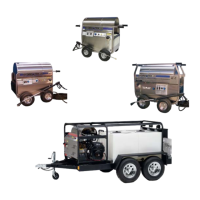
This document is an Operation and Maintenance Manual for Hydro Tek pressure washers, covering various series including CPS, CPX, HD, HP, HN, SM, SS, SCX, and SC. The manual provides comprehensive information for the safe and effective operation and maintenance of these cleaning equipment products.
Function Description
Hydro Tek pressure washers are designed for various cleaning applications, utilizing high-pressure water, and in many models, heated water or steam, to remove dirt, grease, and grime. The equipment can be powered by electric motors, gasoline engines, or diesel engines, and some units include generators for auxiliary power. Key functions include:
- Pumping System: A positive displacement, oil bath crankcase, triplex plunger pump propels water at high pressure.
- Heating System: Many models feature a Spiralast™ heating coil for hot water or steam generation. Burners can be diesel-fired, natural gas, or propane-fired, with electric HE Series models using heating elements.
- Chemical Injection System: Units may have either inlet chemical injection (low vacuum) or downstream chemical injection (low pressure) for applying cleaning solutions.
- Pressure Delivery System: Includes discharge hoses, trigger guns, spray wands, and various nozzles (0°, 15°, 25°, 40°, and turbo nozzles) for different spray patterns and cleaning intensity.
- Safety Features: Incorporates burst disc technology to protect the coil from high-pressure spikes, thermal overload protection for electric motors, high-temperature limit switches for burners, and pressure/flow switches to ensure the burner only fires when water is spraying.
- Accessories: Supports various accessories like wet sandblasters for abrasive cleaning, turbo nozzles for enhanced cleaning power, hose reels for storage, Hydro Twister® surface cleaners for consistent cleaning of flat surfaces, and Hot Link™ heat exchangers to convert cold water pressure washers into hot water units. Hydro Vacuum® wastewater recovery systems are also available for proper wastewater disposal.
Important Technical Specifications
- Pressure: Up to 4200 psi (for Spiralast™ heating coil).
- Water Temperature: Hot water mode up to 200°F; steam mode up to 250°F. Turbo nozzles have temperature limits (e.g., "Turbo Laser" up to 190°F, "Rotomax" up to 170°F).
- Electrical Requirements (Electric Motors):
- 1.5 HP-120V: AWG #14
- 2 HP-120V: AWG #12
- 5 HP-208/230V: AWG #10
- 6.5 HP-230V: AWG #10
- 8 HP-230V: AWG #8
- 10 HP-208/230V: AWG #6
- 6 HP-230V: AWG #12
- 7.5HP-230 & 480V: AWG #12
- 10 HP-480V: AWG #12
- 10HP-230V: AWG #10
- 10HP-208V: AWG #8
- Voltage reading under load should be +/- 10% of nameplate voltage.
- Water Supply: Inlet pressure between 25-60 psi; maximum inlet water temperature 145°F. Minimum ⅝" to ¾" I.D. hose (or ¾" steel pipe for Natural Gas heated HN models). Larger flow (8-10gpm) machines require 1” feed and filtration.
- Gas Pressure (Natural Gas): 4" water column at the outlet of the gas valve for 140° heat rise; 6-7" water column when burner is on.
- Gas Pressure (LPG): 7-11" water column.
- Diesel Burner Fuel Pressure: Typically set at 125 psi, adjustable up to 160 psi.
- Engine RPM (Gasoline/Diesel): 3600 RPM with no load (for 115V generator or 12V burner models).
- Generator Output (if equipped): 110-130 Volts (59-63 Hz) under full load. Maximum 1500 watts (burner on) or 2000 watts (burner off) for auxiliary outlet.
- Discharge Hose: Requires a special 250° rated hose for hot water machines.
- Wands: Wands less than 48" long should not be used with machines producing over 3200psi.
- Trailer Tire Pressure:
- T200 (14" tires): 50 psi
- T300 (13" tires): 35 psi
- T400 (14" tires): 50 psi
- T500 (14" tires): 50 psi
- Engine Oil Capacity: Gas Engine: 0.63 to 3 qt.; Diesel Engine: 3.25 qt.
- Pump Oil Capacity: Cat Hydraulic: 11-42 oz.; AR Hydraulic: 10-41 oz.; General: 11-42 oz.
Usage Features
- Start-up Procedures: Includes checking fluid levels (pump oil, engine oil, coolant), connecting hoses, turning on water supply, purging air from the system, selecting nozzles, and starting the heater/burner.
- Operation Modes: Supports hot water, steam (if equipped), and chemical injection. Dual wands allow for low-pressure and high-pressure modes.
- Washing Techniques: Recommends starting from the bottom up for washing and rinsing from the top down to prevent streaking. Advises using cold water for loose dirt and hot water/chemicals for grease, oil, and stubborn dirt.
- Safety Warnings: Emphasizes electrical precautions (grounding, GFCI, no extension cords), fire precautions (correct fuels, no flammable materials, ventilation), spray injection precautions (risk of skin penetration, proper wand length, eye protection), and personal hazard precautions (disconnect power before servicing, no trigger lock, avoid fatigue/drugs).
- Antifreeze Protection: Instructions for winterizing the equipment by running a water/antifreeze mix or blowing out with compressed air.
- Troubleshooting Guide: Provides detailed solutions for common problems related to the power system (gasoline/diesel engine, electric motor), water temperature, pumping system, and heating/burner system.
Maintenance Features
- Maintenance Schedule: A detailed schedule outlines daily, weekly, monthly, every 3 months, every 6 months, every 12 months, and every 50/100/500 hours maintenance tasks.
- Engine Maintenance: Includes inspecting/changing engine oil and filter, cleaning/replacing air filter, checking diesel engine coolant, battery level, fuel filter, spark plugs, and fuel tanks/lines.
- Pump Maintenance: Daily inspection of pump oil level and clarity, changing pump oil after initial break-in and then periodically.
- Burner Maintenance: Cleaning/replacing burner filter, removing soot, adjusting/cleaning burner, de-scaling coil, and checking/adjusting electrodes.
- General System Maintenance: Checking fasteners/exhaust elbow, replacing spray nozzles and quick connects, cleaning water screen/filter, float/supply tank, and replacing HP hose.
- Belt Drive Maintenance: Inspecting/tightening/replacing belts.
- Electric Motor Maintenance: Cleaning air vent.
- Trailer Maintenance: Monthly checks for tire condition, lug nut tightness, greasing, and checking bearings.
- Maintenance Log: A dedicated section for recording service dates, run hours, and performed services.
- Oil Type Information: Specifies recommended oil types and capacities for gas engines, diesel engines, and various pump models.
- Warranty Information: Details one-year parts & labor warranty, lifetime parts/one-year labor warranty for Spiralast™ coils, one-year parts warranty for accessories, and a two-year evaporative emissions control system warranty. Outlines items not covered and conditions for obtaining warranty service.



 To Next Page

 General