Need help?
Do you have a question about the HydroLogic StealthRO 300 and is the answer not in the manual?
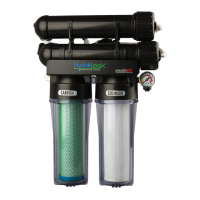
The stealthRO300 is a customized Reverse Osmosis water filter that is capable of reducing up to 99% of most contaminants. This system is designed and built for use with hydroponic or horticultural applications.
General safety guidelines and warnings for operating and maintaining the HydroLogic stealthRO300 system, including pressure, sunlight, and storage advice.
Diagram illustrating the components and water flow within a Reverse Osmosis membrane, detailing product water and waste water paths.
Guidance on when to replace pre-filters and RO membranes, including recommended schedules based on usage and water quality.
Details on the KDF85/Catalytic Carbon upgraded filter, its benefits, and its specific replacement schedule based on gallons purified.
Description of the first stage filter, its function to reduce dirt, sediment, silt, and rust.
Description of the second stage filter, which reduces chlorine and other toxins.
Description of the third stage, featuring two 150 GPD RO membranes that reduce Total Dissolved Solids (TDS).
Details on the inlet pressure gauge, its function to show dynamic line pressure and optimal operating zones.
Specifications of the included tubing: length, color, and size for inlet, waste, and purified water.
Description of the inline shut-off valve, used to turn the system on and off.
Description of the wrench included for loosening and tightening filter housings.
Details on the flow restrictor assembly, which determines waste to purified water ratio.
Description of the connector used to attach the system to a garden hose for water input.
Explains the function of 2:1 white and 1:1 purple flow restrictors for waste to purified water ratios.
Instructions on how to install the chosen flow restrictor into the flow restrictor/flush kit assembly.
Details on connecting the flow restrictor/flush kit assembly to the Automatic Shut-off Valve (ASOV).
Instructions to close the blue valve on the flow restrictor/flush kit assembly for normal operation.
Guide to connecting the inlet, purified water, and waste water tubing to the main RO system unit.
Steps for flushing the carbon pre-filter and membranes with water before use.
Procedure to check for leaks after flushing by pressurizing the system and observing connections.
Step-by-step guide on properly inserting tubing into QC fittings for a secure, leak-proof seal.
Procedure for safely releasing tubing from QC fittings, including tips for clean cuts and preventing leaks.
Detailed steps for removing and replacing the Reverse Osmosis membranes.
First step for changing RO membranes: removing the 1/4” tubing and detaching the housing clip.
Second step for changing RO membranes: gripping and twisting the membrane housing counter-clockwise to open.
Third step for changing RO membranes: using pliers to carefully pull out the old membrane.
Fourth step: inserting the new membrane correctly and re-securing the housing cap and tubing.
Fifth step: repeating the entire process for the second RO membrane.
Sixth step: running the system for 30-45 minutes to flush new membranes before use.
A chart showing the rejection percentages for various ions by the TFC RO membrane, serving as a general guideline.
Optional booster pump to increase pressure and flow rate, ideal for low-pressure situations.
Optional regulator to limit inlet pressure to below 85 psi, protecting the system from high pressure.
Optional float valve for unattended filling of tanks or reservoirs, preventing floods.
Optional upgraded filter that reduces chloramines, chlorine, iron, sulfur, and heavy metals.
Optional monitor to track gallonage and filter capacity, alerting when changes are needed.
Optional sleeve to cover filter housings, blocking light to prevent algae growth.
Optional monitor to measure and compare TDS levels of source and purified water.
Optional UV sterilizer kit to kill 100% of bacteria and viruses, ensuring safest water.
Optional leak detector that automatically shuts off water flow if a leak is detected.
Optional add-on kit for using the system for home drinking water alongside horticulture.
Optional DI kit to reduce TDS to absolute zero, removing final contaminants for purest H2O.
Information that various fittings are available to customize system setup, directing to website.
Information that extra tubing is available to customize system setup, directing to website.
Specifications for the Sediment filter, including micron rating, surface area, temperature limit, and media.
Specifications for the Green Coconut Carbon filter, highlighting its performance and features.
Specifications for the stealth-RO HydroLogic RO Membrane, including material and performance.
Crucial operating parameters for RO membranes, including pressure, temperature, flow rate, and water quality limits.
Specifications for the KDF85/Catalytic Carbon upgraded filter, detailing its media and contaminant reduction capabilities.
Explains how inlet pressure, temperature, and water quality affect the system's GPD and flow rate.
Discusses how high PPM, hardness, iron, and silica can shorten membrane lifespan.
Explains 'TDS creep' and the importance of waiting before taking PPM readings for accuracy.
Details warranty exclusions for lack of maintenance or operation outside parameters, and housing replacement schedule.
Warning that using non-original replacement filters or membranes will void the product's warranty.
Addresses slow flow rates in new systems, explaining factors like source water conditions and recommending solutions.
Explains reasons for decreased flow rate over time, including clogged filters, fouled membranes, or source water changes.
Explains increased PPM due to membrane deterioration from chlorine exposure, linked to carbon filter maintenance.
Explains waste to purified water ratios based on the type of flow restrictor used (2:1 vs 1:1).
Troubleshoots the waste line running continuously, potentially due to a clogged Automatic Shut-off Valve (ASOV).
Identifies causes of system leaks, such as improper fitting installation, O-rings, or tubing cuts.
Explains reasons for pre-filter housing cracks, including freezing, pressure spikes, or light exposure.
Explains pH variations in purified water, noting it depends on source water and is normal for RO technology.
Explains the purpose of offering both 1:1 and 2:1 flow restrictors to accommodate varying water conditions worldwide.
 General
| Product Type | Reverse Osmosis System |
|---|---|
| Membrane Type | Thin Film Composite (TFC) |
| Input Water Temperature | 40-100°F |
| Input Water Pressure | 40 - 80 psi |
| Storage Tank | Not included |
| Operating Pressure | 40 - 80 psi |
| Operating Temperature | 40-100°F |
| pH Range | 4 - 11 |
| GPD | 300 gallons per day |
| Filter Life | 6-12 months |

 To Next Page