Need help?
Do you have a question about the Hyundai HYSC-4000M and is the answer not in the manual?
Important safety measures when working near vehicle batteries to prevent hazards like sparks and explosions.
Guidelines for safe operation and placement of the battery charger unit to avoid electric shock and damage.
Explains standard modes like 12V STD, 12V AGM, and 6V STD for normal battery charging.
Details modes optimized for charging batteries in cold ambient temperatures (below 10°C).
Describes special modes designed to repair old, idle, or sulfated batteries.
Covers initial steps like diagnosis, desulphation, analysis, and soft start for battery preparation.
Explains the main charging phases where the battery receives power at constant and declining currents.
Details the final battery test and continuous monitoring for maintaining charge without overcharging.
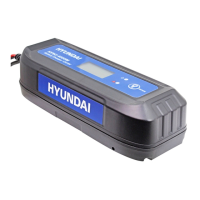
The HYUNDAI HYSC-4000M is a smart battery charger designed for the maintenance and charging of various 6V and 12V lead-acid batteries. This device is engineered to provide a safe, efficient, and user-friendly experience for battery care, incorporating intelligent features to optimize charging processes and protect both the battery and the user.
The primary function of the HYSC-4000M is to charge and maintain all types of 6V and 12V lead-acid batteries. This includes WET (Flooded), MF (Maintenance-Free), EFB (Enhanced Flooded Battery), GEL, and AGM (Absorbed Glass Mat) battery types. It is suitable for charging batteries with capacities ranging from 1.2 to 130 Amp-Hours and is capable of maintaining batteries of all sizes. The charger operates through an 8-step, full-automatic charging cycle, ensuring a comprehensive and optimized charging process.
A key feature of this charger is its built-in intelligent microprocessor, which facilitates faster, easier, and safer charging. This microprocessor manages the charging process, adapting to the battery's condition to prevent overcharging and damage. The device also includes an advanced battery recovery mode, specifically the "12V REPAIR" mode, designed for LEAD-ACID batteries. This mode aims to repair old, idle, stratified, or sulfated batteries by generating pulsing current to remove sulfate, which can extend battery life and improve performance. It's important to note that not all batteries can be recovered, and for optimal results, the battery should ideally go through a full charge cycle before using this repair mode.
The charger is equipped with several safety features to ensure secure operation. These include spark-proof connections, protection against reverse polarity, short circuits, overheating, and overcharging. These safeguards are crucial for preventing damage to the battery, the charger, and ensuring user safety during operation.
The HYSC-4000M offers a range of usage features that make it versatile and easy to operate. It has ten distinct charging modes: Standby, 12V STD, 12V COLD, 12V AGM, 12V AGM+COLD, 6V STD, 12V STD Repair, 12V COLD Repair, 12V AGM Repair, and 12V AGM+COLD Repair. Users must select the appropriate charge mode for their specific battery type and condition to avoid damage. A critical caution is provided: selecting a 12V mode for a 6V battery will damage the 6V battery.
The device features an auto-memory function, which allows it to return to the last selected mode when restarted, with the exception of the Repair Modes. This adds convenience by eliminating the need to re-select the mode for recurring charging tasks. The charging status is clearly indicated by the battery level indicator bars on the LCD screen. When these bars are flashing, the battery is actively charging. Once all five bars are solid, it signifies that charging is complete. The charger then automatically transitions from full charge to a maintenance status, preventing overcharging and ensuring the battery remains in optimal condition.
Connecting the charger to a battery involves specific steps to ensure safety and correct polarity. Users are instructed to identify the positive (POS, P, +) and negative (NEG, N, -) terminals of the battery. For negative grounded vehicles (the most common type), the RED POSITIVE clamp should be connected to the positive battery terminal first, followed by the BLACK NEGATIVE clamp to the negative battery terminal or vehicle chassis. For positive grounded vehicles (less common), the BLACK NEGATIVE clamp is connected first to the negative terminal, then the RED POSITIVE clamp to the positive terminal or vehicle chassis. Disconnecting follows the reverse sequence. An ERROR LED illuminates if battery clamps are reversely connected, prompting the user to correct the connection.
The LCD display provides comprehensive information through various icons. These include indicators for 12V STD Mode, 12V AGM Mode, COLD Mode, 6V STD Mode, Battery Level Indicator, Reverse Polarity Connection Indicator, Faulty Battery Indicator, Clamp Indicator (for open-circuit, dirty battery posts, dead battery, or output short circuit), and a Battery Voltage Indicator, which can be displayed by pressing and holding the Mode button for 3 seconds.
The charging process itself is an 8-step cycle:
The HYSC-4000M is designed with features that contribute to its longevity and reliable performance. Its robust construction and safety mechanisms inherently reduce the need for frequent maintenance. The charger is protected against rain and wet conditions, although it should not be exposed to them during operation. The housing protection rating of IP54 indicates a degree of protection against dust ingress and splashing water, enhancing its durability in various environments.
For optimal performance and safety, users are advised to clean battery terminals before connecting the charger, taking care to prevent corrosion from contacting eyes. The charger itself should not be covered while charging to ensure proper ventilation and prevent overheating.
In terms of repair and service, any damage to the charger, especially after a direct hit or drop, should prompt caution. It is recommended to have the device checked and repaired by the manufacturer or an authorized repair agent to avoid potential hazards and ensure continued safe operation. The design of the charger, with its intelligent microprocessor and automatic charging cycles, minimizes the risk of user error that could lead to damage to either the battery or the charger, thereby contributing to its overall maintenance-free operation under normal use. The auto-memory function also helps in maintaining consistent charging parameters, reducing the chance of incorrect settings that could lead to battery issues.
 General
| Battery Voltage | 12V/24V |
|---|---|
| Output Voltage | 12V/24V |
| Charging Mode | Automatic |
| Battery Type | Lead-Acid, AGM, GEL |
| Protection Features | Overcharge, Short Circuit, Reverse Polarity |

 To Next Page