Need help?
Do you have a question about the ICON Aurora and is the answer not in the manual?
Lists the included items with the microphone, shock mount, and carry case.
Explains the need for a phantom power supply for the condenser microphone.
Guides on adjusting input levels and using the peak LED indicator for proper gain staging.
Discusses positioning for optimal sound, proximity effect, and off-axis adjustments.
Explains pop sounds caused by plosive syllables like 'P' and how to avoid them.
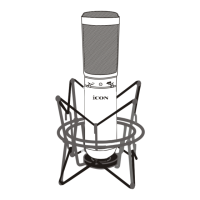
Instructions on attaching the microphone to the suspension mount and pop guard.
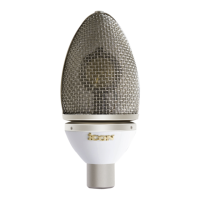
The ICON Pro Audio Aurora is a large-diaphragm studio condenser microphone designed for professional audio recording. It boasts a blend of vintage sound clarity with a distinctive intergalactic design, making it suitable for a wide range of voice and instrument applications.
The Aurora functions as a high-quality condenser microphone, requiring 48V phantom power to operate. This power is typically supplied by most quality mixers, outboard mic pre-amplifiers, or hard disk recorders. The microphone receives phantom power directly through a standard microphone cable when connected to a compatible input. Its primary function is to capture audio with a high degree of clarity, delivering a full, open sound and excellent audio quality. The microphone features a cardioid pickup pattern, which is crucial for outstanding sound source separation and effective feedback rejection. This pattern ensures that the microphone primarily captures sound from the front, minimizing unwanted noise from the sides and rear. The pressure-gradient transducer, coupled with a shock-mounted capsule, contributes to its sensitivity and accurate sound reproduction.
The Aurora is designed for versatile use in studio environments, excelling in recording vocals and acoustic instruments. Setting up the microphone involves connecting it to an input that provides 48V phantom power. Users should ensure the phantom power is engaged on their mixer or recorder. To optimize the signal level, the microphone should be positioned in front of the sound source, and the MIC trim (or gain) control on the mixer should be slowly adjusted until the peak LED lights up, then backed off slightly until it no longer illuminates. The ideal setting allows for the trim control to be as high as possible without causing the peak LED to light, ensuring a good signal-to-noise ratio.
Microphone placement is critical for maximizing sound quality. The Aurora, like other cardioid microphones, exhibits a "proximity effect," where the frequency response changes based on the capsule's position relative to the sound source. Pointing the microphone directly at the sound source (on-axis) yields the best frequency response. Slight off-axis positioning can lead to a drop in low frequencies, making the sound thinner. This characteristic can be creatively used for equalization adjustments, allowing users to fine-tune the sound of various instruments like drum sets, acoustic guitars, or pianos by altering the microphone's angle. For most vocal applications, direct positioning in front of the artist is recommended.
To prevent "P-Popping," an annoying pop sound caused by blasts of air from plosive syllables, the Aurora comes with a clip-on pop shield. The microphone is mounted into a heavy-duty suspension shock mount, which helps isolate it from vibrations and handling noise. To mount the Aurora, users squeeze the two side levers of the shock mount, insert the microphone, and then gently release the levers to secure it. The pop guard is then clipped into position. The microphone's ultra-rugged construction with an electro-plated finish ensures durability, while top-quality components, including Wima capacitors and Fairchild resistors, contribute to its superior performance.
For long-term care, it is recommended to retain the original packaging for the Aurora. In the event that the product needs servicing, the original packaging (or a reasonable equivalent) is required to ensure safe transport. Proper care, including adequate air circulation, will help the microphone operate flawlessly for many years.
In case of issues, users are advised to check the online Help Center at http://support.iconproaudio.com for FAQs, downloads, product registration, and video tutorials. Many common problems can be resolved through the resources available there. If a solution is not found, users can submit a support ticket through the online Help Center, and the technical support team will provide assistance.
For defective products requiring service, users should first ensure the problem is not due to an operation error or external system devices. The owner's manual does not need to be sent with the unit for repair. It is crucial to pack the unit in its original packaging, including the end card and box. If the original packaging is lost, the unit must be properly packed to prevent damage during transit, as ICON is not responsible for damage resulting from non-factory packing. The product should then be shipped to the appropriate ICON tech support center or local return authorization point, depending on the user's geographical location (North America, Europe, or Hong Kong). Contact information for these service centers is provided in the manual. For additional updates and information, users can visit www.iconproaudio.com. The device is also marked with CE, UKCA, and FCC certifications, indicating compliance with relevant safety and quality standards.
 General
| Polar Pattern | Cardioid |
|---|---|
| Operating Voltage | 48V Phantom Power |
| Type | Condenser |
| Frequency Response | 20Hz - 20kHz |
| Load Impedance | ≥1kΩ |
| Connector | XLR |


 To Next Page