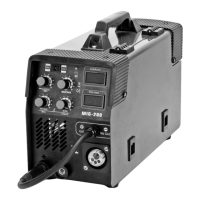
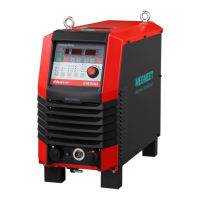
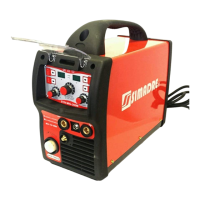
This document serves as an instruction manual for an IGBT Inverter AC/DC TIG welder, covering models TIG(TSE/TMP)-200/250/280/300/315/350/400/500. It provides essential information for safe operation, installation, and maintenance, emphasizing the advanced technology and versatile capabilities of the welding machine.
Safety Warnings and Precautions:
The manual begins with critical safety warnings to ensure the well-being of the operator and others in the vicinity. It highlights several potential hazards associated with welding:
- Electric shock: This can lead to serious injury or death. Users are advised to install proper earthing devices, never touch live parts with bare skin or wet gloves/clothes, ensure insulation from the ground and workpiece, and maintain a safe working position.
- Smoke & gas: These can be harmful to health. Operators should keep their heads away from smoke and gas to avoid inhalation and ensure good ventilation in the working environment, utilizing exhaust or ventilation equipment.
- Arc radiation: This can damage eyes and burn skin. Appropriate personal protective equipment, such as suitable welding masks and protective clothing, must be worn to shield eyes and body. Spectators should also be protected with masks or screens.
- Improper operation: This may cause fire or explosion. Welding sparks can ignite combustible materials, so it's crucial to ensure no such materials are nearby and to practice fire safety.
- Magnetic fields: These can affect cardiac pacemakers. Individuals with pacemakers should consult a medical professional before approaching the welding area.
- Machine fault: In case of difficulties, users are advised to consult the manual or seek professional help from their supplier or service center.
A specific warning is given to install an electricity leakage protection switch for the machine.
General Description and Technology:
The welding machine utilizes advanced IGBT inverter technology. It operates with an inverter frequency of 20 KHz after PWM, converting DC output from a rectifier module and filter into a 20-150Hz AC square wave power source. The circuit incorporates advanced PID control, which ensures fast response, stable welding performance, and good resistance to voltage fluctuations.
Key features of the device include:
- Big power rectifier and IGBT module: These components contribute to the machine's robust performance.
- Good ventilation and dirty free design: This helps maintain optimal operating conditions and prolong the machine's lifespan.
- Good arcing even with small current: This feature enhances precision and control, with options for a pedal switch and current adjustor.
- Stable current for welding: This results in beautiful welding gas, indicating consistent and high-quality welds.
- Multi-functionality: The machine supports AC TIG, DC TIG with pulse, and MMA (Manual Metal Arc) welding.
- Versatile material compatibility: It is suitable for welding a wide range of materials, including Aluminum & Aluminum alloy, Carbon steel, Stainless steel, Steel alloy, Copper, and Titanium.
Environmental Considerations for Installation:
Proper installation is crucial for the machine's performance and longevity. Users must adhere to the following guidelines:
- Installation steps: The machine should be installed strictly according to the provided steps.
- Electrical connections: All electrical connections must be made after turning off the power supply switch.
- Protection class: The machine has an IP21 protection class, meaning it should be protected from rain, excessive sunshine, high humidity, strong wind, and dust.
- Temperature range: The operating temperature should be between -10℃ and +40℃.
- Ground slope: The ground slope should not exceed 15°.
- Clearance: Maintain a distance of at least 20CM between the machine and a wall, and more than 10CM between two machines.
- Water cooler (if applicable): For machines with a water cooler, antifreeze should be used when the temperature drops below zero. When using a water-cooled welding torch, precautions against freezing are necessary.
Operation Instruction - TIG AC/DC Panel:
The manual provides a detailed diagram of the TIG AC/DC panel, highlighting various controls and indicators. The "Digisplay" shows parameters like A (Amps), S (Seconds), % (Percentage), and HZ (Hertz).
Key controls and indicators include:
- Work light and O.C (Over Current) indicators: These provide status feedback.
- Parameter settings: Controls for Peak current, Pulse, Welding current, Time up, AC frequency, Pre-gas, Clean, Duty, Time Down, Gas delay, Base current, Arc start, Offset, and Ending current.
- Output mode selection: Buttons for DC and AC output.
- Arc mode selection: Options for 2T, 4T, and Repeat.
- Weld mode selection: Choices for No pulse, Pulse, and SMAW.
- Adjustment buttons: "+" and "-" buttons are used to adjust values for selected functions.
Function and Parameter Setting Definitions:
The manual defines each parameter:
- Pre-gas: Time for gas flow before welding.
- Arc start: Starting current.
- Time up: Welding current raising time.
- Clean: Time ratio of cleaning current.
- AC frequency: AC output frequency.
- Welding current: Current during welding.
- Peak value: The peak value during pulse output.
- Duty: The time ratio for the peak value.
- Pulse: The frequency for the pulse.
- Base current: Reduced current during pulse output.
- Time down: Welding current drop time.
- Ending: Ending current.
- Gas delay: Time for gas flow after welding.
Status Indicators:
- Work: Illuminates during operation.
- OC: Illuminates if there's a problem, displaying a problem code.
- Code A-0: Current sensor problem.
- Code A-1: Over current protection activated.
- Code XXC: Overheat (XX indicates temperature value), recovers automatically.
- Code EXC: Temperature sensor open (X indicates sensor number).
- Code XXL: Main PCB -15V abnormal (XX indicates voltage value).
- Code XXH: Main PCB +15V abnormal (XX indicates voltage value).
AC TIG Welding Adjustments:
For AC TIG welding, the manual explains how to adjust the "Clean" width and depth to achieve better welding effects. It illustrates how different settings for "Clean effect," "Current wave," and "Tungsten spoilage" are achieved by adjusting a parameter.
- Offset: This refers to the ratio between the cleaning current and welding current. Adjusting this value helps achieve a reasonable cleaning current for optimal welding. The manual suggests that for the same effect, reducing the cleaning ratio and increasing the AC offset ratio can lead to greater welding depth, increased working efficiency, and a longer lifespan for the tungsten electrode.
Output Panel:
The output panel includes various connectors and indicators, including "REM" (Remote) for external control.
Connection Note:
A crucial note emphasizes the correct polarity for connections:
- Output "+" connects to the workpiece.
- Output "-" connects to the torch.
Incorrect connection will result in the tungsten being burned.
Welding Instruction - 2T Welding:
The manual outlines the sequence of operations for 2T (Two-Touch) welding:
- Press on torch switch: Initiates the process.
- Pre-gas: Gas flows before the arc starts.
- Arc start: The arc is ignited.
- Starting current: The initial welding current.
- Current raising: Current increases to the welding level.
- Welding: The main welding process occurs.
- During welding, the machine can operate in DC TIG without pulse, DC TIG with pulse, AC TIG without pulse, or AC TIG with pulse modes.
- Release torch switch: Ends the main welding phase.
- Current drop: Current decreases.
- Ending: The welding process concludes.
- Gas delay: Gas continues to flow for a short period after welding.
- Welding finish: The entire cycle is complete.
Welding Instruction - 4T, Repeat Welding:
The manual also indicates the availability of 4T (Four-Touch) and Repeat welding modes, suggesting similar sequential steps with different trigger mechanisms for continuous or repeated operations.
Setting Value for Reference:
The manual provides reference tables for setting welding parameters based on material and desired outcomes.
-
A. Welding current, Tungsten diameter, and Argon flow rate: This table correlates welding current (A) with recommended tungsten diameter (mm) and argon flow rate (L/Min) for general applications. For example, a welding current of 5-15A uses a 0.5mm tungsten diameter and 3-7 L/Min argon flow, while 400-640A uses a 4.8mm tungsten and 15-25 L/Min argon flow.
-
B. Aluminum welding: This table provides specific recommendations for aluminum welding, correlating thickness (mm) with tungsten diameter (mm), wire diameter (mm), welding current, and argon flow rate. For instance, welding 0.6mm aluminum might use 1.0-1.6mm tungsten, 0-1.0mm wire, 25-40A welding current, and 4-5 L/Min argon flow. For 8.0mm aluminum, it suggests 3.2-4.0mm tungsten, 3.2-4.0mm wire, 200-300A welding current, and 12-18 L/Min argon flow.
Reminding:
The manual includes important reminders for specific operational scenarios:
- Generator usage: If a generator is used as a power source, both the generator's power output and the cable's capacity should be 3-5 times greater than the machine's rated input power to ensure stable and safe operation.
- Water cooling torch: When using a water-cooled welding torch, the water pressure must be maintained at more than 0.6 Mpa to ensure effective cooling and prevent damage to the torch.
This comprehensive manual aims to guide users through the safe and efficient operation of the IGBT Inverter AC/DC TIG welder, leveraging its advanced features for various welding applications.

 Need help?
 General

 To Next Page