MAINTENANCE 9VX3
UNUSUAL OPERATING CONDITIONS
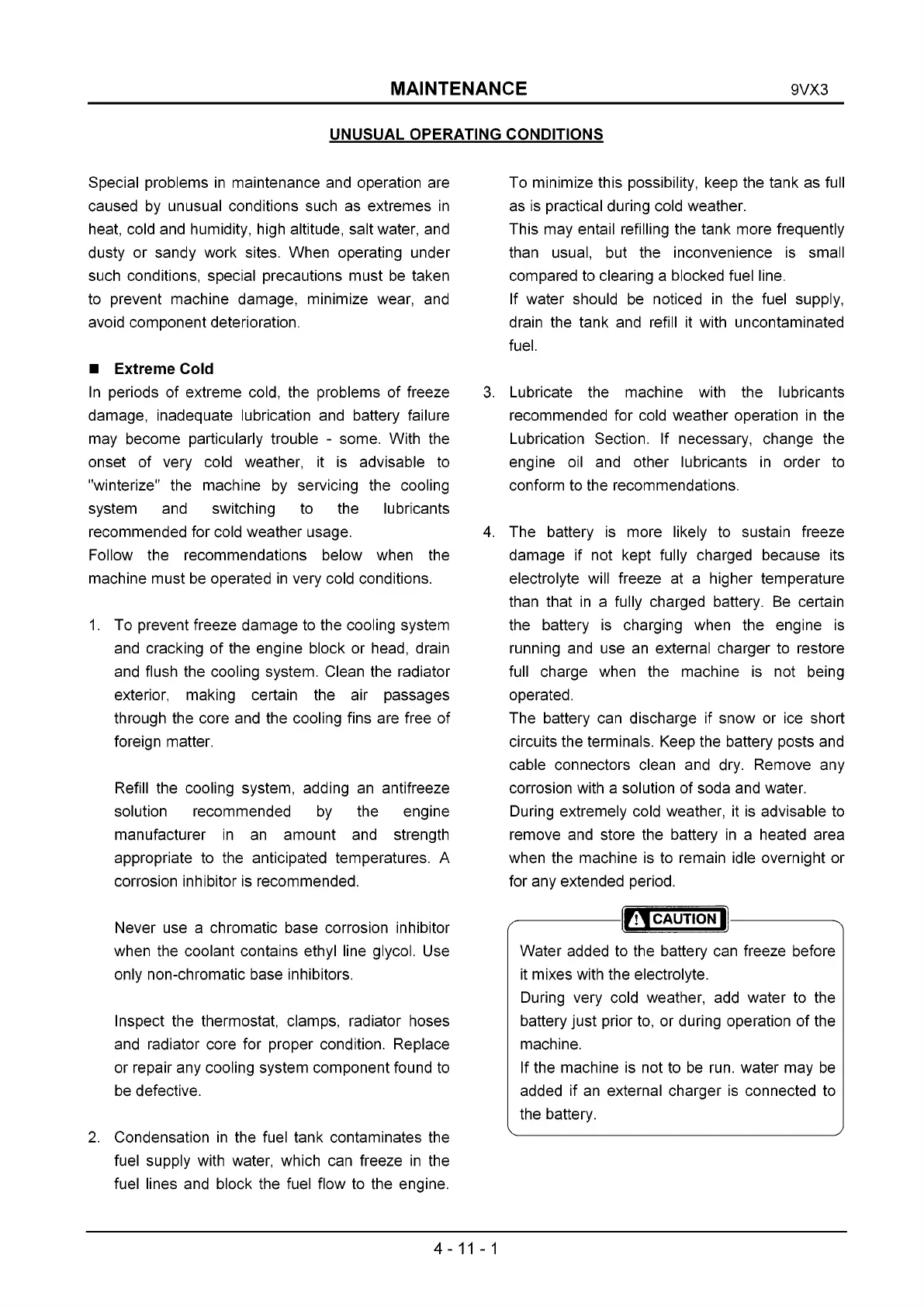
Special problems in maintenance and operation are
caused by unusual conditions such as extremes in
heat, cold and humidity, high altitude, salt water, and
dusty or sandy work sites. When operating under
such conditions, special precautions must be taken
to prevent machine damage, minimize wear, and
avoid component deterioration.
■ Extreme Cold
In periods of extreme cold, the problems of freeze
damage, inadequate lubrication and battery failure
may become particularly trouble - some. With the
onset of very cold weather, it is advisable to
"winterize" the machine by servicing the cooling
system and switching to the lubricants
recommended for cold weather usage.
Follow the recommendations below when the
machine must be operated in very cold conditions.
1. To prevent freeze damage to the cooling system
and cracking of the engine block or head, drain
and flush the cooling system. Clean the radiator
exterior, making certain the air passages
through the core and the cooling fins are free of
foreign matter.
Refill the cooling system, adding an antifreeze
solution recommended by the engine
manufacturer in an amount and strength
appropriate to the anticipated temperatures. A
corrosion inhibitor is recommended.
To minimize this possibility, keep the tank as full
as is practical during cold weather.
This may entail refilling the tank more frequently
than usual, but the inconvenience is small
compared to clearing a blocked fuel line.
If water should be noticed in the fuel supply,
drain the tank and refill it with uncontaminated
fuel.
3. Lubricate the machine with the lubricants
recommended for cold weather operation in the
Lubrication Section. If necessary, change the
engine oil and other lubricants in order to
conform to the recommendations.
4. The battery is more likely to sustain freeze
damage if not kept fully charged because its
electrolyte will freeze at a higher temperature
than that in a fully charged battery. Be certain
the battery is charging when the engine is
running and use an external charger to restore
full charge when the machine is not being
operated.
The battery can discharge if snow or ice short
circuits the terminals. Keep the battery posts and
cable connectors clean and dry. Remove any
corrosion with a solution of soda and water.
During extremely cold weather, it is advisable to
remove and store the battery in a heated area
when the machine is to remain idle overnight or
for any extended period.
Never use a chromatic base corrosion inhibitor
when the coolant contains ethyl line glycol. Use
only non-chromatic base inhibitors.
Inspect the thermostat, clamps, radiator hoses
and radiator core for proper condition. Replace
or repair any cooling system component found to
be defective.
2. Condensation in the fuel tank contaminates the
fuel supply with water, which can freeze in the
fuel lines and block the fuel flow to the engine.
,
---------------------
(filCAUTION l
----------------------
.
Water added to the battery can freeze before
it mixes with the electrolyte.
During very cold weather, add water to the
battery just prior to, or during operation of the
machine.
If the machine is not to be run. water may be
added if an external charger is connected to
the battery.
V
-----------------------------------------------------------------------
/
4-11-1


 To Next Page
 Loading...