9
RCT B sc 0305
Page
Guarantee 2
Safety instructions 9
Proper use 10
Unpacking 10
Commissioning 10
Starting 10
Function heating 10
Adjusting the safety temperature
limit “SAFE TEMP” 11
Controlling the medium temperature via ETS-D
or contact thermometer 11
Function stirring 12
Maintenance and cleaning 13
Associated standards and regulations 13
Accessories 13
Technical data 14
List of spare parts RCT basic 21
Spare parts diagram RCT basic 22
Caution: Never process and heat up any medium with flash
point higher than the adjusted safety temperature limit (50 to
380 °C).
The adjusted safety temperature must always be appropriate
for 25°C below the flash point of the liquid used.
Examine regularly (we recommend every 4 weeks) the function of
the safety temperature limiter. For this the safety temperature
must be changed around at least 2 scale parts of the value alrea-
dy stopped and be accomplished the attitude as under “adjusting
the safety temperature delimitation SAFE temp” described. By
the exceeding of the adjusted safety temperature (e.g. rotary but-
Safety instructions
Contents
ton “temp” posed on max.) you can examine the function. The
“temp” LED must expire and the heating must be lasting swit-
ched off.
The instrument may not be operated in rooms with explosion
hazard.
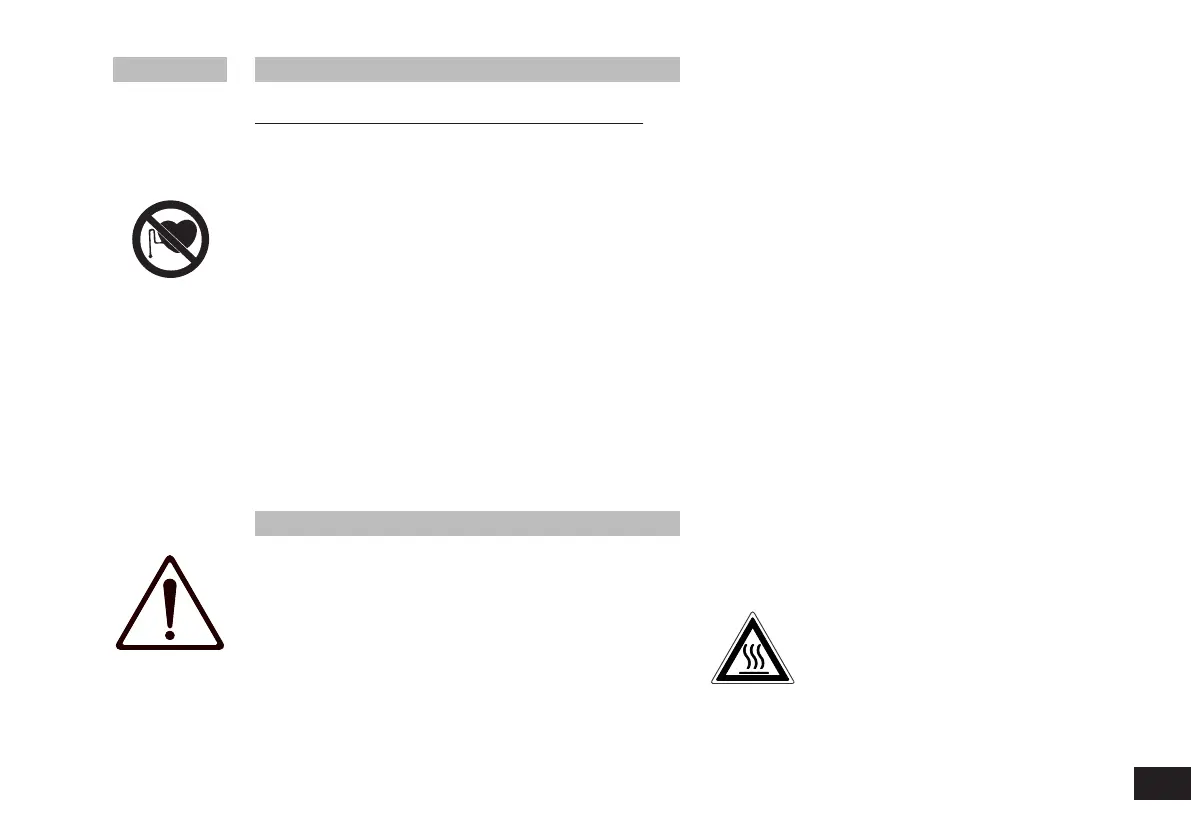
Attention – Magnetism!
Effects of the magnetic field have to be taken into account
(e.g. cardiatic pacemaker, data carriers ...).
A separation from the line is made with the equipment only by
pulling net and/or device plugs.
The plug socket for mains connection line must be easily attai-
nable and accessible.
Please make sure that the mains cable does not contact the
heating plate.
The power cable must be replaced by a cable of equal qua-
lity and capacity.
When using PTFE-coated magnetic bars, the following has to
be noted:
Chemical reactions of PTFE occur in contact with molten or
dissolved alkaline and alkaline - earth metals, as well as with
fine-particled powders of metals of the 2. and 3. group of the
periodical system at temperatures above 300-400°C.
Only elementary fluorine, chlorine trifluoride und alkaline
metals do attack PTFE, halogen hydrocarbons have a reversib-
ly swelling effect.
Source: Römpps Chemie-Lexikon and „Ullmann“ Bd.19
Exercise caution when touching the housing
parts and the heating plate!
Risk of burns!
The heating plate can reach temperatures in
excess of 300°C.
Please consider possible endangering due to release of toxic or
flammable gases caused by heated medium.



 To Next Page