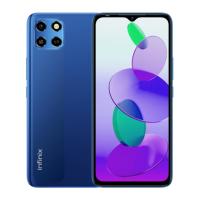
Need help?
Do you have a question about the Infinix Smart 6 Plus and is the answer not in the manual?
Device complies with FCC Part 15, subject to conditions preventing harmful interference and accepting received interference.
Unauthorized changes may void the user's authority to operate the equipment.
Equipment tested for Class B limits, providing protection against interference. Offers tips to correct radio/TV interference.
Mobile phone meets government requirements for exposure to radio waves, with specific SAR limit and tested values.
Device tested for body-worn operations. Maintain 1.0 cm separation; use supplied or approved antenna, avoid metallic accessories.
This document is the user manual for the Infinix X6823, providing essential information for its operation and maintenance. The manual covers key aspects such as device identification, SIM/SD card installation, charging procedures, and important regulatory compliance details, specifically focusing on FCC regulations.
The Infinix X6823 is a mobile phone designed for communication and various smart functionalities. Its physical layout includes a front camera, volume control keys (volume + and volume -), and a power key. These components are standard for modern smartphones, facilitating basic interactions such as taking photos, adjusting audio levels, and turning the device on or off. The front camera is typically used for selfies, video calls, and facial recognition features, enhancing the user's interactive experience. The volume keys allow for quick adjustments to media playback, call volume, and notification sounds, providing convenient control over audio output. The power key serves multiple functions, including powering the device on and off, locking/unlocking the screen, and often acting as a shortcut for other features depending on the operating system's configuration.
For initial setup, the manual details the process of SIM/SD card installation. This is a crucial step for enabling cellular connectivity and expanding storage capacity. Users are instructed to power off the mobile phone before attempting to install the cards, a standard safety precaution to prevent potential damage to the device or the cards themselves. The manual refers to a visual aid (picture) for the correct placement of the SIM and SD cards, ensuring that users can correctly insert them into the designated slots. Proper installation of the SIM card is necessary for making calls, sending messages, and accessing mobile data networks, while the SD card allows users to store additional photos, videos, applications, and other files, thereby extending the device's utility.
Charging the Infinix X6823 is another fundamental aspect covered in the manual. The device can be charged using a dedicated charger or by connecting it to a computer via a USB cable, which is included with the phone. The manual emphasizes the importance of correctly orienting the USB plug, reminding users to pay attention to the front and back of the plug to avoid damaging the charging port. A critical maintenance feature highlighted is the recommendation to use only Infinix-branded chargers and cables. The manual explicitly states that using other chargers or cables may damage the device and will invalidate the phone's warranty. This advice is crucial for ensuring the longevity of the device's battery and internal components, as incompatible charging accessories can lead to overheating, inefficient charging, or even permanent damage. Adhering to this guideline helps maintain the device's performance and ensures that any potential issues are covered under warranty.
The manual also includes important regulatory information, particularly concerning FCC (Federal Communications Commission) compliance. This section is vital for users in regions where FCC regulations apply, ensuring that the device operates within established safety and interference standards. The device complies with Part 15 of the FCC Rules, meaning it is designed to operate without causing harmful interference and must accept any interference it receives. This ensures compatibility with other electronic devices and systems.
For maintenance and user information regarding FCC compliance, the manual provides several key points. It warns that any unauthorized changes or modifications to the device could void the user's authority to operate the equipment, reinforcing the importance of using the device as intended and avoiding tampering. The manual also details how the equipment has been tested and found to comply with Class B digital device limits, which are designed to provide reasonable protection against harmful interference in residential installations.
In cases where the device causes harmful interference to radio or television reception, the manual offers troubleshooting steps. These measures include reorienting or relocating the receiving antenna, increasing the separation between the equipment and the receiver, connecting the equipment to an outlet on a different circuit, and consulting a dealer or an experienced radio/TV technician for help. These guidelines empower users to resolve potential interference issues, contributing to a better overall user experience and ensuring the device's harmonious operation within a home environment.
Furthermore, the manual addresses Specific Absorption Rate (SAR) information, which is a measure of the rate at which energy is absorbed by the human body when exposed to a radio frequency (RF) electromagnetic field. This section confirms that the mobile phone meets government requirements for exposure to radio waves. It explains that the guidelines are based on scientific studies and include a substantial safety margin. The FCC RF Exposure Information and Statement specifies the SAR limit for the USA (FCC) as 1.6 W/kg averaged over one gram of tissue. The Infinix X6823 (FCC ID: 2AIZN-X6823) has been tested against this limit, with the highest SAR value reported for use at the ear being 1.22 W/kg and for body-worn operation being 1.17 W/kg. This information assures users of the device's safety compliance.
For body-worn operation, the manual provides specific instructions to ensure compliance with RF exposure requirements. It states that a minimum separation distance of 1.0 cm must be maintained between the user's body and the handset, including the antenna. This is a critical usage feature for maintaining safety. The manual also advises against using third-party belt-clips, holsters, and similar accessories that contain metallic components, as these may not comply with RF exposure requirements. Users are encouraged to use only supplied or approved antennas and accessories to ensure safe operation. This guidance is essential for users who carry their phone on their person, emphasizing the importance of proper accessory selection to maintain RF safety standards.
Finally, the manual includes information about DTS patents and the operating system. It directs users to http://patents.dts.com for DTS patents and states that the device is manufactured under license from DTS Licensing Limited. DTS, the Symbol, and DTS and the Symbol together are registered trademarks or trademarks of DTS, Inc. The operating system is Android™, which is a trademark of Google LLC. This information provides context about the software and audio technologies integrated into the Infinix X6823, highlighting its modern capabilities and adherence to industry standards for mobile operating systems and audio processing.
 General
| Resolution | 720 x 1600 pixels |
|---|---|
| Front Camera | 5 MP |
| Battery Capacity | 5000 mAh |
| GPU | PowerVR GE8320 |
| SIM | Dual SIM (Nano-SIM, dual stand-by) |
| Network | GSM / HSPA / LTE |
| Rear Camera | 8MP |
| Operating System | Android 12 (Go edition) |
| RAM | 3 GB |
| Storage | 64 GB |

 To Next Page